
Classics in Short No.135: A Wonder-Book for Boys and Girls
Brian Alderson assesses the first classic children’s book to come from the United States.
High on a hill
in the New England Berkshires Eustace Bright, a young student from Williams College, is expatiating to a giggle / gaggle of children on the surrounding topography: Monument Mountain, the Taconic range, and way over to the west the Catskills. There, he says, was where an idle fellow called Rip Van Winkle ‘had fallen asleep and slept twenty years at a stretch’, but Eustace forbears to tell of his adventure for ‘that had been told once already [as indeed in BfK, last time round] and better than it ever could be told again’.
For Eustace Bright is cousin
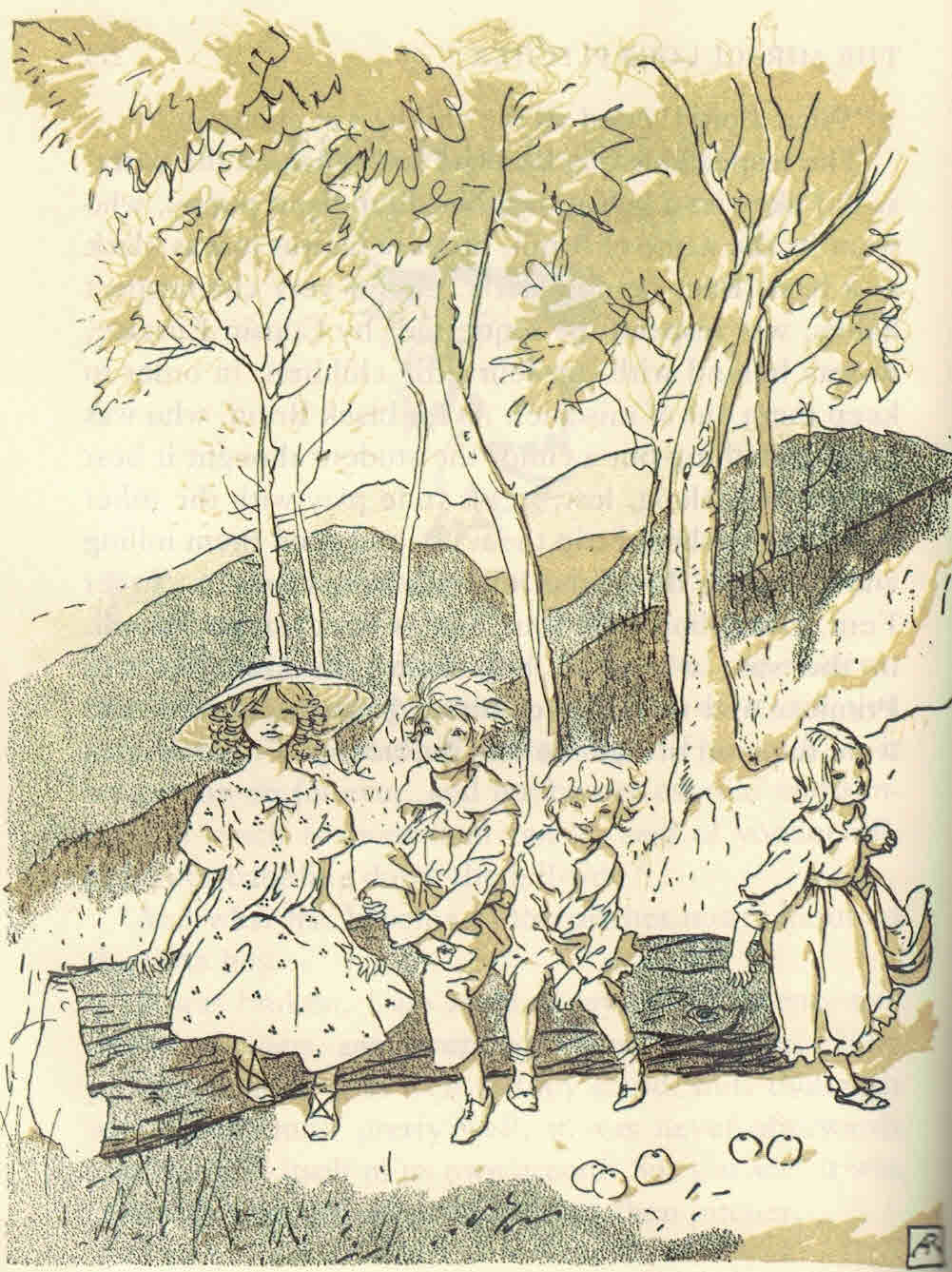
and honorary storyteller to these children and a regular vacation visitor to their home at Lenox, presided over by his uncle, Mr Pringle, a retired classicist. By way of disguising the identities of the audience, whom our interlocutor suggests may actually exist, they are furnished with such fanciful names as Periwinkle, Squash-Blossom, Sweet Fern etc although that is a dangerous ploy in a story as bringing a touch of sentimentality to the proceedings. (Kathleen Lines, in a 1963 reprint of Eustace’s stories, kicked them all out as ‘a dated and, for our day, artificial nineteenth century additions’!) They are though vital constituents in a work of some experimental consequence for their presence allows for a descriptive frame to be given at start and finish of the six stories that Eustace is to tell to the children and indeed to pin down the nature of the storytelling involved.
Collected together,
the stories and the comings and goings of the child chorus at the Pringles’ house at Tanglewood are relayed to us as A Wonder-Book for Boys and Girls by Eustace’s choice of editor, a neighbour in the Red House down the road, Mr Nathaniel Hawthorne. (The liveliest of the child auditors, ‘saucy Primrose’ may well be based on his seven-year-old daughter.) The book was published in 1851, with a frontispiece and six full-page wood engravings by Hammat Billings and within a year had come out (the illustrator unacknowledged) in London. If you don’t count Rip, which initially came out in a collection of essays, it may be accounted the first classic children’s book to come from the United States.
Hawthorne, via Eustace Bright,
was quite clear in his intentions to lay before children six stories taken from Greek mythology as a local entertainment. As with folktales the narratives have no definitive form or text (and indeed, coming as some of them do from a pre-Homeric antiquity, they may have multiple variants). Seemingly told off the cuff with ‘sophomorical erudition’ much refashioning is undertaken, carrying the stories, as may be seen below, a long way from their likely origins. (A hint in the text suggests that young Bright used as his source a classical dictionary edited by one Charles Anton):-
The Gorgon’s Head which excerpts the central episode from the myth of Perseus and thus omits the prophecy that generates the story and barely touches on his rescue of Andromeda. Hermes / Mercury who comes into later stories too is the only named god to appear but has been anglicised as Quicksilver.
The Golden Touch: Eustace here prides himself on giving King Midas a daughter, Marygold, to sharpen up the moral force of the legend.
The Paradise of Children, which is the tangled myth of Pandora, is also subject to large scale re-invention with an Edenic world, populated only by the young and innocent, corrupted by the opening of the Box. [Some interpreters have it that Pandora’s feminine curiosity, like that of Eve, was responsible for releasing calamity upon the world, but Eustace respects the source (also followed by Charles Kingsley in his treatment of the legend in The Water-Babies) that the decision was a joint affair between Pandora and her friend/husband Epimetheus.]
The Three Golden Apples follows the tale of the eleventh labour of Hercules where he gets Atlas to undertake the mission on his behalf.
The Miraculous Pitcher also stays fairly close to the less well-known story of Baucis and Philemon (one of the odder introductions by Goethe in the rambling events of the second part of Faust). Quicksilver is much in evidence although his travelling companion – Zeus/Jupiter – is never named and, for a child audience, the wine that they produce by the jugful is changed to milk.
The Chimaera, which concludes the sextet, avoids the background complications of the story of Bellerophon and Pegasus in telling of the killing of the lion-goat-snake [?dragon]-headed Chimaera, but the capturing of Pegasus at the Pirean Spring is elaborated by Eustace into a subsidiary comedy.
Our joint authors
are much concerned to justify their tweaking of the sources and (so much for Kathleen Lines’s ‘dated…additions’) they supply in their frame for the story of the Golden Apples an argument between Eustace and Mr Pringle as to the former’s unseemly Gothicisation of classic elegance which Eustace stoutly defends on the grounds that ‘an old Greek had no more exclusive right to [the stories] than a modern Yankee has’. One can see Mr Pringle’s point that ‘the idiom of modern fancy and feeling’ does injury to the imaginative tenor of myth and he was to receive unexpected support for his view when Charles Kingsley on the other side of the Atlantic was moved by his dislike of the Yankee debasements, which he found ‘distressingly vulgar’, and, in 1855, created for his own children the classic versions in The Heroes.
After the publication
of A Wonder-Book Hawthorne moved to the rural surroundings of Concord where, he has it, he was paid a friendly visit by Eustace , now a senior at his college. It seems that he had continued storytelling among his cousins and was now entrusting a further six of his versions, including ‘The Minotaur’ and ‘The Argonauts’, to his friend who might act again as editor. There is some by-play in the Introduction in which the student assures Hawthorne that he has been astonished by the readiness with which these old legends ‘ brimming over with every thing that is abhorrent to our Christianised moral sense’ render themselves presentable to children, and thus it is that in 1853 a second Wonder-Book was published as Tanglewood Tales.
Brian Alderson is founder of the Children’s Books History Society and a former Children’s Books Editor for The Times. His book The Ladybird Story: Children’s Books for Everyone, The British Library, 978-0-7123-5728-9, £25.00 hbk, is out now.
A Wonder-Book for Boys and Girls is published by Everyman Library, 978-1857159301 , £12.50 hbk


