Books For Keeps
  • Home
  • Reviews
  • Articles
  • Past Issues
  • Latest Issue
  • Authors and Artists
  • Latest News
  • Search
  • Menu Menu

Posts

‘Joy must lead the way’ Cross-Party Education Committee ‘Reading for Pleasure’ report

July 17, 2026/in news /by Andrea Reece

The cross-party Education Committee has today published its report on ‘Reading for Pleasure’ after taking evidence from education experts, the publishing industry, charities and the author and previous Children’s Laureate Frank Cottrell Boyce.

The Committee calls for the government to commit to a National Reading Guarantee, ensuring that every child has the opportunity to enjoy books, stories and shared reading experiences as part of everyday life, from birth to adulthood.

It says this Guarantee should see every child automatically enrolled in a public library when they are born, should encompass early years support and childcare, school and public libraries, working together in a comprehensive Reading for Pleasure Strategy to reverse the decline in reading among children and young people.

The Committee recommends the government funds a library in every secondary school, recognises access to school libraries as an essential part of a good education and makes them a legal requirement. MPs say ministers should introduce a school library development fund, so that schools refresh their shelves and train staff, and set an expectation for all schools to include dedicated library lessons in the school timetable.

MPs also stress that ‘joy must lead the way’ in developing a love of reading during the critical early years.  The Committee warns that the government’s current policies focus ‘overwhelmingly on proficiency over pleasure’ and that without experiencing the fun and enjoyment of reading, or of shared stories, children may not carry a love of reading into later life.

The Committee’s recommendations include an update to the early years foundation stage profile and inspection framework to emphasise that reading should be focused on enjoyment. It also says the Department for Education should fund and deliver research into best practice in reading for pleasure for secondary school teachers and encourage breakfast clubs, as they are being rolled out across the country, to offer books and reading activities so that children can enjoy stories before the start of the school day.

The Committee acknowledges the many barriers that prevent parents reading with their children including pressure from work, a lack of time, and a lack of confidence. These were exacerbated for those living in poverty or facing food insecurity. The government could provide more support in its guidance for parents of young children, as a “quick win”, the Committee argues.

The report also reiterates earlier findings on the need to limit screen time for children and for adults to set a positive example for the children in their lives.

The Committee calls for the government to introduce a National Decade of Reading to ensure reading for pleasure remains a long-term priority, working with educators, authors, publishers and booksellers to design activities and establish more national moments to promote reading for pleasure throughout the year.

MPs heard concerns that the secondary English curriculum, described by one witness as ‘dispiritingly dull’, holds children back from developing a love of reading, and that its lack of diversity left children disengaged. The Committee judged the Curriculum and Assessment Review a ‘missed opportunity’ to create more space for pupils to develop a true enjoyment of reading.

It calls for the government to revise the GCSE English Literature to make developing a love for books and literature a core objective of the qualification. The government should also improve the diversity of texts, expanding the definition of literature from the British Isles to literature in English and extend the requirement for a 19th century novel to a longer period.

Chair of the Education Committee, Helen Hayes MP, said:, ‘We should be extremely concerned that so few children currently say they enjoy reading or regularly pick up a book. This matters for everyone in society.

We know that children from disadvantaged backgrounds or those with additional needs are less likely to develop a love of reading. But access to literature should never be a luxury available only to the most prosperous families. We need to start taking action as early in a child’s life as possible, before disadvantage is baked in.

But we do not need to lose hope. Our report published today sets out concrete steps the government can take to put pleasure and fun back into childhood reading. A National Reading Guarantee, better library access and curriculum reform would give the children the opportunity and motivation to find books that they love.

None of this is inevitable. It’s time to write a new ending to this story and make reading for pleasure a possibility for every child.’

You can download and read the report in full.

Jonathan Douglas, Chief Executive of the National Literacy Trust, said, ‘We welcome the time, care and commitment the Committee has dedicated to this important issue and the bold vision it has set out. Recommendations to introduce a National Reading Guarantee to ensure every child has regular access to high-quality, diverse reading materials in homes, schools and communities from birth to 18 is essential, alongside a cross-government Reading for Pleasure Strategy to drive forward and sustain this vital work.’

https://booksforkeeps.co.uk/wp-content/uploads/2024/01/Children-reading-image.jpg 312 600 Andrea Reece http://booksforkeeps.co.uk/wp-content/uploads/2020/12/bfklogo.png Andrea Reece2026-07-17 07:26:582026-07-17 07:26:58‘Joy must lead the way’ Cross-Party Education Committee ‘Reading for Pleasure’ report

New National Literacy Trust report finds rise in some children’s reading for pleasure

June 10, 2026/in news /by Andrea Reece

New findings from the National Literacy Trust reveal that children’s enjoyment of reading and daily reading habits have risen, albeit ‘modestly’, for the first time in five years, after hitting a record 20 year low in 2025. However, despite these ‘green shoots of recovery’ the research shows the gender gap for younger children and the disadvantage gap for older children is widening.

Based on a survey of 125,375 children and young people aged 5 to 18 from across the UK between January to March 2026, more than a third (36.1%) of those aged 8 to 18 say they enjoy reading in their free time (vs 32.7% in 2025) while a fifth (20.3%) read daily in their free time (vs 18.7% in 2025).

Despite this rise, reading enjoyment (58.6% in 2016) and daily reading (32.0% in 2016) levels still lag significantly behind those of a decade ago, with the gender gap for younger children (aged 5-8) and the disadvantage gap for older children (aged 8-18) both widening.

The disadvantage gap in reading enjoyment more than doubled in the past year (from 2pp to 5.2pp), with enjoyment levels for those not in receipt of free school meals increasing more (from 33.0% to 37.3%) than their peers in receipt of free school meals (31.0% to 32.1%). The daily reading gap also widened over this time (from 3.6pp to 5.1pp) [2, 3].

Based on a survey of 125,375 children and young people aged five to 18 from across the UK between January to March 2026 – the first three months of the National Year of Reading – more than a third (36.1%) of those aged eight to 18 said they enjoy reading in their free time (compared to 32.7% in 2025) while a fifth (20.3%) read daily in their free time (18.7% in 2025).

However, despite this “small but important increase” reading enjoyment (8.6% in 2016) and daily reading (32 % in 2016) still lag significantly behind figures of a decade ago, with the gender gap for younger children (aged five to eight) and the disadvantage gap for older children (aged eight to 18) both widening.

According to the findings, the disadvantage gap in reading enjoyment more than doubled in the past year (from two percentage points to 5.2 percentage points), with enjoyment levels for those not in receipt of free school meals increasing more (from 33% to 37.3%) than their peers in receipt of free school meals (31% to 32.1%). The daily reading gap also widened over this time, from 3.6% to 5.1%.

Meanwhile, children aged 5-8 were the only group to report a year-on-year decline in their reading enjoyment (from 62.6% to 61.6%). This was driven by a simultaneous fall in boys’ enjoyment of reading (from 58.8% to 56.3%) and rise for girls (from 66.4% to 67.1%). The reading enjoyment gender gap for this age group widened (from 7.6pp to 10.8pp), as did the daily reading gap (from 7.3pp to 9.4pp).

Building on extensive research demonstrating the positive relationship between reading and children’s life chances, the report found that when children and young people enjoy reading, they read more often, with benefits for learning, wellbeing and empathy.

Indeed, 10 times as many children and young people who enjoy reading say they read regularly in their free time compared to those who don’t enjoy reading (49.8% vs 4.5%); while the greatest benefits of reading for young people included learning new words or things (85.2%), helping them to relax (64.4%) and understanding others’ views (63.5%).

While the relationship between reading enjoyment and daily reading is important, it is not absolute. The report highlights that, for reading to become more strongly embedded in children and young people’s daily lives, it must also be relevant, meaningful and supported by people around them.

Nearly half (48.7%) of children and young people said that reading helps them explore their interests – with relevance particularly important for groups who are the least engaged with reading [6] – while two-thirds (65.8%) are encouraged to read by their teachers and more than half (54.8%) by their parents.

The National Literacy Trust targets its work in the nation’s most deprived wards, where low literacy and poverty are having the greatest impact on people’s lives and in these high priority areas, where the charity works most intensively with schools and community partners, it points out that children and young people’s reading skills and engagement have significantly improved.

Between 2023 to 2025, the reading skills of 11-year-olds in primary schools in high priority areas rose three times faster than those of their peers across England, from 66% to 73% (7pp) compared with 73% to 75% (2pp) – substantially narrowing the attainment gap. These children were also 15% more likely to enjoy reading in their free time (41.6% vs 36.2%).

Meanwhile, in schools that participated in the charity’s evidence-based reading programmes over the last academic year, children and young people who were the least engaged with reading at the start saw their reading confidence (84%), enjoyment (77%) and frequency (66%) increase significantly.

As the National Literacy Trust’s Department for Education-backed National Year of Reading campaign reaches its half-way point, and against a backdrop of multiple government commitments to support children and young people’s reading, the NLT is calling for national leadership, sustained cross-sector partnerships and long-term investment to maintain this year’s upturn so every child can thrive.

Jonathan Douglas CBE, Chief Executive of the National Literacy Trust, said: ‘After years of decline in children and young people’s relationship with reading, we’re starting to see some green shoots of recovery. But we can’t take this early progress for granted – reading is fundamental to children’s life chances, yet too many are still being left behind.

“The National Year of Reading has been a galvanising force, bringing together schools, libraries, charities, businesses and government behind a single mission – to reinvigorate the nation’s relationship with reading. If we are to maintain and build on this momentum beyond 2026, we must continue to invest in what we know works – championing reading for enjoyment in our homes, schools and communities, and supporting more young people to see reading as a relevant, meaningful and fun part of everyday life.’

The Education Select Committee is currently undertaking an inquiry into reading for pleasure to better understand its benefits, why fewer children and young people are enjoying reading than two decades ago and what can be done to reverse this trend. The National Literacy Trust and other literacy bodies and organisations have provided written and oral evidence to the inquiry.

Helen Hayes MP, Chair of the Education Committee, said, ‘I’m encouraged by today’s research from the National Literacy Trust, which shows some cause for optimism. But we still need to do much more to encourage children to read for enjoyment, particularly younger children, boys of all ages, teenagers and disadvantaged children.

‘While my Committee considers what action the government should take to tackle this dangerous trend, research like this helps to make the case for a concerted effort to put reading for pleasure at the top of the agenda.’

Read the National Literacy Report in full.


https://booksforkeeps.co.uk/wp-content/uploads/2024/01/Children-reading-image.jpg 312 600 Andrea Reece http://booksforkeeps.co.uk/wp-content/uploads/2020/12/bfklogo.png Andrea Reece2026-06-10 10:01:412026-06-10 10:02:18New National Literacy Trust report finds rise in some children’s reading for pleasure

National Literacy Trust research shows children’s reading enjoyment plummets

November 5, 2024/in news /by Andrea Reece

The latest report from the National Literacy Trust research makes for gloomy reading.

Its survey of more than 76,000 UK children and young people revealed that only 1 in 3 (34.6%) 8 to 18-year-olds say they enjoy reading in their free time. This is the lowest level recorded by the charity since it first started surveying children about their reading 19 years ago, and a staggering 8.8 percentage point drop in the past 12 months alone (43.4%)

The research found that the reading enjoyment crisis is particularly impacting boys and young people in secondary school. The gender gap in children and young people’s reading enjoyment nearly tripled in the last year (from 4.8 to 12.3 percentage points), with fewer than 3 in 10 (28.2%) boys now saying they enjoy reading in their free time, compared with 4 in 10 (40.5%) girls.

Reading enjoyment has fallen across all age groups, with those in secondary school reporting the steepest declines. Just 3 in 10 secondary pupils (30.7% aged 11-14 and 29.7% aged 14-16) currently say they enjoy reading in their free time, compared with more than half of primary pupils (51.9% aged 8-11).

The research revealed that when children and young people enjoy reading in their free time, their reading skills, aptitude for learning, wellbeing, empathy and confidence benefit.

Indeed, twice as many children and young people who enjoy reading in their free time have above average reading skills than children who don’t enjoy it (34.2% vs 15.7%). This finding is important at a time when children and young people’s reading skills are cause for concern, particularly for those from disadvantaged communities.

Among the broader benefits unveiled in the research, children and young people who read in their free time at least once a month said it helps them to relax (56.6%) and feel happy (41%), learn new things (50.9%), understand the views of others (32.8%), learn about other cultures (32.4%) and be confident (26.0%).

The National Literacy Trust is calling on the government to urgently form a reading taskforce and action plan with multi-sector partners to address declining rates of reading enjoyment and, in its curriculum and assessment review, prioritise reading for pleasure alongside the skills that are vital in the development of confident, motivated readers.

The charity is also committing, over the next three years, to directly supporting and empowering 1.5 million more children and young people from disadvantaged communities to read for pleasure and develop greater confidence in their reading skills. This will include accelerating the growth of its Libraries for Primaries campaign, to ensure every primary school in the UK has a dedicated library space by 2028.

Jonathan Douglas CBE, Chief Executive of the National Literacy Trust, said, ‘With children and young people’s enjoyment of reading at an all-time low, and high numbers leaving primary and secondary school without the reading skills they need to thrive, the futures of a generation are being put at risk.

‘So many families, schools, libraries, charities, publishers, businesses, and more, are already inspiring children’s reading in such diverse and innovative ways. But to truly make reading for pleasure a national priority, we are urging the government to form a reading taskforce and action plan with multi-sector partners – amplifying our collective reach and influence, strengthening our impact and re-imagining solutions to this complex crisis.

‘Our dedication to this cause will be unrelenting. Over the next three years, we will support and empower 1.5 million more children and young people from disadvantaged communities to read for pleasure and develop greater confidence in their reading skills. By expanding and deepening our work in schools and communities, we will strive to play a significant role in growing a generation of readers.’

Frank Cottrell-Boyce, Waterstones Children’s Laureate says, ‘We know that children who read for pleasure, and children who are read to, gain all kinds of benefits. From increased vocabulary to vastly improved mental wellbeing. But today’s survey shows that too often as a nation we are withholding those benefits from our children. Over the last nineteen years, enjoyment of reading has dropped by almost a third. These benefits are becoming a kind of invisible privilege. This has gone on long enough. The bad news is that we are at risk of losing a generation. The good news is that the solution is in our hands.’

The National Literacy Trust has also launched the #GrowAGenerationOfReaders social media campaign – backed by authors, charities, publishers and more – flipping the concept of content warnings on its head to instead extol the benefits of reading, as identified by children and young people through its research.

The public are being urged to join the campaign, posting a photo of a book cover, captioned with its warning – for example: May Spark Joy, Could Build Confidence, and High Wellbeing Factor. Use the free social media graphics provided.

The National Literacy Trust has also curated a range of free resources to help families, teachers and businesses encourage children’s reading.


https://booksforkeeps.co.uk/wp-content/uploads/2024/11/Screenshot-2024-11-05-105610.png 572 589 Andrea Reece http://booksforkeeps.co.uk/wp-content/uploads/2020/12/bfklogo.png Andrea Reece2024-11-05 10:58:032024-11-05 10:58:03National Literacy Trust research shows children’s reading enjoyment plummets

BBC Radio 1 broadcasters Greg James and Chris Smith win the Ruth Rendell Award 2024 with poet Laura Mucha runner-up

February 22, 2024/in news /by Andrea Reece

Broadcasters Greg James and Chris Smith have been named winners of the Ruth Rendell Award 2024 for their work promoting reading in schools.

Launched in 2016 by ALCS and the National Literacy Trust, the Ruth Rendell Award honours best-selling crime author and literacy advocate Ruth Rendell, who passed away in 2015. It recognises those who have had the most significant influence on literacy in the UK over the past year. Previous winners include Andy McNab and Cressida Cowell. Dapo Adeola and Nigel Lungenmuss-Ward were last year’s joint winers.

Greg and Chris were nominated for their work profiling the National Literacy Trust and Penguin Random House UK’s Libraries for Primaries campaign to transform primary school libraries in the UK, which face underinvestment. The pair also visited schools throughout the country to inspire a love of reading and writing.

On winning the prize, Greg and Chris said, ‘We’re absolutely delighted and actually really rather shocked to receive this award, considering the other amazing nominees. We love visiting schools and meeting our readers, and hopefully this incredible honour will help get the message out there that every primary school should have a library.’

Poet and Author-in-Residence in the Department of Public Health & Primary Care at the University of Cambridge, Laura Mucha, was announced as runner-up for her poetry workshops and training sessions in schools. The judges said, ‘Laura’s sensitivity is extraordinary and she is deeply committed to what she is doing. Thinking about the vulnerability of young people’s mental health at the moment, her work is so important.’

National Literacy Trust Chief Executive Jonathan Douglas said, ‘I am thrilled to celebrate Chris Smith and Greg James as the winners of the Ruth Rendell Award this year. They have given their time, enthusiasm, and passion to championing school libraries and consistently promoted the importance of reading for enjoyment with children across the country. At the National Literacy Trust, we know that reading for pleasure can have a real impact on a child’s future, supporting their literacy skills, their wellbeing, and their confidence, and Chris and Greg’s dedication has made such a difference to so many lives. Congratulations to them both – they are deserving winners.’

ALCS Chief Executive Barbara Hayes said, ‘As an organisation deeply committed to championing literacy, we are delighted to see those shortlisted going above and beyond to promote this important life skill. Greg and James are such passionate advocates and have inspired a love of reading in school children up and down the country. Congratulations to Greg and James, as well as our runner up Laura and all those shortlisted.’

The shortlist also included Michael Morpurgo, Sharena Lee Satti, Richard O’Neill, Harry Heape and Ellie Crawshaw-Prince.

This year’s judges were Chief Executive at the National Literacy Trust, Jonathan Douglas, screenwriter and Non-Executive Director at ALCS, Di Redmond, school librarian, Lorraine Gill and previous winner of the Ruth Rendell Award, author Tom Palmer.


https://booksforkeeps.co.uk/wp-content/uploads/2024/02/Screenshot-2024-02-22-142444.png 432 422 Andrea Reece http://booksforkeeps.co.uk/wp-content/uploads/2020/12/bfklogo.png Andrea Reece2024-02-22 20:00:562024-02-22 14:38:15BBC Radio 1 broadcasters Greg James and Chris Smith win the Ruth Rendell Award 2024 with poet Laura Mucha runner-up

OUP Study raises concerns about vocabulary development

December 12, 2023/in news /by Andrea Reece

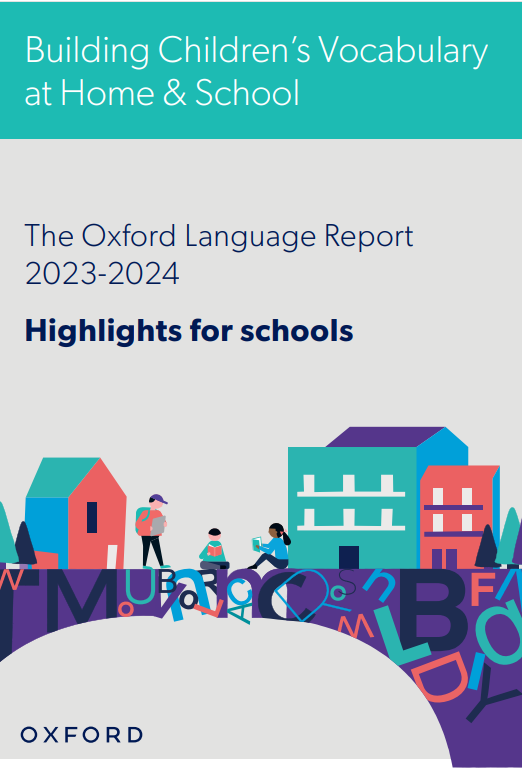
Oxford University Press’ (OUP) Oxford Language Report, an annual study of vocabulary development in under 18s in the UK, points to an increasing number of children in the UK falling behind in their English vocabulary development. More than 800 teachers and parents were surveyed across the UK as part of research and a majority of teachers felt this is impacting their learning.

Teachers are keen for schools to work with parents to tackle the issue, with 85% believing schools could do more to encourage parents to be involved in their child’s vocabulary development. Equally over two thirds of parents surveyed are eager to engage with schools, with 68% of parents welcoming more guidance when it comes to developing their child’s vocabulary.

Overwhelmingly, teachers highlight the significant consequences of the pandemic with 95% believing school closures and disruptions during Covid-19 contributed to a widening vocabulary gap. The study publishes as OUP reveals plans for the second year of its Raise a Reader initiative. Launched in 2022 in partnership with the National Literacy Trust, Raise a Reader aims to support children’s literacy in the wake of the pandemic.

To help tackle the issue, OUP will be extending its Oxfordshire Raise a Reader programme to an additional ten schools across the county in 2024, including Banbury, Witney and Oxford. Almost 3,000 children growing up in some of the most disadvantaged areas in Oxfordshire benefitted from the programme in 2023, which saw dedicated libraries set up in ten primary schools as part of the and NLT Libraries for Primaries campaign. 5,000 books were donated to the schools, along with a range of soft furnishings and books storage. Each school received in-person specialist training to help develop effective whole-school literacy strategies and ongoing support from OUP across the year.

Avnee Morjaria, Policy Director, Education at Oxford University Press, said, ‘We can see first-hand the impact the pandemic had on young people’s education and this is one of the key reasons why we launched our Raise a Reader campaign last year. Falling behind on vocabulary development is a significant issue for many children, and one which can impact their learning at school and later life chances. The research captures the views of teachers and parents across the UK and based on their feedback, aims to give practical advice on the different ways in which we can support children’s literacy and language development. We are looking forward to working with the National Literacy Trust to support more schools next year and ensure that all children have the tools and opportunities to become life-long readers’.

Sinéad Naidoo, National Literacy Trust, Senior Programme Manager, Raise a Reader, said, ‘This report is further evidence of the need for every primary school to have a library. School libraries are essential in helping to fuel a child’s imagination, build a rich vocabulary, and give them the literacy skills they need to succeed in life. When families across the country may be struggling to afford books at home, school libraries can be a child’s only access to books and the joy of reading. We are delighted to be working with Oxford University Press for a second year to get ten wonderful new reading spaces into primary schools in Oxfordshire.’

To support parents with developing vocabulary at home, OUP has also updated its free Raise a Reader pack for parents filled with tips and activities based on the latest research to support vocabulary development and reading at home. The packs include advice from teachers, as well as three key approaches to building vocabulary: conversation; reading; and activities.

Other key findings in the Oxford Language Report included:

  • Over half of teachers report that there has been an increase in the number of children who have fallen behind in their vocabulary knowledge compared to previous years
  • Teachers almost all agree that parents should be actively involved in their child’s vocabulary development – but only 44% of schools encourage parents to do so
  • All parents surveyed consider it ‘important’ or ‘very important’ for their child to have a broad English vocabulary
  • 68% of parents would like more guidance from schools when it comes to developing their child’s vocabulary
  • 52% of schools do not have a school-wide vocabulary policy or strategy in place
  • Among parents who look for help and guidance, only 36% consult their child’s teacher for guidance.
https://booksforkeeps.co.uk/wp-content/uploads/2023/12/Screenshot-2023-12-12-092752.png 768 522 Andrea Reece http://booksforkeeps.co.uk/wp-content/uploads/2020/12/bfklogo.png Andrea Reece2023-12-12 09:30:042023-12-12 09:40:42OUP Study raises concerns about vocabulary development

Search for a specific review

Author Search

Search


Generic filters


Filter by Member Types


Book Author

Download BfK Issue Bfk 279 July 2026
Skip to an Issue:

About Us

Launched in 1980, we’ve reviewed hundreds of new children’s books each year and published articles on every aspect of writing for children.

Read More

Follow Us

Latest News

Longlists announced for the 2026 Diverse Book Awards

July 30, 2026

‘Joy must lead the way’ Cross-Party Education Committee ‘Reading for Pleasure’ report

July 17, 2026

The Art of Learning Poetry by Heart Celebrated in Style

July 13, 2026

Contact Us

Books for Keeps,
30 Winton Avenue,
London,
N11 2AT

Telephone: 0780 789 3369

ISSN: 0143-909X (this is our International Standard Serial Number).

© Copyright 2026 - Books For Keeps | Proudly built by Lemongrass Media Website Design
Scroll to top