Books For Keeps
  • Home
  • Reviews
  • Articles
  • Past Issues
  • Latest Issue
  • Authors and Artists
  • Latest News
  • Search
  • Menu Menu

Posts

Peace is Oxford Children’s Word of the Year for 2025

January 21, 2026/in news /by Andrea Reece

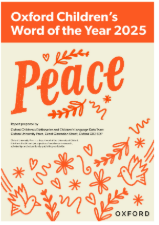
Oxford University Press (OUP) have announced the Oxford Children’s Word of the Year for 2025 and it is peace. 35 per cent of children surveyed for the research chose peace, though it was narrowly followed by a third (33 per cent) choosing AI. 21 per cent opted for resilience.

Photo by Kaja Sariwating on Unsplash

The research, carried out in 2025, surveyed opinions from almost 5,000 children across the UK aged 6–14, and highlighted children’s awareness of current affairs. One in ten children mentioned ‘war’ when asked why they chose peace and highlighted specific conflicts such as ‘Ukraine’ and ‘Gaza’. Words such as ‘need’, ‘want’, ‘should’ were frequently mentioned in their answers when calling for peace across the world.
A study of the Oxford Children’s Corpus, the world’s largest database of writing by and for children in the English language containing over half a billion words, reveals mentions of peace in children’s stories submitted to the BBC 500 Words competition has increased by 60 per cent since 2015.

AI selected runner-up for the second year in a row

For the second-year running, AI was selected as runner-up, and when asked why they chose the word a fifth of children (20 per cent) mentioned ‘hearing’ and ‘talking’ about AI highlighting its ubiquitousness in daily life.

When asked how the word made them feel children gave positive responses with more than one in ten using the adjective ‘excited’ or ‘exciting’. More than a quarter of six- to eight-year-olds (29%) chose AI as their word of the year, demonstrating how even very young children are aware of the every-day role AI plays.

Six-seven slang word gives children social currency

Almost half (47 per cent) of children chose six-seven as their slang word of the year, followed by aura (24 per cent) and delulu (7 per cent). Research revealed that the use of six-seven among children fosters inclusivity and social currency, with almost one in ten mentioning ‘friends’ when asked how they use the term and ‘popular’ was frequently mentioned in reference to what six-seven meant to them along with more than one in four (28 per cent) citing ‘fun’ and ‘laugh’.

‘It means whatever you want it to mean’ explained one nine-year old boy, while more than one in ten (12%) of children admitted six-seven had no meaning. Still, most children highlighted the value of such words, with 72 per cent of children stating it was important to have words they only use with friends.

Call for schools to participate in the next Oxford Children’s Word of the Year

OUP is calling for schools to participate in the next Oxford Children’s Word of the Year to further support children’s reading, vocabulary development and oracy skills. Schools are encouraged to hold ‘word of the year’ conversations throughout the school year and vote for their word choice for 2026. OUP has developed an accompanying activity pack with tips and resources for taking part, including how the sessions can encourage book talk and language development. More details on how schools can download the pack and get involved can be found here.

To mark the announcement, and to support the National Year of Reading 2026, OUP will be collaborating with the National Literacy Trust on school events across the UK. The author-led events will encourage children to engage with different forms of reading and reflect on the words they read, hear, speak and learn about.

Andrea Quincey, Director of Early Years and Primary Publishing, Oxford University Press, said: ‘A key theme we see from our Oxford Children’s Word of the Year research is just how attuned children are to current affairs. This year is no different; whether that’s calling for peace in response to current conflicts or highlighting how AI has permeated daily life. Perhaps it’s no surprise that ‘six-seven’ is voted, overwhelmingly, as their slang word of the year. A word which brings them laughter and joy and connection with friends. We see how important it is for children to have agency over their language away from the grown-up world and share words that adults can’t understand.

‘For this reason, we are calling for schools to get involved with our Oxford Children’s Word of the Year research for 2026. Not only do we want to hear from more children, but we also want to hear about colloquial words and capture regional voices. This year’s research demonstrates just how important it is that we continue to research children’s language and support their vocabulary development as it plays a vital role in their self-expression.‘

For more than a decade, experts and academic researchers at OUP have been tracking Children’s Word of the Year, analysing the evolution of children’s language and how it is used to reflect their emotions and experiences.

Previous Oxford Children’s Word of the Year

2024     Kindness

2023     Climate Change

2022     Queen

2021     Anxiety

2020     Coronavirus

2019     Brexit

2018     Plastic

2017     Trump

2016     Refugee

2015     #hashtag

2014     Minion

https://booksforkeeps.co.uk/wp-content/uploads/2026/01/Screenshot-2026-01-21-080517.png 225 159 Andrea Reece http://booksforkeeps.co.uk/wp-content/uploads/2020/12/bfklogo.png Andrea Reece2026-01-21 07:30:522026-01-21 08:06:54Peace is Oxford Children’s Word of the Year for 2025

Kindness is Oxford Children’s Word of the Year

January 22, 2025/in news /by Andrea Reece

Reasons to be cheerful part one: kindness is Oxford Children’s Word of the Year for 2024 according to Oxford University Press (OUP).

Kindness was chosen by more than six in ten children (61%) among a shortlist of three words: kindness, artificial intelligence, and conflict. A quarter of children selected artificial intelligence (25%) and 7% selected conflict. There was also the option to select no preference from the shortlist.

The research, which surveyed opinions from over 6,000 children aged 6-14 years across the UK, revealed mental health to be a reason for some children selecting kindness, ‘It’s always important to be kind as a lot of people struggle with their mental health’ said one young person.  According to the survey, teachers also cite a growing awareness among young people of the wider impact of kindness on mental wellbeing.

Numerous references to global violence and current conflicts further emphasised how attuned children are to current affairs; with words such as ‘need’ and ‘should’ frequently used in their responses.

A study of the Oxford Children’s Corpus, the world’s largest database of writing by and for children in the English language containing over half a billion words, reveals AI is a keen topic of interest for children who express varying viewpoints on the subject. Analysis, which includes looking at the stories submitted for the BBC 500 WORDS 2024 story competition, shows the phrase ‘take over the world’ is commonly used in relation to AI, whilst there are also themes around AI machines being empathetic to humans.

The 25% of children choosing artificial intelligence expressed cautious optimism about the technology. Whilst children expressed concerns around fake online content and superintelligence, of those who selected artificial intelligence, 53 per cent gave positive responses, such as ‘excited’ and ‘optimistic’, as one respondent says, ‘Because I think that the world is a better place with ai as long as they do not take over our lives.’

Top slang word is slay

Children were also asked to choose their favourite slang word, with more than one in four (28 per cent) opting for slay, citing it as a term of approval and expression of support. Whilst slay has appeared on the colloquial shortlist for the past two years, 2024 saw a rise specifically in younger children voting for the word, with a 16% point increase from 2023 among six-eight-year-olds. The terms sigma and skibidi were voted as second and third choices respectively (16 per cent and 15 per cent) highlighting the influential role social media plays on children’s language.

Andrea Quincey, Director Early Years and Primary Publishing, Oxford University Press, says, ‘It is so encouraging that kindness has been voted—by a considerable majority—as the Oxford Children’s Word of the Year for 2024. We know from previous years that young people are very conscious of the big issues that can divide us as a society and attuned to the important role which language can play in bringing people together. This choice suggests something more personal: an awareness of mental health issues and of the hidden challenges others may be facing. It tells us that empathy, and tolerance and the language we use matter, and that kindness is not only a solution to so many problems but is something everyone and anyone can do to make a difference.’

For more than a decade, experts and academic researchers at OUP have been tracking Children’s Word of the Year, analysing the evolution of children’s language and how it is used to reflect their emotions and experiences. In response to the latest findings, the Children’s Language department at OUP have published the Oxford Children’s Word of the Year 2024 report, which you can read in full now.

The Children’s Word of the Year has reflected the influence and impact of media news stories and important topics of conversation in the grown-up world on young minds and imaginations.

Previous Words of the Year areL

2023     Climate Change

2022     Queen

2021     Anxiety

2020     Coronavirus

2019     Brexit

2018     Plastic

2017     Trump

2016     Refugee

2015     #hashtag

2014     Minion

https://booksforkeeps.co.uk/wp-content/uploads/2025/01/Kindness.png 1080 1080 Andrea Reece http://booksforkeeps.co.uk/wp-content/uploads/2020/12/bfklogo.png Andrea Reece2025-01-22 10:16:072025-01-22 10:16:07Kindness is Oxford Children’s Word of the Year

Search for a specific review

Author Search

Search


Generic filters


Filter by Member Types


Book Author

Download BfK Issue Bfk 279 July 2026
Skip to an Issue:

About Us

Launched in 1980, we’ve reviewed hundreds of new children’s books each year and published articles on every aspect of writing for children.

Read More

Follow Us

Latest News

‘Joy must lead the way’ Cross-Party Education Committee ‘Reading for Pleasure’ report

July 17, 2026

The Art of Learning Poetry by Heart Celebrated in Style

July 13, 2026

‘Extraordinary’ John Agard wins CLiPPA for Unprecedented Third Time

July 9, 2026

Contact Us

Books for Keeps,
30 Winton Avenue,
London,
N11 2AT

Telephone: 0780 789 3369

ISSN: 0143-909X (this is our International Standard Serial Number).

© Copyright 2026 - Books For Keeps | Proudly built by Lemongrass Media Website Design
Scroll to top