
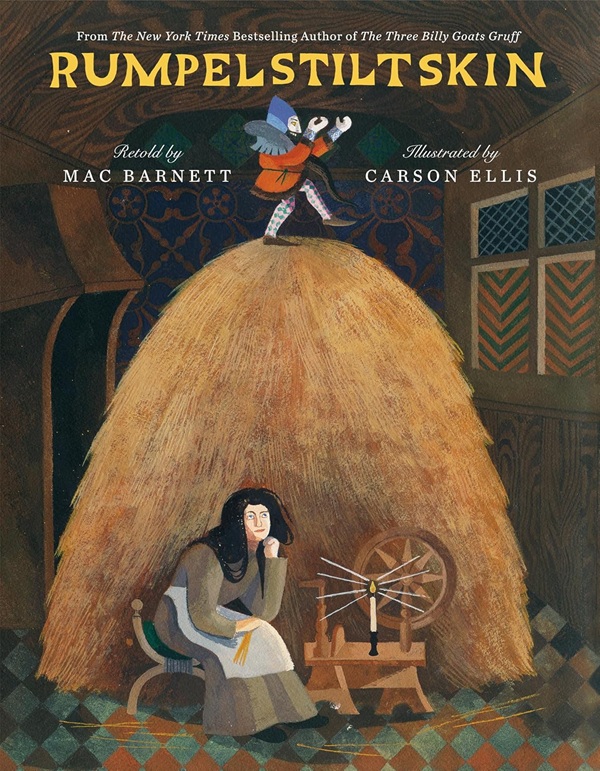
Picture This: Pictures to knock your socks off
Sometimes we, young and old, love a picturebook because it makes us laugh or think (or both). Or because it is moving or reassuring – or scary. Or rich in rhyme, language, ideas, knowledge, interactivity, surprises or diggers. Maybe it transports us into unfamiliar places and magical settings, new experiences and other people’s lives, or makes sense of our own, and we recognise ourselves.
But the images are always the core. And my favourites are the ones with pictures that stop you in your tracks, even before you have a clue what the words say.
There have been rich pickings for the chosen #NewIllustrationoftheDay on my Instagram and Bluesky feeds this year. As usual the skills and techniques of illustrators from around the world (but available here) seem to have infinite variety. Everything is possible, and some of it is joyous. For this ‘Picture This’ feature I have chosen three arresting images that triggered heart-lifting delight, in the hope that others might feel at least a flicker of the same.
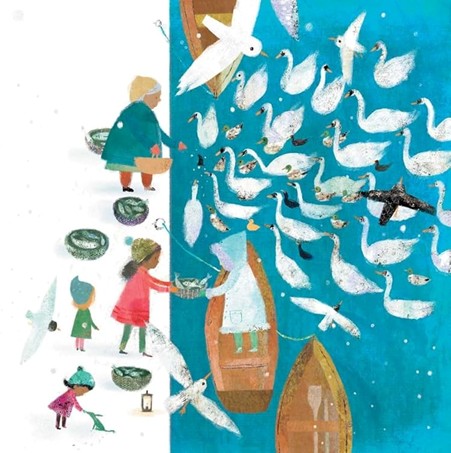 Richard Jones’s image here is from You and I Are Stars and Night (Beach Lane Books), with rhyming text by Kate Hosford, about an adult and child sharing dream-like imaginative adventures. It illustrates the words ‘to where the fisherwomen go,’ and is evidence of how much a picture can contribute beyond literal description.
This is in fact half a spread, the white background blending into a snowy mountainside on the left-hand page. The scattered feed that causes the birds to gather also merges with what could be spots of snow falling on both parts of the scene. The most exhilarating aspects of this picture though are the colour and the composition, the pattern of swans, ducks and gulls, mostly white against the turquoise, perfectly offset by the black coots and the dark bird flying in. And the red coat balancing the eau de nil makes the colour zing. (Although the colour is strong, it is also softened with textures – of feathers, fish, basket weave, woolly hats and wooden boats.) Meanwhile the absolutely vertical line that marks the edge of the quay is placed at the Golden Mean, which is perhaps why the arrangement is so satisfying. The beautifully-spaced flock, too, makes a near-circle, herded by the little boats, with more birds flying in.
There is also a good deal of narrative in this picture. The red coat suggests fairy tales: Little Red Riding Hood, especially in conjunction with the older woman in the picture – Granny? – or, together with the child in a white coat handing over the basket of fish: Snow White and Rose Red. There are three main interactions: the older woman feeding the birds, the two children exchanging the basket with a third, smaller child waiting, and another child feeding a small dog, which reaches forward with its ears back. An old-fashioned lantern with a candle makes us think these people were up early to reach the quay, and came through the dark. The hats, coats and gloves conjure warmth in a cold setting. And among all the other birds is a small, yellowish one, perhaps a rubber duck, reminding us that all this is happening in the imagination.
The overall effect is glorious, with a somewhat retro style in the elf-like figures, and a quality of John Burningham’s work in the whole. It adds up to a celebration of nature, light, togetherness, snow, water and dreams. It would be a happy picture to live with on a wall.
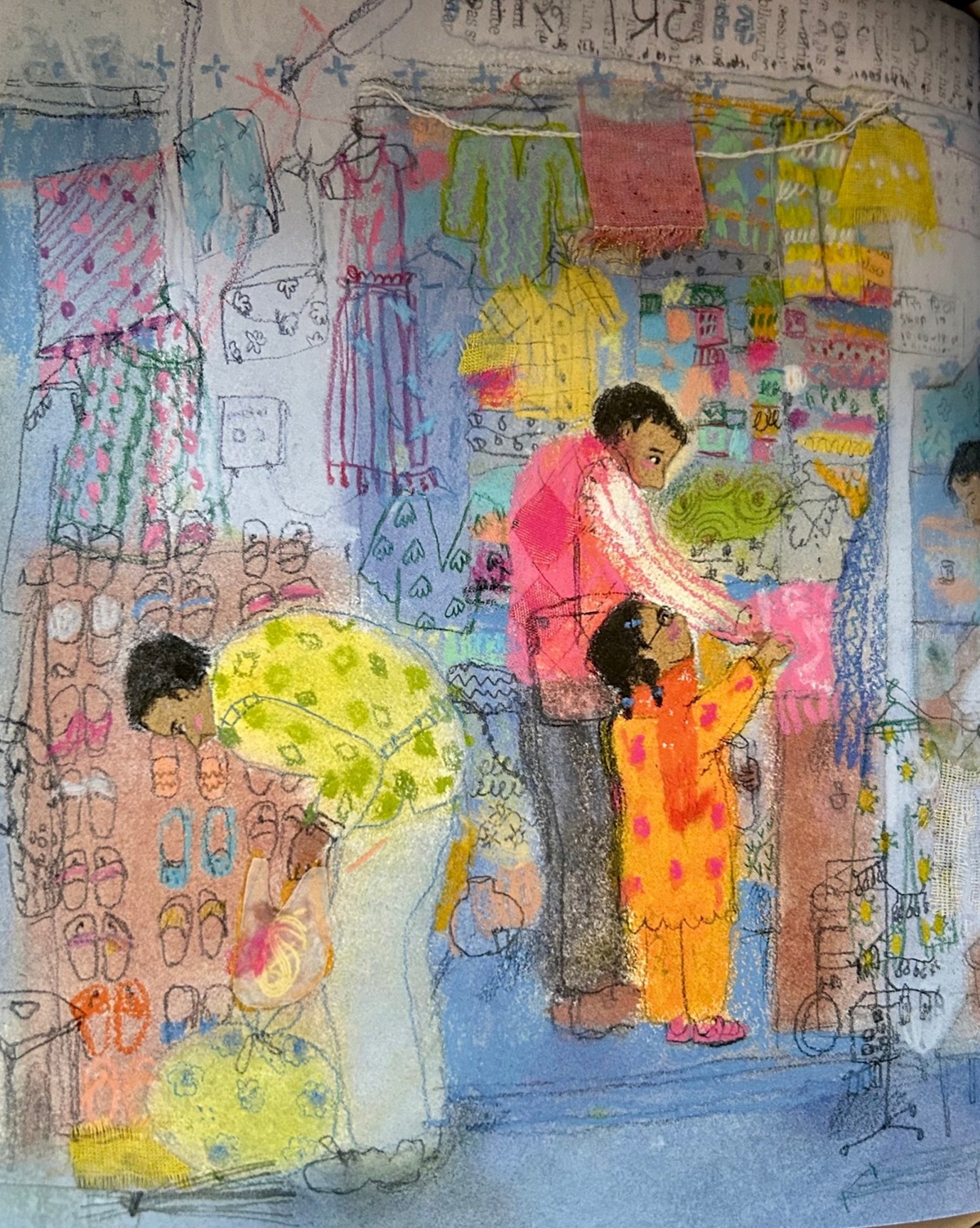 The same is true of my second choice, from Aditi Anand’s The Fabric of Us (Walker), again half a spread. Oranges and pinks glow in this scene of a fabric shop in India (where Anand lives), vivid against a soft blue-grey background and vibrating with the intensity of a Mark Rothko. Using pencil crayon and pastel (I think), as well as a few collaged instances of thread, newsprint, fringed fabric and cheesecloth, Anand has made a ravishing image and one to pore over. The shoe rack, the jewellery stand, and the stacked or hanging items of clothing with their patterns make for a busy background without losing points of focus: the figures whose various stances are casually but accurately depicted.
There is a tenderness in the proximity of the child and parent, and their faces tell us they are making important choices. (The book is about dealing with the absence of one of the child’s two fathers.) The minutely observed and slightly chaotic profusion contributes to the sense of place – this is not the haberdashery section of John Lewis, as the Hindi lettering near the top confirms. The complete spread is rich in incidents to explore but, while the parts are fascinating, the sum is greater: a transporting doorway that is all the more tempting because it is so beautifully coloured and hand-made.
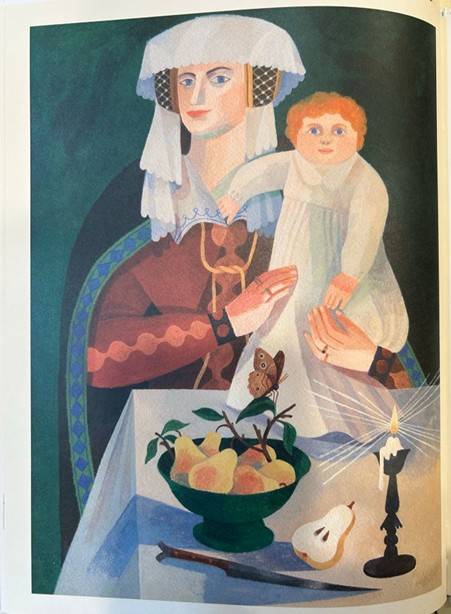 My third choice is by Carson Ellis, illustrating Mac Barnett’s retelling of Rumpelstiltskin (Orchard Books/Scholastic). Ellis is a fan of the Tudors, and this image of the miller’s daughter, now the queen, with her baby, shows the influence. The queen has a ramshorn hairstyle (the mediaeval precursor of Princess Leia’s coiled side buns) encased in ornate mesh nets called crispinettes, or crespines, and draped with a fine cloth ‘templar’. There is something here of Holbein’s famous portrait of Anne of Cleeves, with the headdress extending out to the sides. The figures are daringly in the attitude of a different subject, though: a Madonna and Child, with the baby’s hand (as was common) reaching inside the mother’s dress. Red hair was often also a feature of Renaissance paintings, from Michaelangelo (the first time round) to Millais (revisiting).
When pears appeared in Renaissance images of a Madonna and Child, as they did in the work of Bellini and Durer, for instance, they symbolised redemption (in contrast to apples which symbolised the Fall). And a butterfly symbolised renewal. Both are apt here when we know the queen is about to escape Rumpelstiltskin’s trap. When a knife is used to cut fruit in such a context, it also foreshadowed Mary’s sorrow at the Crucifixion. Here perhaps Ellis’s knife on the table suggests the sorrow of losing a child that the queen is about to dodge.
Incidentally, the butterfly seems to resemble a woodland brown, and this book has a theme running through it of the miller’s daughter’s love of the forest. Ellis, I suspect, thought the elements of this illustration through in great detail. The queen in her picture looks straight at us with a knowing expression, because she has already found out Rumpelstiltskin’s name. Another enthusiasm declared by Ellis is for the work of Edmund Dulac – and there are lots of instances in his work of characters gazing straight at the viewer.
A word too about the materials Ellis has used. She made her own colours from oak gall, and iron rust, as the Tudors did, for authenticity. And ink from walnuts. With such a level of commitment, and such grand influences, no wonder the finished image knocks your socks off.
Nicolette Jones writes about children’s books for the Sunday Times and is the author of The Illustrators: Raymond Briggs (Thames & Hudson); The American Art Tapes: Voices of Twentieth Century Art (Tate Publishing) and Inspire Me! (Nosy Crow), illustrated by Axel Scheffler.
Books mentioned
You and I Are Stars and Night, Kate Hosford, illus Richard Jones, Beach Lane Books, 978-1665940382, £14.99 hbk
The Fabric of Us, Aditi Anand, Walker Books, 978-1529524680, £7.99 pbk
Rumpelstiltskin, Mac Barnett, illus Carson Ellis, Scholastic, 978-1338673852, £14.99 hbk


