
Price: N/A
Publisher:
Genre:
Age Range: 5-8 Infant/Junior
Length: 32pp
Buy the Book
Dogs and Bears
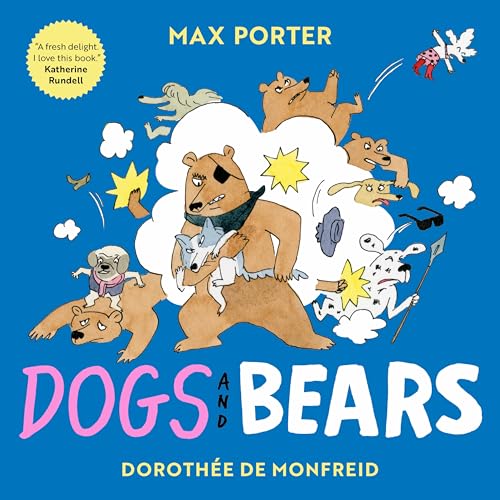
Illustrator: Dorothée de MonfreidOne of the great pleasures of childhood reading is discovering that some books are willing to misbehave. From its opening pages, this gloriously unruly picture book establishes a playful relationship with its reader, introducing a narrator who appears to be in control of proceedings but increasingly proves to be anything but. What follows involves dogs, bears, arguments about clothing, several increasingly spectacular brawls and, eventually, an entirely unexplained storm of squid. It is absurd, anarchic and very, very funny.
Beneath the chaos, however, something rather clever is happening. The bears decide that the dogs are doing things they shouldn’t. There are rules about what can be worn and how one ought to look, and difference becomes sufficient reason for conflict. The dogs are hardly innocent themselves and, before long, nobody seems entirely certain why everybody is fighting. Porter allows ideas about conformity, prejudice and tribalism to flicker beneath the surface without ever pinning them down into a lesson. These are possibilities the story makes available rather than meanings it insists upon.
Then the squid arrive.
The escalating absurdity is matched perfectly by de Monfreid’s wonderfully loose, expressive linework. Her fluid ink contours give every creature immediate personality and allow bodies to tumble, squash, chase and collide with tremendous comic energy (I have a particular fondness for the poodle and her pink boots). As the brawls grow, so does their occupation of the page, until dogs and bears spill together across the gutter. Yet de Monfreid rewards quieter looking too. A seemingly innocuous picture of a wave hanging behind the narrator at the beginning anticipates the later diagram explaining the squid storm: one of those delicious details that reveals itself only to an observant reader or upon rereading.
Perhaps the book’s greatest joke, though, is its narrator. It interrupts, apologises for interrupting, announces the moral of the story and then discovers that the story stubbornly refuses to behave accordingly. Even the suggestion that fighting has somehow brought everyone clarity arrives with an almost audible narrative cough. When peace finally appears to have prevailed, our narrator consults the very book we are reading and discovers that this is not, in fact, the end.
There is another brawl.
And therein lies the joy. Porter and de Monfreid understand that a children’s book can think deeply without becoming solemn. Adults may recognise questions about arbitrary rules, othering, conflict and our desire to impose coherent morals upon complicated behaviour. Children are equally entitled simply to delight in bears, dogs, spectacular fights and squid falling from the sky. Neither reading is privileged over the other.
Wildly inventive, visually exuberant and magnificently silly, this is a picture book clever enough to contain big ideas and wise enough not to explain them. It trusts its readers to make meaning for themselves.
And then, just in case things are becoming too sensible, drops another squid on their heads.


