
Price: N/A
Publisher:
Genre: Non Fiction
Age Range: 14+ Secondary/Adult
Length: 56pp
Buy the Book
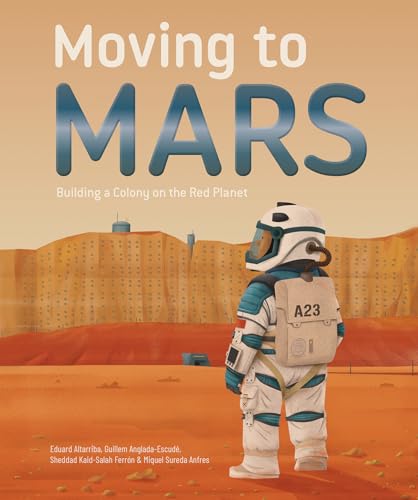
Moving to Mars: Building a Colony on the Red Planet
This hardback considers how humans are reaching for Mars, ‘Our unavoidable destiny if we want to become a multi-planetary species, living not just on Earth but on many planets’ (p.3).
It begins by looking at the myths around Mars and how it was named before delving into the comparison between Earth and Mars and continuing with a look at the red planet’s two moons. After exploring solar wind and cosmic radiation more of the practicalities of humans reaching and staying on Mars are explained.
‘Moving to Mars’ contains sections on, ‘Some orbital mechanics’, ‘Setting up Base Zero’ and then ‘A city on Mars’. Various aspects of life on the planet which is most like Earth are then discussed in sections about ‘Community life’, ‘Energy’, ‘Parks and green spaces’, ‘Martian diet’ and ‘Transport’. This publication ends with a look at terraforming which is, “A process of ‘planetary engineering’ aimed at improving a planet’s environment and climate” (p.54).
This volume is full of some very clear and well-labelled diagrams to explain the physics and practicalities behind living in alien conditions in Space. I feel that the knowledge needed to access some of the text is at GCSE level because topics include parabolas as conical trajectories, for example. Students with physics and/or astronomy as a special subject will enjoy this book, and it could inspire budding physicists who would be eager to imbibe meticulous scientific details. However other students might be turned off by the high level of knowledge needed to enjoy the book fully.
It is a pity there is no glossary or index included here as they would both be useful. There is ample scope for bringing together explanations and definitions of scientific terms at the end of the book, and an index would help with accessibility. If you are looking for information on conquering Mars this is a very full and advanced study of the subject.


