
Price: N/A
Publisher:
Genre:
Age Range: 10-14 Middle/Secondary
Length: 288pp
Buy the Book
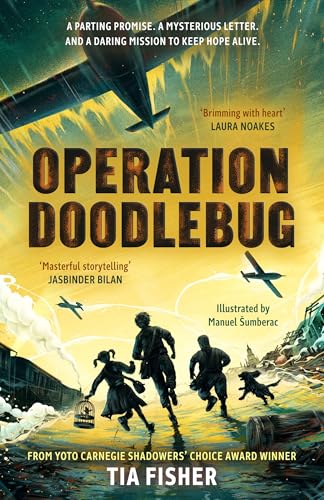
Operation Doodlebug
Acclaimed YA author Tia Fisher follows up her 2026 Carnegie Medal– shortlisted verse novel, Not Going to Plan, with a middle grade historical adventure novel. Operation Doodlebug begins in Croydon in 1944 and will appeal to all young readers who enjoy the writing of Judith Eagle, Emma Carroll, Phil Earle and Tom Palmer.
Young Stan’s father has just joined up and is headed off to training camp. Stan is torn between pride that his dad will eventually be joining the troops in Europe and fear of the unknown. He clings to the promise made when they part: that his dad will come back. Life in Croydon has already been disrupted by the Blitz, but when the German air force begins dropping V1 buzz bombs (or doodlebugs) as vengeance weapons, Stan’s mother decides he should be evacuated to the Norfolk coast, along with his close neighbourhood friends, Billy-the-Moon and Nellie.
Before they leave, Stan finds a mysterious metal cylinder, dropped during a bombing raid, and a telegram arrives that indicates his father mas been reported missing, believed killed in action during D-Day. Stan refuses to believe that his father would break his promise, despite the bleak news. The remainder of the novel focuses on Stan’s attempts to discover what has really happened to his dad and the mystery behind the cylinder marked ‘V1.POW.Post’. Could the two somehow be linked?
Operation Doodlebug is meticulously researched and the friendship between Stan, Billy and Nellie is believable and full of warmth. The trio have a nose for investigation and a strong sense of justice, which often leads to danger. Fisher deals thoughtfully with complex issues of bullying, illiteracy, anxiety and grief. The children are all bullied as evacuees and are therefore seen as outsiders: Billy is treated cruelly because of his dwarfism; Nellie struggles to read and Stan is constantly on high alert due to fear for his father’s safety.
Fisher’s Historical Note at the end of the novel details some of her research and several interesting facts (i.e. the number of road deaths in England during the Second World War due to blackouts and the lack of street signs; what life was like before the NHS was set up in 1948).
A worthy class read and essential to any primary school library collection.


