
Price: N/A
Publisher:
Genre:
Age Range: 5-8 Infant/Junior
Length: 40pp
Buy the Book
The Lost Robot
Todd-Stanton excels at placing small, searching characters within worlds that feel vast, ancient and quietly mythic. His graphic novel-like picture books often move between intimacy and enormity: a lone child or creature whose quiet vulnerability becomes the emotional anchor as they are swept into forces much larger than themselves. In this latest adventure, he turns his gaze towards the future while retaining that same emotional architecture. This remains a story about scale and belonging, about what it means to feel insignificant in a world that seems too large to hold you.
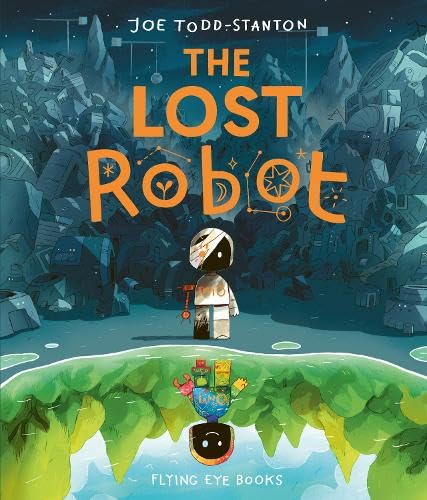
The narrative begins in silence and abandonment. A small robot awakens in a sprawling mechanical dump, surrounded by the remains of other broken things. Even here, there is a hint of human presence. An older woman moves through the wreckage with a quiet purpose that feels significant long before we understand why. From this moment, the story unfolds as both physical journey and emotional search. Mio sets out towards the distant lights of the city, driven less by programming than by an instinctive sense that something essential has been lost. Encounters with the environment bring flashes of connection. When Mio finally uncovers the truth of his origin, the discovery offers no neat resolution. Instead, it reframes his quest as one not for function but for relationship.
This movement from design to experience is echoed in the book’s careful visual construction. Flying Eye’s characteristic attention to peritext deepens the reading. Endpapers trace a subtle emotional arc from isolation to belonging, while beneath the dustcover, a blueprint of Mio suggests a life once defined by precision and purpose. As in Todd-Stanton’s earlier work, environments shape the story’s inner weather. Vast cityscapes, lonely wastelands and pockets of unexpected warmth carry the reader through shifting states of hope and uncertainty.
Healing, when it arrives, does so through recognition rather than rescue. A mother and daughter living close to the rhythms of the natural world offer Mio a different way of being seen. The mother’s eye patch gently mirrors the robot’s own damaged state, reframing brokenness as shared experience rather than defect. Gradually, damaged circuitry gives way to colour and memory. Mio becomes a living tapestry of encounter and care, his identity something grown rather than manufactured. Todd-Stanton’s palette warms in response, moving from metallic restraint towards luminous spreads filled with sea spray, forest light and starlit possibility.
By the closing pages, Mio’s journey suggests that belonging is rarely found where we are first placed, but where we are finally understood. This is a quiet meditation on loss, repair and chosen connection. It reminds us that being fixed is not the same as being healed, and that even the smallest figure can discover a place within the vastness of the world.


