Price: N/A
Publisher:
Genre:
Age Range: 14+ Secondary/Adult
Length: 640pp
Buy the Book
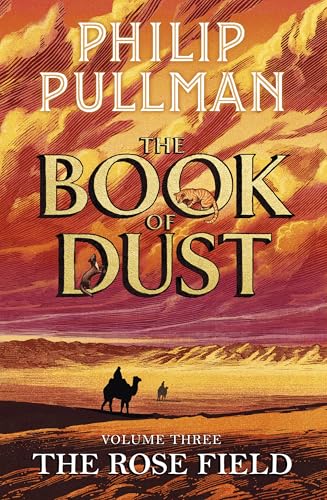
The Rose Field
Lyra has reached Al- Khan al–Azraq, the Blue Hotel or to some Madinat al-Qamar, the City of the Moon, where she hopes to find Pan, her daemon who has left her to search for her ‘imagination’. He is not there; her journey must continue. This is not the Lyra of His Dark Materials, and it is a mistake to expect her to be. Lyra is no longer a child, now 20, a student in the Oxford at St Sophia’s College, she is on the verge of adulthood, seduced by ideas of reason and rationality. A mechanistic philosophy is taking over her world as the imperatives of money are becoming all-powerful. It is uncomfortable, oppressive, and authoritarian. A particular focus is the trade in a mysterious, powerful elixir made from the essence of roses coming from another world. The ultimate prize for governments, it also represents a challenge to the Magisterium and other fanatics whose goal is to destroy it. Searching for the Rose Field, the source of this essence, is the other strand in Lyra’s quest which began in the opening chapters of The Secret Commonwealth when Pan witnesses a murder and rescues a wallet with a key. Now Lyra – and Pan – separately, travel East and the action develops as the protagonists race towards The Rose Field. It is relentless as we travel through cities, over mountains, across seas towards that mysterious red building. We meet old friends – Matthew Polstead, of course, taking the place of Will; we make new acquaintances. There are deaths, new friendships, jeopardy, betrayal, reconciliation, an explosion – and an ending. There are intense discussions, magical journeys. It is a rich, immersive, experience – challenging but well worth it.
Perhaps one problem for some readers is that this is not fantasy. It does not conform to the familiar tropes. Pullman himself has said he is not interested in writing fantasy. He is interested in people – what makes us truly human, complete beings. He is interested in imagination. The world he has created has plenty to excite the imagination – daemons, gryphons, spies, witches, multiple worlds that may be accessed through secret doorways – it is fantastic but it is also recognisable. He presents us with real people, good, flawed, evil – surely Marcel Delamare the new head of the Magisterium is one of the most chilling of characters. His world has a tangible solidity. Pullman is a master at creating landscape and atmosphere. His prose direct, immediate, ensures that the reader is drawn into and through the pages. Above all Pullman is a storyteller, his narrative flows like a river with tributaries, some that frustratingly disappear, others moving to rejoin the main flow. Characters come and go. This is not the perfect construct but this is what life is like. Throughout he challenges the reader to be curious. And the ending? No trumpets, coronation or wedding – just a lake and sunshine. Not quite what one might have expected, but in the words of T S Eliot ‘..finding the place; it was (you may say), satisfactory’.
This is a book for intelligent, curious readers, young adult and older, who are prepared to follow a consummate storyteller.