
Price: N/A
Publisher:
Genre:
Age Range: Under 5s Pre-School/Nursery/Infant
Length: 40pp
Buy the Book
A Day Off School
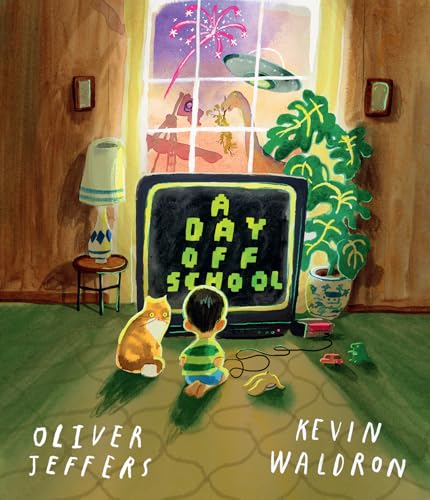
Illustrator: Kevin WaldronThere is a particular thrill to being told that ‘yes, you are poorly enough to have a day off school’. For Herbie, waking ‘with a sniffle’ *cough* presents an irresistible opportunity: an entire day stretching ahead with no lessons, no timetable and nobody else deciding what happens next. Yet beneath this wonderfully simple premise, Jeffers and Waldron create something far more interesting. This is a book about what happens in the gap between experience and possibility.
Herbie begins magnificently. There are forts to build, computer games to play, cars to race, pictures to paint, yo-yo tricks to practise and cartoons to watch. Waldron fills these early domestic scenes with gorgeous warm washes of purple and playful detail. But there is a problem. Herbie completes his carefully prepared list before lunch. Suddenly, freedom contains an unexpected emptiness.
And nothing to do creates imaginative space.
Herbie begins wondering what everyone else might be doing at school. At first, his possibilities remain almost plausible: perhaps there is a dog loose in the corridors or somebody has brought birthday cake. Soon, however, imagination takes flight. Fireworks erupt, pirates invade and monsters burst spectacularly across the gutter. Aliens arrive in typography that recalls Herbie’s computer game, while objects and images encountered earlier begin finding new lives within his imagined world. Waldron brilliantly escalates the visual language alongside Herbie’s thoughts, allowing colour, scale and composition to carry much of the storytelling.
Yet imagination is not presented simply as an antidote to boredom. The same faculty that liberates Herbie also troubles him. The more extraordinary school becomes in his mind, the more conscious he is that everybody else is there without him. Beneath the glorious absurdity lies something emotionally recognisable: sometimes what we miss when we are alone is not the activity, but the community.
Jeffers’ restrained text and characteristic lettering are beautifully matched by Waldron’s visual storytelling, with the artwork jointly created by both artists. Words frequently leave space for pictures to complicate what we think we know. A muted, almost sepia classroom contrasts with Herbie’s increasingly colourful imagined possibilities. Later, one tiny visual detail accompanying his sister’s return quietly destabilises our confidence about where imagination ends and reality begins. By the final, wordless spread, the book leaves that boundary deliciously unresolved.
The opening Seneca quotation tells us that ‘we suffer more often in imagination than in reality’, but this playful, perceptive book ultimately makes imagination far more complicated than that. It can create anxiety and longing, certainly, but also play, creativity, wonder and possibility. Warm, funny and visually sophisticated, this is a picturebook that trusts readers enough not to explain its mysteries.
After all, even the most ordinary day might contain something extraordinary.


