
This article is in the Publishing Profiles Category
20 Years of Book-Loving Lulu
In 2006, a pint-sized, book aficionado with puff balls bounced on to the children’s literature landscape. 20 years later, Lulu is still with us – a little older, perhaps, but still just this side of five years old. Fen Coles celebrates this important little girl.
 Lulu punches well above her weight. Created by Anna McQuinn and Rosalind Beardshaw, published by indie Alanna Books (now Alanna Max), the Lulu series has run to: 11 picture books; co-publishers in Brazil, The Netherlands, Denmark, Sweden and the US; a spin-off for Zeki, Lulu’s little brother.
Anna describes Lulu’s longevity as ‘kind of unbelievable.’ Here, at Letterbox Library, we well remember her arrival, even though this was, in many ways, ever so quiet: a trip to the local library with mum, told through an upbeat, sparse text, accompanied by soft washes of colour. But, in 2006, a Black girl protagonist in a high-quality format picture book with such contemporary illustrations within such a universal setting – well, that was, if not unprecedented, still remarkable. Her presence felt, already, ‘mainstream’. She landed with an undeniable confidence, quickly developing into a series character.
With the sequel, Lulu Loves Stories, Lulu was the cover star for Letterbox Library’s 25th Anniversary 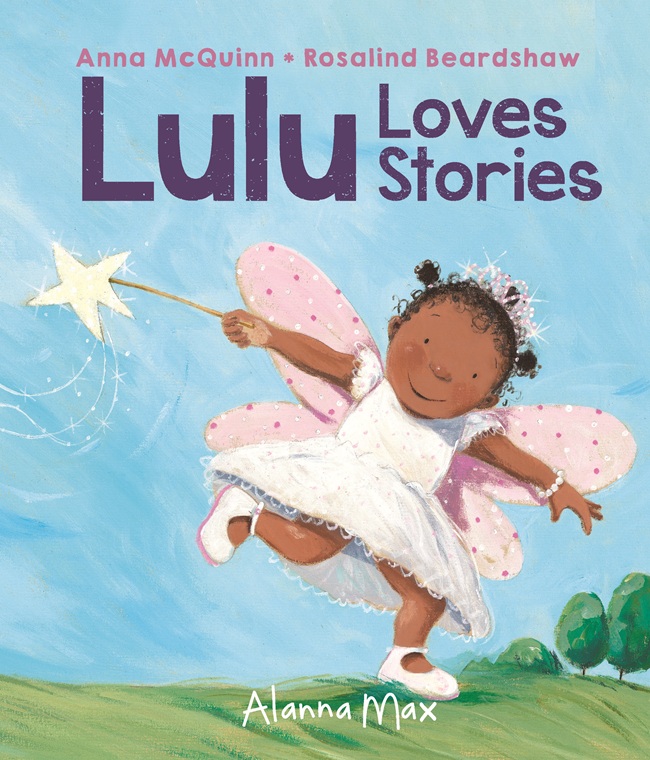 catalogue (2009). In this second outing, Lulu’s dad appears as primary carer and their shared reading leads to our little hero imagining herself switching effortlessly between a fairy, farmer and DIY expert. Fittingly, this catalogue edition’s special focus was Girls & Boys: Same Difference. Fitting because when I ask Anna about her journey into children’s publishing, she replies, ‘It began at the infamous Letterbox Library conference! That’s when I decided I needed to be in children’s publishing.’ She’s referring to the 1991 conference: We’ve Gotta Have It!: Feminism and Children’s Books. This is also where she met children’s publisher, Verna Wilkins, who was then Chair of The Working Group Against Racism in Children’s Resources*. By the end of the day, Anna had both joined the working group and signed up as a Letterbox Library member.
Given the impact of this feminist-themed conference, it’s perhaps not such a surprise that when I ask Anna to reflect on Lulu’s impact as a protagonist of colour at the time of publication, she replies, ‘Weirdly, I was more focused on her being female.’ (More on this later).
Anna’s launch into all things children’s publishing took her to Child’s Play International, Tamarind Books, Reader’s Digest, Frances Lincoln, DeAgostini and Little Tiger. In 1998, alongside Andrew MacMillan, she set up her first children’s publishing house, Zero to Ten. The industry felt like her natural home: ‘It brought together my politics and teacher training and an interest in child development.’ I wonder which of those houses impacted on her later commitment to publishing inclusively. Child’s Play, she says, ‘was very progressive’, plus, at the time, they were distributing Wilkins’ Tamarind list. Frances Lincoln were also ‘at the sharp end of inclusion.’
Anna’s publishing trajectory was followed by a very different, but equally influential, role: a 2-year contract with Acton Sure Start; she ended up staying for 14 years. Sure Start was a 1998 Labour initiative designed to support families with children under 5. Anna was tasked with running Acton’s literacy programmes. ‘I spent from 9 to 4, four days a week, just in the company of lots of different small children.’ The families attending spoke a multitude of languages and came from a wide range of cultures. This is the environment in which Anna wrote her first Lulu. She secured American publisher, Charlesbridge, in 2004 but, unable to attract a UK publisher, she resolutely established Alanna Books.
Anna’s Sure Start background undeniably helped establish the Lulu series as one finely calibrated to an early years’ audience. You sense how keenly attuned she is to the dimensions of children’s attention, how they scan their world: ‘They notice all the small things.’ Rosalind Beardshaw’s illustrations pan and tilt, tracking a toddler’s point of view, zooming in on the teeniest details. This lends an intimacy to the work, often commented on by reviewers. The cosy correlation of text and artwork is also striking, something Anna attributes to the deliberate absence of an art director role: ‘There’s just us as a pair.’
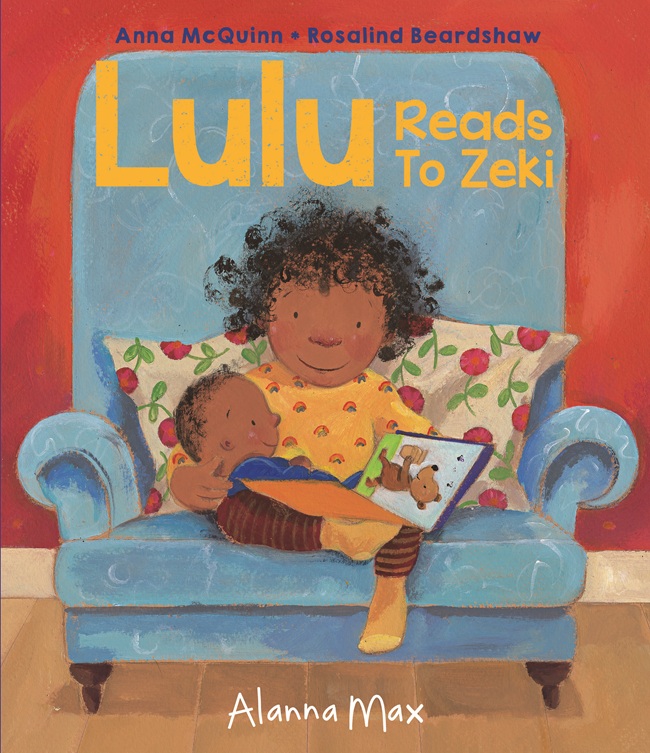 Lulu’s ‘ordinariness’ is also a perfect early years’ pitch: she becomes a big sister, starts school, gets her first pet, moves home. It would be disingenuous to ignore the fact that in the mid 2000s, a protagonist of colour within ‘casual’ and universal narratives, rather than issues or identity-based ones, was still unusual. Early on in our interview, Anna insists on Lulu’s feminist origins; she says she wanted to correct a largely default male setting in picture books’ lead characters. However, when Beardshaw presented her first drafts, Anna wondered, ‘Gosh! She could be a great Black little girl.’ So, she concludes, the decision ‘was very early but I think it wasn’t immediate…I guess I hadn’t thought of her race at all.’ Author and artist came to converge on a shared idea of incidental inclusion, a model which later extended to also embrace disabled and queer representations as well as social economic differences.
Anna recognises Tamarind Books as ‘probably the biggest influence in terms of incidental stuff.. the sort of ‘everydayness’.’ She also remembers that when Alanna Books and Frances Lincoln were both shortlisted for the 2015 Alison Morrison Diversity Award, Janetta Otter-Barry compared Lulu to Mary Hoffman’s Grace series (1991-2011): ‘She said to me, “Lulu is Grace’s little sister and she’s going to take the baton.” It was an incredibly kind thing to say. I didn’t think of her as having that kind of longevity.’ The most cursory glance at artist Ken Wilson Max’s work also shows how Lulu would have settled in ever so comfortably alongside his Lenny and Max series when Alanna Books became Alanna Max Books in 2018; their mission reads, ‘To create naturally inclusive picture books.’
Anna says, ‘People think you need to kind of go out with an intent to change the world and do representation. I more thought, there’s no reason 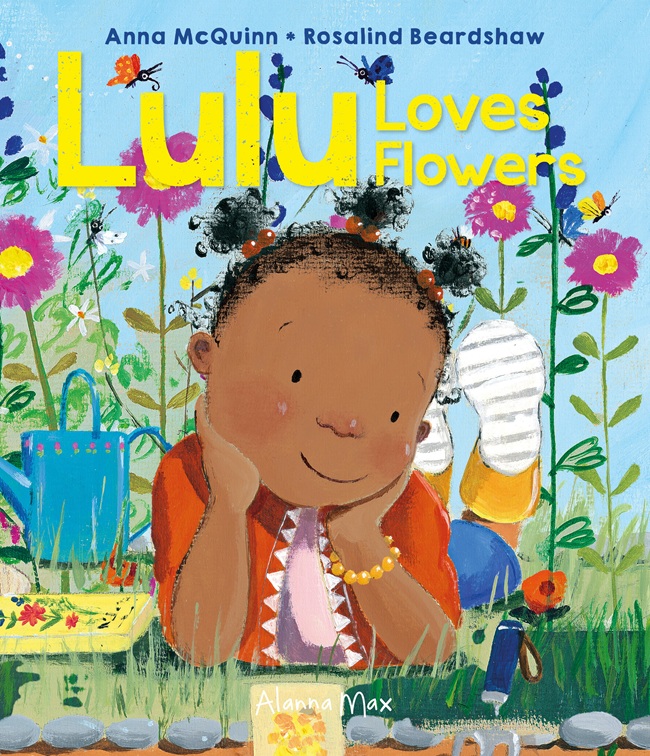 for Lulu not to be [black].’ Interestingly, the ‘politics’ of Lulu’s presence on the children’s literature landscape surfaced with her marketing. ‘The more I was presenting to people,’ Anna explains with palpable frustration, ‘the more I’m…I’m constantly asked but why is she black?’ This flip to the present tense speaks volumes. She elaborates, ‘For all that we’ve moved forward…I really believe that… in publishing… and corporate mainstream bookselling…we still believe that our audience is white. And if we’re doing a ‘diverse’ book it’s to teach the white child to be tolerant.’ Likewise she feels that too often ‘inclusive literature is done in silos.’ So, for example, ‘you do the eco book and then you do the inclusive book’ and never the twain shall meet. It was only when Lulu Loves Flowers featured in Sands O-Connor/Chetty’s Beyond the Secret Garden column, England’s White and Pleasant Land (Books for Keeps, March 2018), that she understood how rare it was to imagine a Black child in a garden (in this case, an allotment, adding an economic dynamic). ‘That shouldn’t be revolutionary!’
So, while Anna says, ‘I’ve always parked the politics and written the story,’ she also describes Lulu’s influence as – unavoidably – political: ‘That’s the legacy…that the widest range of children will see themselves in the story.’ And, when I suggest she and Beardshaw are using a wonderfully executed incidental model of inclusion to do something radical almost by stealth, she accelerates this: ‘Natural inclusion IS still radical… Lulu is a three year old Black child who stars in the story for no reason other than that she is the star. And it’s the ‘no reason’ that is quite hard to explain, It seems like it’s not radical… but it feels more radical that you don’t need any reason.’
(As a side note, it may interest and surprise readers to learn that Lulu has faced book bans in the US). In the end, at Letterbox Library, we have every confidence that Lulu’s status as surely one of the most endearing, irrepressible – let’s say it, CUTEST- picture book protagonists will be her biggest legacy.
Fen Coles is co-director of Letterbox Library.
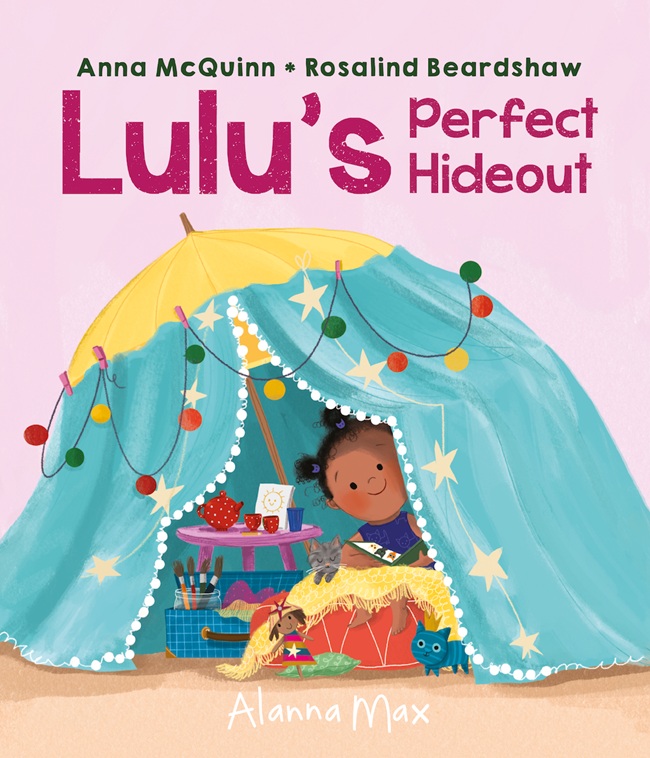 Lulu’s Perfect Hideout publishes this October.
*set up in 1983 by the Inner London Education Authority


