
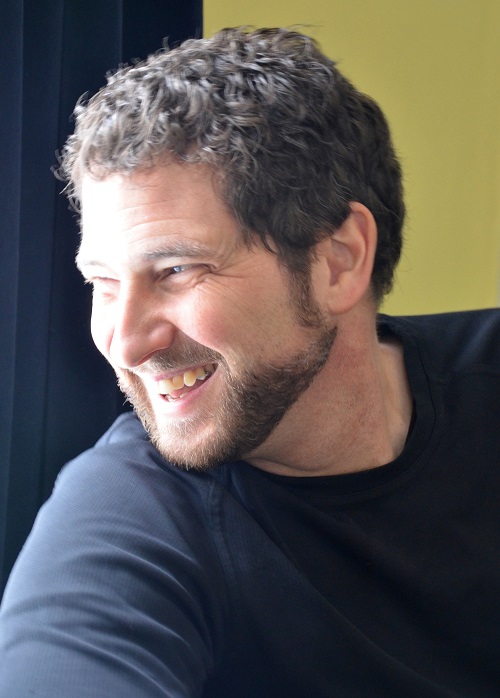
Authorgraph 273: Kenneth Oppel
Kenneth Oppel interviewed by Alison Brumwell.
 ‘We made a grave marker, even though there was no body to bury.’ So opens the latest thought-provoking YA novel by Canadian author, Kenneth Oppel. Best of All Worlds is a speculative survival novel with science fiction and thriller overtones. Teenager Xavier has reluctantly agreed to join his Father and new (pregnant) stepmother on a holiday to their familiar lakeside cottage. But, when he wakes on the first morning, it smells and looks all wrong. There’s no lake anymore, no phone signal, no GPS, no connection to the outside world, his brother and mother. Xavier reflects, ‘I was shot through with the feeling that once that door opened and we passed through it, things would never be the same.’ The reader feels his anxiety and apprehension, and Xavier turns out to be right. Kenneth Oppel says this was deliberately intended to hook the reader in, setting the tone and establishing clearly that this is not a middle grade read. He drew upon his experiences of film and television growing up, particularly the micro-narratives associated with the beginning of James Bond films, or The White Lotus where an episode opens with a dead body and flashes back. It’s an effective mystery trope and introduces Xavier’s voice as a 16-year-old, with 16-year-old thoughts and feelings. The reader also knows something momentous has happened though, as Kenneth says, this is an alien book where you will never see aliens.
Best of All Worlds was a long time in gestation. Kenneth says that in its earliest manifestation the plot was about a family and aliens, and them being collected like specimens, ‘But I felt as if I’d read that before’. Xavier not only has to navigate the unknown, trapped under an invisible dome with just his family in a seemingly specially constructed world, forced to grow and harvest their own food and with no visible means of escape, but also find his place in a new blended family. He questions his future… whether he’ll ever have the ‘normal’ experiences other teenagers take for granted. As with most of Ken’s writing, it was hearing the young person’s voice that lends the narrative its power and vibrancy. ‘What would it be like,’ he wondered, ‘if a young person had their life truncated?’ The voice he heard ‘was cantankerous… a bit bitter’, and that was the starting point for Xavier’s character. ‘I hear my characters more than see them a lot of the time,’ he explains, which is why the dialogue is so effective, and why the narrative moves at such a clip. Oppel comments that each of his books finds its own length and that some of his previous novels have felt, to him, ‘bloated’. Certainly not something that can be said about Best of All Worlds, which is tightly plotted, and driven by a taut, pacy narrative.
The novel touches on contemporary issues of conspiracy theories and pseudo-science; for three years Xavier and his family adjust to life beneath the dome, and it is only when a second family is introduced, with very different beliefs, that tensions escalate. Oppel finds these subjects fascinating: the zeal with which people follow things and believe unquestioningly is a theme he feels is common to many of his books. ‘It seems odd to me,’ he says, ‘that people are reluctant to believe experts, scientists and Nobel Prize winners but they’ll follow grass roots conspiracy theories with such conviction.’ The conspiracy theory elements in Best of All Worlds are analogues of QAnon and Great Replacement Theory, a reference to ‘reptilian bloodlines’ by newcomer Riley an offshoot which Ken felt was too good to pass up. He also did research into hate groups in the USA and found there are more statistically in Tennessee than any other state (hence Riley’s origin). There was also much research related to farming. ‘I spent a lot of time finding out about subsistence farming,’ he explains, ‘how much acreage you’d need, the best crops and when to plant things.’ He says he over-researched but this fed into his confidence as a writer: he’s a self-confessed city person with no prior knowledge of crops or livestock or what self-sufficiency of the type forced on Xavier entails.
While Best of All Worlds is unlike Oppel’s recent novel, Ghostlight, in terms of subject matter and structure, they share themes of grief, 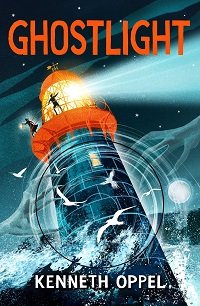 letting go and reconciliation. These are the fore of Xavier’s story. The characters Oppel develops shift and change throughout the course of the novel and their experiences of the dome affect them differently. In many ways, the dome and associated issues are secondary as much of Oppel’s story exposes the cracks in family relationships; often featuring an absent, or disengaged parent. Xavier contends with separation from his mother and his idolised older brother Sam and struggles to connect with his step-mother and new family unit when they are confined to the dome.
What is integral to the character of Xavier, Oppel believes, is the idea of temptation, being conflicted between two differing ideologies. His father and stepmother Nia, and Riley, have equally zealous, but opposing, belief systems. A tightrope motif is used to show how Xavier tries to keep his balance; naturally drawn more towards his father’s liberal beliefs but with Riley’s authoritarian even ‘masculine’ approach a powerful pull. For a young mind trying to find a balance between these incompatible belief systems and make a reasonable decision in the face of so many distractions (Xavier’s attraction to Riley’s daughter, teenager Mackenzie being just one), is what Oppel, as an author, found the most interesting theme in Best of All Worlds.
Oppel says it took him a long time to get to know Xavier, at whom he throws every possible challenge. Xavier’s life in the dome provided fertile territory for exploring teenaged frustration, resentment and a sense of loss. Xavier is a good kid at heart, one who tries to pitch in with his farm chores in the dome and to deal with conflicted feelings towards his half-brother. Any child coming from a family that has been broken up, he maintains, would struggle to cope with the presence of a stepparent. When they are isolated, as Xavier is in the dome, these issues are magnified: a distant father (referred to as Boardroom Dad), a new baby brother and losing access to his music all have a profound impact. Xavier’s phone is a memory vault, a connection with his other life, and Ken says he feels for this loss and sense of separation. Interestingly, it is Riley who restores this connection.
While Riley as a character is erratic and obsessive, Ken took care to make him nuanced. He clearly loves his children, tries to be a good father and is attentive to Xavier in a way that his father Caleb can’t be. He’s interested in the hole Xavier spots in their sky and very committed to finding a way to break out of the dome, which is almost irresistible to Xavier. But, ultimately, can he be trusted as a figure of authority? He’s not a villain the reader will love to hate, unlike the ‘delicious baddie’ Viker in Ghostlight; despite this, Riley wears the clothing of some abhorrent ideologies. Ken says he ultimately pities Riley, that he isn’t worthy of hatred, and this is borne out by the empathy and care taken to develop his character. Oppel’s US editor, David Levithan, remarked, ‘I don’t hate Riley…until I do,’ and Oppel himself says he feels Riley will be the litmus test for many reviewers: is he sufficiently nuanced, or does he conform too much to stereotypes?
There are satirical elements in Best of All Worlds too and Ken describes it as enormous fun to write, appealing to his ‘off-kilter’ sense of humour. Imagine being trapped in a dome with your worst enemy, he says. ‘On one hand, it’s Sartre’s ‘Hell is other people’; on the other, it’s a sit com’. Some of what Riley says is jaw-droppingly awful and induces typical teenaged eye-rolling from Mackenzie. He hopes readers find these elements as darkly amusing as he does and says he deliberately chose not to lob his characters into one basket, so Mackenzie is a dissenter. All the characters in Best of All Worlds (even the children) have beliefs and moral compasses which are tested at various points in the narrative, in addition to the physical adjustments they must make to survive. Noah, Xavier’s little brother, presented a problem for Ken who likens him to Jack, the narrator of Emma Donoghue’s The Room; preternaturally bright for a three-year-old. He has no real knowledge or understanding of ‘Erf’ and we don’t know what really happened when he was born in the dome.
Ken believes that, ultimately, everything in Best of All Worlds comes back to Xavier’s tightrope walk and the necessity of making very complicated decisions. While he believes it’s not his job to give kids a theme, a manifesto or a takeaway he’d like his readers to talk about current issues. ‘Best of All Worlds is a challenge which requires us to ask, ‘Is there another way?’ Humans have messed things up so badly’, he says, ‘But can we do better and what could that look like?’
Alison Brumwell is education and literacy consultant and chartered librarian.
Books mentioned, by Kenneth Oppel, published by Guppy Books
Best of All Worlds, 978-1916558458, £14.99 hbk
Ghostlight, 978-1913101763, £7.99 pbk


