
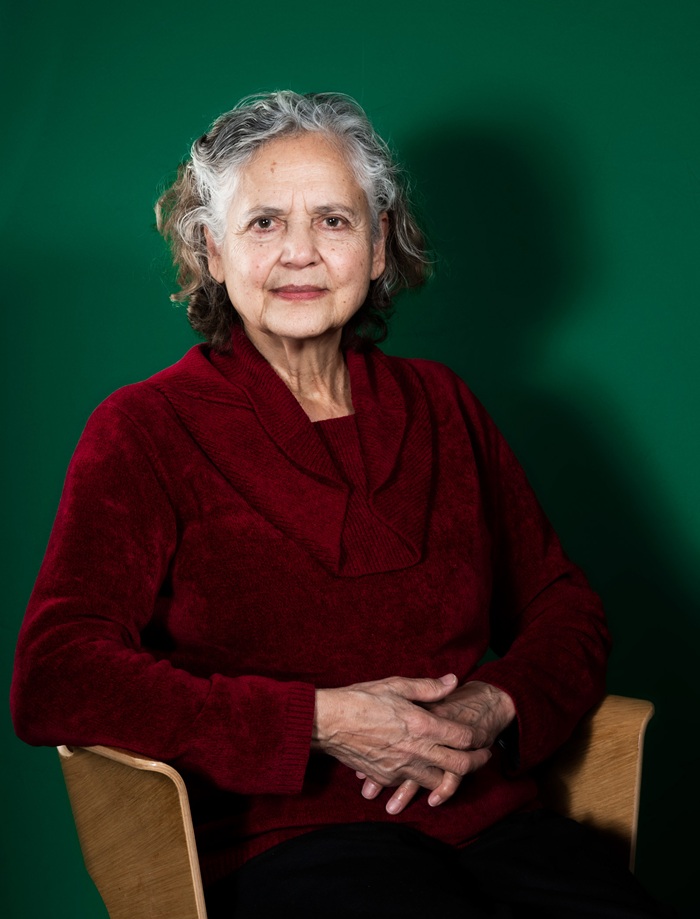
My Soul, A Shining Tree An interview with Jamila Gavin, shortlisted for the Nero Book Awards
Nicolette Jones talks to Jamila Gavin about her book My Soul, A Shining Tree in our series of interviews with the children’s authors shortlisted for this year’s Nero Book Awards.
Jamila Gavin has written a number of acclaimed novels that include real historical figures and events among her fictional ones. For instance, Coram Boy (2000), which won the Whitbread Children’s Prize (a previous incarnation of the Costa Book Awards) and became a stage play at the National Theatre in 2005, incorporates the true fact that Handel trained the children of the Coram Foundling Hospital to perform his Messiah every year from 1749 to 1759. Gavin’s 1992-1997 trilogy The Wheel of Surya unfolds in the context of Partition. The Second World War saga Never Forget You (2022) revolves around the wartime experience as grown-ups of four friends at a girls’ boarding school, one of whom is Noor Inayat Khan who went on to spy for the Special Operations Executive and was posthumously awarded the George Cross after her execution at Dachau. (The novel was my choice as Sunday Times Children’s Book of the Year.)
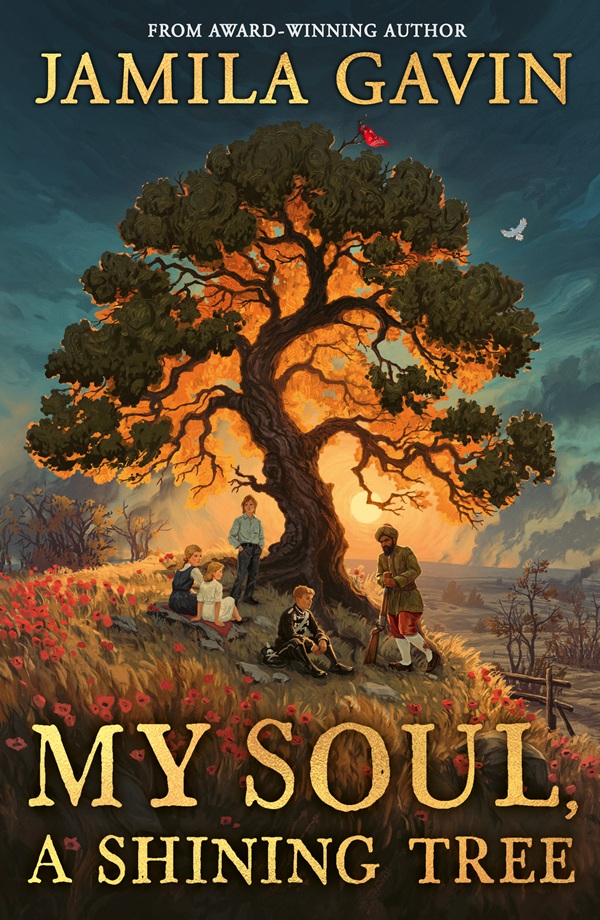 Gavin’s latest novel, My Soul, A Shining Tree (the title a quote from Siegfried Sassoon), is one of the four books shortlisted for this year’s Nero Children’s Book Award. Its four narrators reveal aspects of the First World War. They are Lotte, a 12-year-old Belgian girl, a 15-year-old German cavalry officer, Ernst, and a walnut tree that stands on a ridge near Ypres. The fourth narrator is Khudadad Khan, the first British Indian soldier to be awarded the Victoria Cross.
The book evolved from a story about Khan called The Man in the Red Trousers, commissioned for a first world war anthology by Tony Bradman, who suggested to Gavin’s publisher that she might amplify it into a novel. Gavin invents an encounter in which Khan saves the life of the German boy – a characteristic aspect of a story which suggests that there is no such thing as an enemy, nor any Us and Them.
‘I knew Khudadad Khan had come to Flanders. He was put on a ship in Mumbai. They sailed over to Marseille, were dumped on a train, taken straight into Flanders, into that rainy, muddy hellhole. And his experience of war would have been barely a year, because then he was defending that ridge that all my action there takes place on, under the walnut tree. And all his mates were killed. He was the only one that survived out of six of them. We know that as historical fact. And that he was sent to the Brighton Pavilion Hospital.’ Then there is an instance of her weaving in fiction: ‘And it was totally feasible that Lotte and her sister could land up in Brighton as well.’
Gavin’s lifetime passion has been music, and she studied at conservatoires in Paris and Berlin. But she grew up with a curiosity about history. ‘We’ve always talked history in the household.’ Jamila’s mother studied history at Cambridge and it was a subject that interested her father. She is a bit shocked, at 84, to realise that her own past, which inspired The Wheel of Surya, including the first six years of her life spent in India, is now ‘history’. ‘And I’ve always been interested in class and caste and the divisions between people.’
Her mother’s father was a potter in Hanley, Stoke-on-Trent, ‘obviously a ferociously intelligent man who would himself have gone to Cambridge if he had belonged to a different class. My mother could ramble through Beethoven sonatas and Schubert and I asked her one day who taught her and she said, ‘Oh, my father’. So he was a highly educated and talented man who I think invested himself in my mother and was appalled when she went off with the Church Missionary Society (though she was an agnostic) and married an Indian and disappeared to India. I don’t think he ever forgave her.’
On her father’s side, Gavin’s great-great-grandfather ‘in the 1850s during what was then called the Mutiny, now the First War of Independence, supposedly saved a British officer called Phillips. And this British officer converted him to Christianity. So from then on, it became a Christian family. And as is traditional, they took on the name Phillips. When my father subsequently became passionately pro-independence for India, he changed his name back to the family name: Singh. So I was Jamila Singh all through my school years. (As he used to say, all Sikhs are Singhs, but all Singhs aren’t Sikhs.)’
Gavin still loves music. ‘And I’ve often got music in my head in terms of rhythm, of words, structures. You know, I was trying to explain to my editor recently, about this. They can’t bear repetitions. And I said, why? You have repetitions in music, in poetry, in art. Why can’t you have it in a book?’ Certainly there is music in Gavin’s prose. She identifies it in the structure particularly. ‘When you think of Sonata form, there’s the main theme, there’s the sub-theme; they’re the things that develop into and towards the conclusions.’
Gavin thinks of herself as always on the side of the child. But she does not baulk at offering youngsters difficult material. She believes that anything a child might experience, not least in wartime, is a suitable subject for a children’s book, and she sees very little distinction between writing for children and writing for adults.
‘With most of my novels, but the Surya trilogy and Coram Boy and Never Forget You and particularly My Soul, A Shining Tree, I just wish they weren’t categorised as children’s books. People say: ‘What do you write? Children’s books, oh.’ I literally had someone turn their back on me at a dinner table in India – I have to say it was the headmaster of La Martiniere in Lucknow, the original of the school that Kipling’s Kim attended.’
Gavin’s book has musical prose, historical fact about a hero who won the Victoria Cross, and empathy for a range of people. All beneath the attention of adults, obviously.
Nicolette Jones writes about children’s books for the Sunday Times and is the author of The Illustrators: Raymond Briggs (Thames & Hudson); The American Art Tapes: Voices of Twentieth Century Art (Tate Publishing) and Writes of Passage: Words to Read Before You Turn 13 (Nosy Crow).
My Soul, A Shining Tree by Jamila Gavin is published by Farshore, 978-0008617189, £8.99 pbk


