
On Royal Horses, Mickey Mouse, and Impossible Creatures
Darren Chetty discusses the controversy around ‘The Queen’s Christmas Present’.
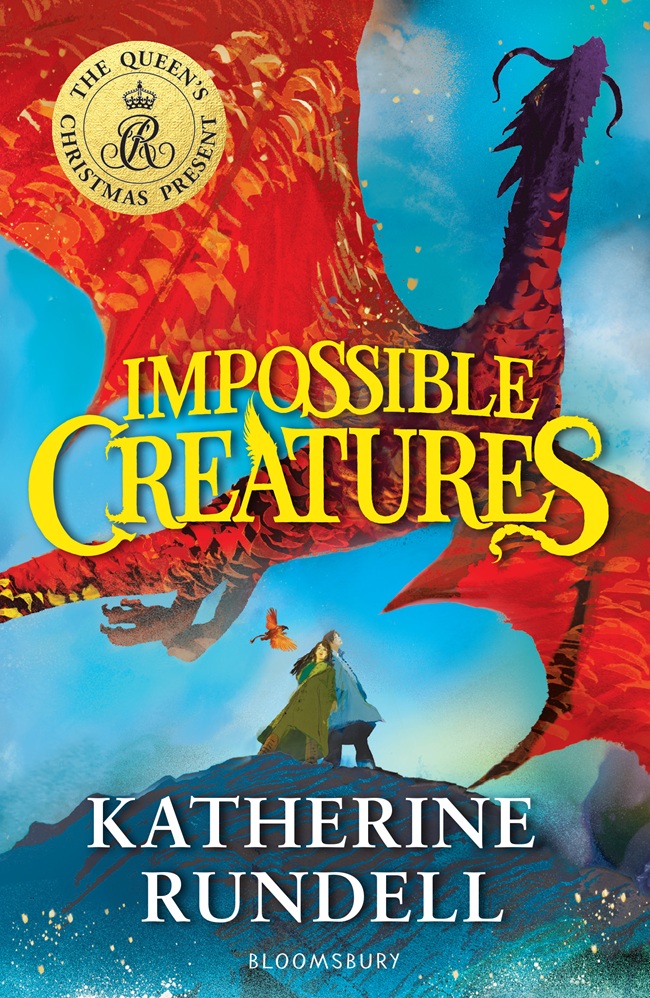 On July 17th 2026, educational charity the National Literacy Trust (NLT) announced an initiative entitled ‘The Queen’s Christmas Present’. We learned that all Year 6 and P6 children in the UK will be gifted a copy of Katherine Rundell’s Impossible Creatures. The 800,000 books, we were told, were a gift from Queen Camilla. Each book will feature a unique royal stamp on the cover and a message from Camilla. In an Instagram post, Rundell spoke excitedly about how this initiative will mean that every single child in the country will have something in common, her book.
What emerges through the details of this project is a particular vision of Britishness. But this book, rather like Christmas and The British Monarchy, will not be everyone’s cup of tea. Certainly, the announcement has not been met with universal approval. Waterstones Children’s Laureate Patrice Lawrence offered her view, ‘I would have loved this book as 10-year-old, but I was a confident and prolific reader. However, I would have been in the minority in my class, because ten-year-olds have widely diverse tastes, including some who don’t enjoy books at all. A comic book would have been a wonderful gift, with a mixture of contributors and different elements – comic strips, quizzes, longer form prose, a participatory element. Something to engage all children.’ Michael Rosen, former Children’s Laureate and professor of children’s literature captured the spirit of many online responses from writers, librarians and teachers when saying, ‘Free books for all Year 6s? Great! Only one title? Why? How? Surely, reading for pleasure is about choice, isn’t it?’
No further details about the decision-making process or the financial side of this initiative were shared. Was the decision made by Camilla herself? In response to a list of questions from me, Jonathan Douglas, NLT CEO, offered only that the Queen, Katherine Rundell’s publisher Bloomsbury and the National Literacy Trust ‘came together to build this initiative.’ We do not know if Rundell or her company The Katherine Rundell Story Studio Limited were involved in the financing of the project as details have not been released.*
Funding for production and distribution has come from unnamed ‘individual philanthropic donors and foundations.’ However public money, in the form of a special grant from the Department of Culture, Media and Sport will be used for ‘marketing and communications to support the outreach programme for schools and communities.’ Public funding to market an initiative based on a commercial product is not so rare, but should prompt questions. It will be for others to determine whether in this case there is any conflict of interest, given Katherine Rundell’s role as an Ambassador for the NLT. The Society of Authors is aware of members’ concerns regarding the details of the project.
The bigger question is how this initiative fits with the aims of the National Year of Reading which the NLT has been tasked with driving. The website for the National Year of Reading lays out a vision of reading that is centred on the agency of young readers and their freedom to make choices; ‘Centred on the message, “if you’re into it, read into it,” we position reading as a gateway to deepening existing interests.’ In stark contrast to this positioning, the gift to be bestowed on children is, we are told, one selected by ‘Her Majesty the Queen, the Queen of the United Kingdom of Great Britain and Northern Ireland, and of her other Realms and Territories, Head of the Commonwealth, Defender of the Faith’. When asked if this initiative was informed by research on volitional reading, Jonathan Douglas referred to research on the importance of book ownership. But curiously he also appeared to echo some of the criticisms of his organisation’s initiative, saying that, ‘evidence shows that giving children choice and access to books that match their interests is one of the most effective ways to encourage reading engagement.’
As many have pointed out, Impossible Creatures will not be of interest and indeed will not be accessible to all children. Former headteacher James Lumber of The Rebel Reading Society said, ‘As a headteacher I would’ve felt the need to invest in a book that all children could go home with that would ensure the excitement of book-giving was guaranteed and that no child in Year 6 felt deflated or disheartened by not being able to access Impossible Creatures.’ Irish Children’s Laureate Chris Haughton commented that ‘gifting a selection of books or a book token allows children to discover for themselves the book that is right for them. A choice makes it far more likely they will get a book they will enjoy. Not only that but they can then swap books amongst each other creating multiplier effects and discover yet more titles and authors. All this seems such basic common sense. It is baffling that this could have been accidentally overlooked.’
In response to the announcement and subsequent criticism, NLT trustee Jasmine Richards commented, ‘Personally, I think we missed a trick with not giving the gift of choice with the Queen’s gift but it does not undo the efforts of what has come before and during the National Year of Reading. Or what will come after.’
I am not alone in comparing this initiative to the infamous U2 / Apple collaboration of 2014. On September 9th 2014, 500 million users of Apple’s iTunes woke up to find the latest album by U2, Songs of Innocence, had been added to their computers. Slate magazine wrote that it was ‘extremely unsettling’ that ‘consent and interest are no longer a requisite for owning an album, only corporate prerogative.’ Lead singer Bono apologised, describing the move as ‘a drop of megalomania, a touch of generosity, a dash of self-promotion and deep fear that these songs that we poured our life into over the last few years mightn’t be heard.’
So, who might be negatively impacted by this initiative? Those children for whom the book is not a suitable gift might find themselves on the outside of the envisioned reading community that forms around Impossible Creatures. Teachers and Headteachers will no doubt feel the pressure to use curriculum time to help include them. While Jonathan Douglas confirmed that it is not compulsory for teachers to use the book as a class reader or include it on the curriculum there will be considerable coercive pressure to do so. The initiative might well interfere with teacher autonomy and expertise in terms of choosing the right book for their class. My personal view is that the National Literacy Trust itself may be most negatively impacted. Having offered sessions on inclusive libraries (sessions at which I have been paid to speak), it now suggests that inclusivity is merely a strand of work for the charity, rather than a value that informs key decisions. This might come as a shock for many who work with and for the charity. Having worked to broaden the view of what reading is and emphasised the agency of young people, this initiative appears to take us back to a view of reading as medicine, effectively communicating: ‘Here, take this. It’s good for you. I don’t care if you don’t like it.’ As Charlotte Hacking, Teacher Engagement Lead at the Helen Hamlyn Centre for Pedagogy, puts it, ‘Giving every child the same title risks missing the chance to connect some children with a book that could ignite a love of reading. It’s the right book reaching the right reader at the right time that can make all the difference.’
A second email from Jonathan Douglas informed me that the NLT would now be ‘putting together an advisory group of experts from across the industry to listen to concerns and help shape the project.’ This raises questions as to why experts within and beyond the NLT were not consulted at the outset. To help answer this question it is perhaps worth considering the main beneficiaries of the ‘The Queen’s Christmas Present’. Certainly, some children will benefit – those who do not yet own the international bestseller and find it to their liking. The book is being described as gift from The Queen yet it appears she is not contributing a penny. At a time of concern and questions about the Monarchy in relation to the welfare of young people, this project is good PR for the institution. The most obvious beneficiaries are Katherine Rundell and her publisher. Those who do enjoy the book might ask their parents to buy them the rest of the series. But book-sales are not the major money-spinner in play here. Last year Rundell signed a film deal with Disney for Impossible Creatures with plans to create a film franchise. If successful, this could generate the kind of money for Rundell that it did for another Bloomsbury children’s writer. Indeed, the cover of the third book in the series, bears a striking resemblance to Harry Potter and the Order of the Phoenix – surely no accident. We don’t know who is funding this initiative. We may never know. But we do know that Rundell is now backed by Disney money. One headteacher described the gift books as ‘big fat flyers for a film franchise. Can’t read the book we’ve all been talking about? Don’t worry, the movie will be out soon.’
We often talk about the power of reading. But as educators we should be equally attuned to the reading of power. And when the beneficiaries of an initiative announced without any sense of a consultation process are shown to be some of the most powerful institutions in the world, we have a moral duty to ask questions. It may be churlish to look a gift horse in the mouth. It is downright irresponsible to fail to investigate potential Trojan horses.
Darren Chetty is an academic and writer, specialising in children’s literature, antiracist education and philosophy for children. His book Beyond the Secret Garden: Racially Minoritised People in British Children’s Books (EMC 2025), co-authored with Karen Sands-O’Connor, draws on their long-running column for Books for Keeps.
This article was updated on 28 July at the request of the National Literacy Trust to clarify that the Queen, Katherine Rundell’s publisher Bloomsbury and The National Literacy Trust came together to build this initiative.
* Since publication of this piece, I have been informed by Bloomsbury via email that Katherine Rundell’s ‘own money is in no way involved here, she is not one of the private funders on the project, nor is her company in any way.’


 Dina Reaume