 Dina Reaume
Beautifully baffling: Greek Myths by Liv Albert
Author, podcaster, classicist Liv Albert explains the limitless appeal of Greek myths.
Mythology is one of those things that we consume all the time, without or without our knowledge, simply by existing in the Western world. Stories of ancient Greek gods and goddesses, mortals and monsters, continue to consume our imagination. Whether it’s stories of Hercules (Heracles, in Greek) and his labours, the ten-year-long Trojan War, or any of the countless stories of nymphs and gods, these myths and characters have lost none of their shine in the 3,000 or so years they’ve existed. Instead of losing relevance over time, myths have expanded. Different perspectives on old stories always bring about something new and, often, revolutionary.
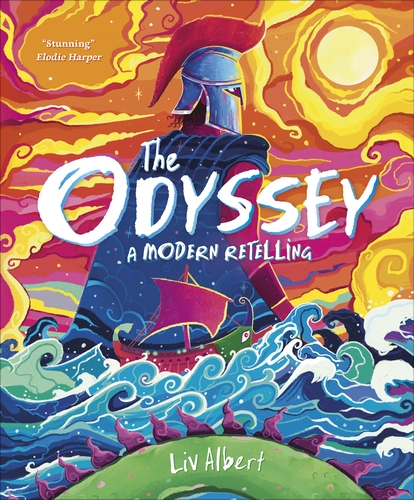 The oldest of these Greek myths remain the most relevant of all: Homer’s Iliad and Odyssey. Unlike most other myths which survive only in small fragments of text, or visual representations in art and pottery, these two stories survive as singular, complete, epic myths. Homer’s epics are my favourite texts from the ancient world for countless reasons, but the most obvious is the simple fact that they are complete, and so, very, ancient. These two poems come to us from sometime around the 8th century BCE, but historians believe that the stories themselves were much older. Epic poems like the Iliad and the Odyssey were sung by poet-bards across the ancient Mediterranean for centuries before they became the (somewhat) finalized versions we read today. Despite being literal millennia old, both of these poems could very well have been written in the last few hundred years, for all the relevance they still hold. The Iliad is the story of rage and the fragility of character, set alongside the horrors of war. The Odyssey, meanwhile, is the story of sea-faring adventure and the West’s first unreliable narrator. Odysseus is as loveable as he is detestable and that is what makes him so appealing to me as a writer and lover of myth. It’s easy to think of these hero characters as beacons of righteous good, but that’s not the reality nor is it what the ancient Greeks intended. Greek myths didn’t set out to tell stories of good people doing valiant things, they wanted to tell stories of humans being human, of people interacting with the world around them, from the natural to the divine. Myths are about understanding, problem solving, and a general exploration of the human condition. These are the elements I’m most passionate about, it’s not just accurate to view these stories as complex tales of human resilience, intelligence, and failures, but also far more beneficial to the world around us. Characters like Achilles and Odysseus may be labelled as ‘heroes’ but that doesn’t mean they were implicitly good or bad, they were intended to mirror humanity in their flaws and complexity. Modern interpretations have a habit of flattening that complexity in favour of traditional Man Saves World hero narratives; I find those to be as boring as they are inaccurate.
Similarly to the way we understand ‘heroes’ today, as modern readers we often expect ancient stories to be told in certain ways, or to have at least somewhat predictable details. But a concept as simple as a clear beginning, middle, and end was irrelevant to the people developing myths of the ancient world. Greek myths weren’t about conveying a coherent narrative, they were about exploring humanity and the natural world, something which doesn’t always have traditionally satisfying plot points.
Homer’s epics are (somewhat) exceptions to this, they certainly have narrative structures that resemble beginning-middle-end, but even these epics tend to surprise people who are only familiar with the modern ‘story’ of the Trojan War. The Odyssey may be my favourite, but it’s the Iliad that best describes my point here. That poem drops the reader straight into the middle of the action: the Trojan War has been going on for nine years and it’s only now that we, the audience, meet the rage of Achilles and all the comes from it (ie.,the entire Iliad poem). A twenty-four-book poem later and the plot points most people think of when they think of the Trojan War still haven’t happened. When the Iliad ends, Achilles is still alive and the Trojan Horse hasn’t even begun to be imagined. 3,000 years later our culture has a clear idea of how the story of the Trojan War ended – Achilles’ death-by-heel and the famed Trojan Horse – but these details are entirely reconstructed from stories written some thousand years after the Iliad and the Odyssey.
It’s this complexity, this lack of coherent structure, and other beautifully baffling elements of Greek myth that keep me so entirely consumed. These are not simple stories to be read once and understood fully, in fact with the exception of the Iliad and the Odyssey there are very few myths which can be read in their entirety, and even fewer for which ‘original versions’ exist. Instead, myth is about understanding the bigger picture, the culture that created the stories and why, and the wider implications for human understanding. Because of the fact that myth is infinite, that there is no ‘one true myth’, the things we can learn from myth, from ancient history to modern culture, are similarly limitless.
Liv Albert is the host, creator, and executive producer of the ancient history podcast, Let’s Talk About Myths, Baby! Liv studied English Literature and Classical Civilizations and has dedicated the last decade to understanding Greek mythology and the wider Ancient Mediterranean. Her book,
The Odyssey: A Modern Retelling by Liv Albert, illustrated by Hazem Asif, is published by DK, 978-0241790663, £18.99 hbk.


