
What Baby Books do Babies Really Look at?
By Taysa-Ja Newman & Professor Anna Franklin, The Sussex Baby Lab, University of Sussex.
New insights into colour, contrast and simplicity could reshape how we design and sell books for the youngest readers
Walk into any bookshop and the baby section offers a wide array of choices, from high-contrast black-and-white designs with simple shapes to softly coloured, intricately illustrated, heartwarming books. As adults, we choose books for babies based, not only on what we find visually appealing, but also on what we assume will appeal to babies. So, what books do babies really look at?
In our new research, published in the Journal of Experimental Child Psychology, we challenge some long-held assumptions about what makes a baby book visually engaging. We carried out the research in the Sussex Baby Lab at the University of Sussex, where we investigate how babies see, think and learn. We showed babies, between the ages of two and twelve months, pages from 100 board and picture books. The selection reflected the breadth of the baby book market, from classic, softly illustrated titles such as Guess How Much I Love You (Walker Books) to black-and-white, high-contrast books and brightly coloured, bold designs. We also included a few picture story books aimed at toddlers and preschoolers, to better understand the limits of what babies can engage with.
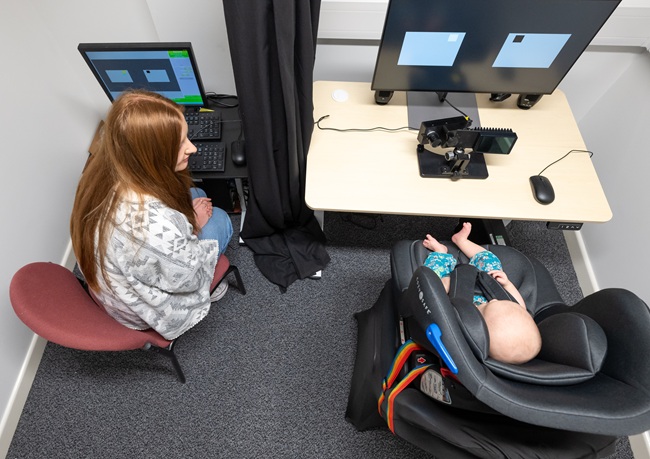
Taysa-Ja Newman, a doctoral researcher at the Sussex Baby Lab getting ready to record the eye-movements of a young baby in the Sussex Baby Lab.
Using an eye-tracking camera equipped with infra-red technology, we recorded how infants looked at each page. We measured how long babies’ gaze lingered, where it settled, and how their eyes moved across the images. These patterns allowed us to build a detailed picture of babies’ visual engagement: which images held attention, what features drew the eye, and how actively babies explored what they saw. To explore whether adult preferences align with those of infants, we also asked adults to rate how much they liked each of the book pages.
Surprisingly, we found that babies looked least at the books that adults liked the most. Whilst adults favoured books with softly illustrated, detailed and gentle illustrations, babies were least drawn to these. Babies of any age, even the youngest, also did not particularly favour the high contrast black and white books. Rather, the book illustrations which captured babies’ attention the most had intense and contrasting colours and had bold well-defined shapes and images.
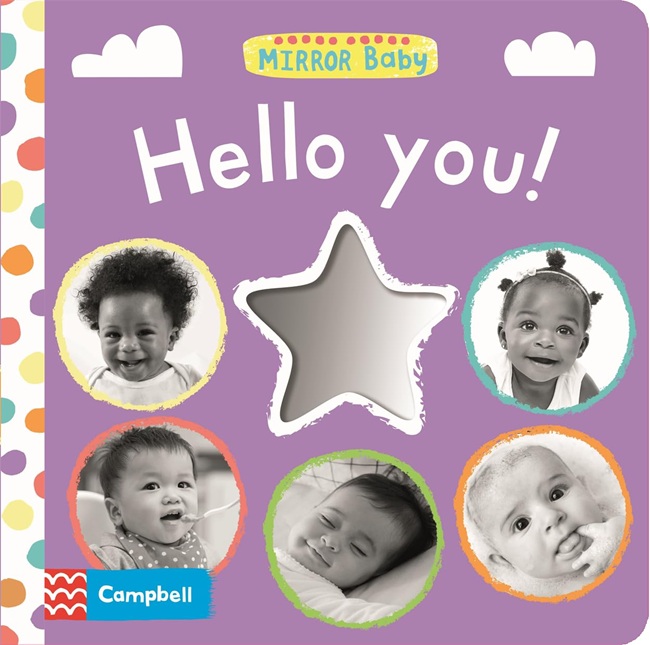
By analysing both the eye-tracking data and the visual properties of the images, we were able to identify more precisely what kinds of designs engage babies. As well as being colourful, the most engaging pages often featured large faces with clear, bold features. For example, pages from Who is Smiling (Minedition), Hello You! (Campbell), Look, Touch, Learn: Sky (Child’s Play (International) Ltd.), and All About Me! (DK), all included face-dominated images, and all appeared in babies’ ‘top 10’. Babies were also drawn to strong visual contrasts, such as the red and green striped hat in Look, Touch, Learn: Sky (Child’s Play Ltd), the bright yellow sun against a black background in Faces: A Black and White Baby Book (Ladybird), and the clearly defined, curved contours of the animals in Where’s Mr Penguin? (Nosy Crow).
The image below shows an eye-movement analysis of how babies look at a page from Look, Touch, Learn: Sky (Child’s Play (International) Ltd.): the ‘heat map’ on the right shows that babies look for the longest at the high contrast eyes and hat, but that babies also appear to be drawn to other facial features and snowflakes.
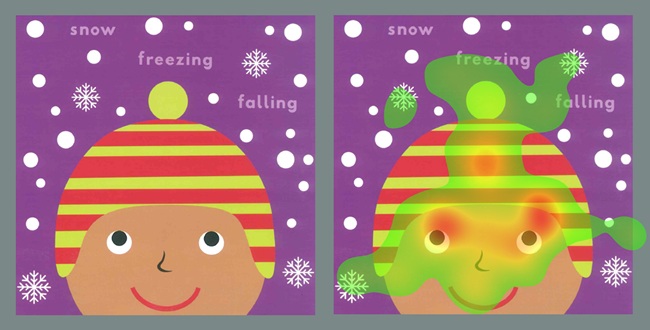
Results of an eye-tracking analysis of how babies look at a page from Look Touch Learn Sky © 2022 Child’s Play (International) Ltd. The page as shown to babies is on the left, the page with the eye-tracking ‘heat map’ is on the right. The lime green areas of the heat map show regions of the image that babies particularly look at, and the reddish areas of the heat map show the areas where babies look for the longest (e.g. the eyes and the hat).
The findings from our study which investigates how babies look at books are supported by our previous research on how babies’ vision develops. While it is often assumed that babies prefer black-and-white designs due to their immature vision, evidence shows that they can perceive a range of colours by around two to three months of age. In this context, black-and-white designs may quickly become too visually simple, whereas highly contrasting colour combinations, such as red and green, become engaging.
Our earlier work has also shown that babies tend to look longer at certain colours, including red, blue and purple, compared with others such as green, pink or brown. Notably, the books that featured in babies’ ‘top 10’ made strong use of these more visually engaging colours. Even when babies can perceive colour, it needs to be bold and saturated to be seen: softer, pastel palettes will appear muted or washed out. For example, the gentle tones of Guess How Much I Love You (Walker Books) are likely to appear as a washed out grey for most of the first year after birth.
While babies’ ability to perceive fine detail improves rapidly over the first six months, many of the books we tested contained levels of detail that are difficult for young infants to resolve. Using software developed at the Sussex Baby Lab, we simulated how these images appear at different stages of visual development. Our simulations show that baby vision is too blurred for babies to be able to make out the detailed and softer illustrations clearly. However, the eye-tracking data also showed that when colour, contrast and simplicity are well matched to infants’ visual abilities, even the youngest babies can engage meaningfully with images. With the right design, babies are able to focus on relevant features and actively explore what they see. This visual exploration of books by young babies, and the shared attention of babies and their caregivers, lays down the foundation for a childhood of book reading.
For those designing or choosing books for babies, our research helps sharpen what ‘appealing to babies’ really means. By focusing on bold colour, strong contrast and simplicity, we can better match books to babies’ visual abilities. Crucially, what engages babies does not always align with what adults find most appealing, reminding us to look beyond our own preferences when designing or choosing books for the youngest readers.
Taysa-Ja Newman is a PhD student in the School of Psychology at the University of Sussex, and her current research is investigating how infants respond to nature: https://www.linkedin.com/in/tj-newman/.
Professor Anna Franklin is co-lead of the Sussex Baby Lab and has been researching how babies see, think and learn for the last 25 years. She regularly consults on the design of products for babies, including books: email: anna.franklin@sussex.ac.uk; https://www.linkedin.com/in/anna-franklin-a30711201/


