
Picture This Seeing the Wood and the Trees
If you were to set out to illustrate a tree, how would you go about it? From March to May alone my #NewIllustrationoftheDay on Bluesky and Instagram has shown an image from all of the following twenty-six illustrators answering that question in their own way: Quentin Blake, Thomas Doherty, Elin Manon, Pepe Smit, X Fang, Julien Arnal, Ian de Haes, Sophie Pluim, Robert Sae-Heng, Kevin Howdeshell, Anthony Browne, Beatrice Alemagna, Polly Dunbar, Emma Chichester Clark, Jiu’er, Tiphanie Beeke, Richard Jones, Neil Clark, Gill Smith, Ryo Takemasa, Natalia Shaloshvili, Aysha Tengiz, Fiona Lumbers, Britta Teckentrup, and Ruth Brown.
Between them their answers have included, for instance, a simple green triangle (Lumbers), runny blots of watercolour (Beeke and Pluim), a rhythmic tracery of branches (Dunbar, Manon, de Haes), childlike symbols (Saloshvili), succinct observation (Blake, Smith), minimal suggestion (Smit, Arnal), flat graphic representations (Neil Clark, Takemasa, Sae-Heng, Tengiz) and celebrations of pattern and colour or light (Jones, Teckentrup) … And even within these categories the techniques are various.
We also know that trees lend themselves to so many styles of representation, including the Gothic, the Romantic, the Impressionistic (picture a Rackham forest, a Boucher pastoral, Monet blossom …). The way we see and depict trees is full of possibilities, so I have chosen to consider in this piece the approach and skill of three artists from the list above.
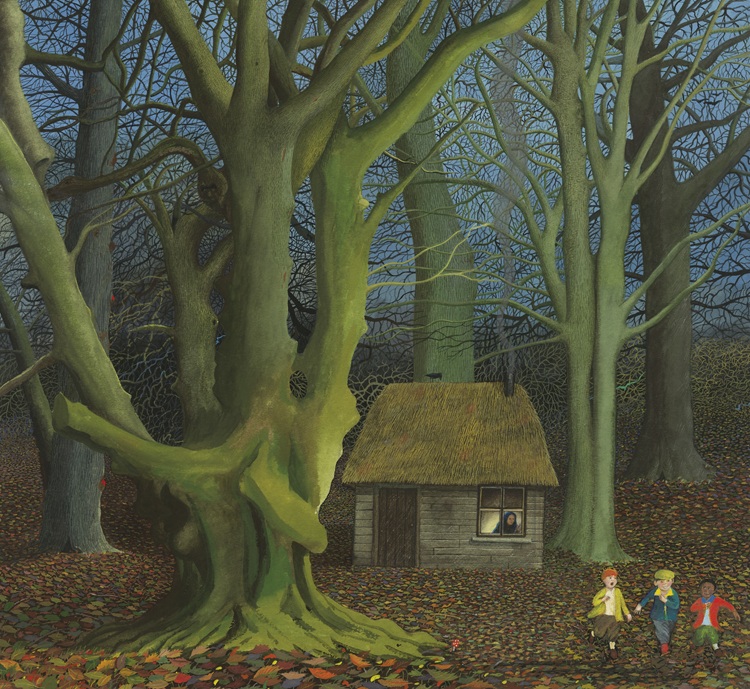 First, Anthony Browne, with an image from his Once Upon A Time in the Woods (Puffin). It is an example of his extraordinary miniaturist talent, depicting not only the trunks of trees, but also the tiniest branches, making a filigree pattern against the darkening sky, as if to miss one tiny twig would be a betrayal. In the same way he scrupulously records every fallen leaf on the ground, and every piece of straw in the thatched roof of the cottage. This is a kind of extreme realism, a visual metaphor for anxious overthinking. And yet despite its diligent exactitude, it also has a fantastical quality, in the way the trees bunch together, like standing figures with their arms aloft or around each other, and in the eerie greenish light on their textured bark.
There is also the typically Browne-esque hint of other shapes: a snake-like branch, or the slight suggestion of faces in the wood – a feature more explicit in other pages of this book. It is characteristic wizardry that Browne can make a scene seem both hyper-real and gothic at the same time. And his minutely observed trees also make a pattern which is decorative and therefore simultaneously fanciful. All of which fits a story that has a fairy tale setting – ‘Once upon a time in the days when wolves roamed the land’ – and also feels up-to-date in its theme of misplaced suspicion of outsiders.
My second choice is a spread by Ruth Brown from her Tick Tock Around the Clock (Scallywag Press) which tells the story of a day in the life of a cat. In this image the trees are only part of a beautifully composed and beautifully drawn image, which focuses attention in several other directions: on the tabby coming through the cat flap, who is watching the dog at the gate pulling away from its owner, and apparently startling both the squirrels in one background tree and the birds in the other. With one tree inside and one outside the garden, together they help to give the picture its depth, and to unite the garden with the world beyond.
These trees, like the animals and the plants and the stones in the wall and the wooden planks of the door and the shed, are not recorded 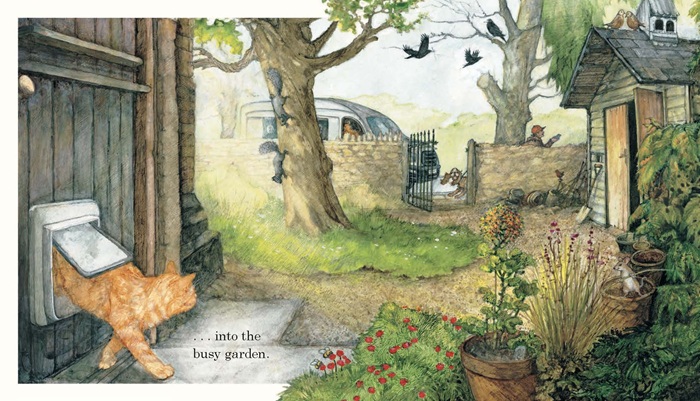 so obsessively as Browne’s but they are unquestionably observed. The colours of trunk and foliage are allowed to suggest the way the light falls and the fact of bark and leaves, without taking a microscope to them. And yet we trust the truth of the way they look.
My painter father used to say that the problem about landscapes was that it was easier to cheat with them than with other genres, when it came to draughtsmanship. If you drew a face or a figure or a creature or an object inaccurately, it was immediately obvious that it was wrong. But you can fudge distant woods or fields and nobody can tell that the drawing is faulty. Brown’s great strength is that we believe her drawing is faultless, even with an object as impossible to judge as the canopy of a tree.
There is also some hard-to-define quality of the drawing of these trees that is friendly. The branches seem to offer themselves up, to wave cheerily, or invite an embrace, leaning amiably towards us. These trees are not sinister, nor gothic nor mysterious, and they do not harbour strange faces. Instead they are happy, approachable refuges for lively, unintimidating creatures.
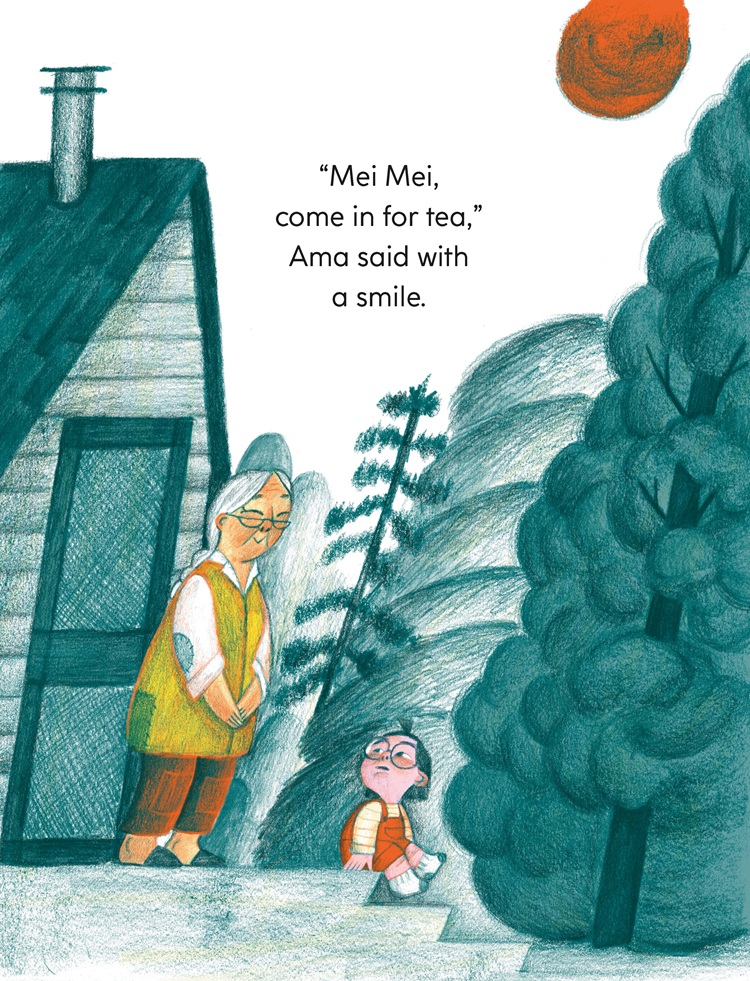
My third tree picture demonstrates yet another way in which representations of trees can express emotion. Browne’s were mysterious and a bit frightening. Brown’s were kindly and reassuring. In this page from US-based author X Fang’s picturebook Broken (Pushkin Children’s), something different is going on.
This picturebook is the story of a child who breaks her grandmother’s favourite cup and blames it on the cat. The guilt is too much, she confesses, the cup is mended and she is forgiven. In this image she still carries her guilty secret. All the background of this picture (but for a red sun) is in one colour: green. Dark, vigorous, slanting strokes create with pencil crayon the entrance to grandma’s house and an array of trees, which are slanting themselves.
Here the trees are not so much observed objects as an expression of Mei Mei’s own state of mind. Their lean makes everything feel unstable. The stylisation reduces them to menacing objects, variously sharp, towering and blobby. They lour, menacing and large, like Mei Mei’s worries. They are deliberately ill-defined, as if the anxious child perceives their general but not their specific shape: you could not identify the species on an app. In the midst of this pathetic fallacy, Mei Mei sits precariously on a step, she and her grandmother in colours that stand out against the black-green trees, as their relationship is the focal point of the story and of Mei Mei’s thoughts.
Trees are often used by illustrators to make decorative patterns, in unquantifiable different ways. They may also look quite unlike the trees outside your window, while still being ‘readable’ as vegetation. Consider, say, David McKee’s jungle in the Elmer books (itself indebted to Henri Rousseau), or Chris Haughton’s psychedelic trees in almost any of his books.
But it turns out trees also lend themselves to the creation of mood. There are so many ways to depict them, but next time you look at trees in an illustration, or embark on making one, think about the feeling they communicate and how much of the work of the narrative they are doing.
No wonder woods are so often a setting for stories.
Nicolette Jones writes about children’s books for the Sunday Times and is the author of The Illustrators: Raymond Briggs (Thames & Hudson); The American Art Tapes: Voices of Twentieth Century Art (Tate Publishing) and Inspire Me! (Nosy Crow), illustrated by Axel Scheffler.
Books mentioned:
Once Upon A Time in the Woods, Anthony Browne, 978-0241710449, Puffin
Tick Tock Around the Clock, Ruth Brown, 978-1836300410, Scallywag Press
Broken, X Fang, 978-1774882009, Pushkin Children’s Books


