Picture This Widening the Net
In her latest of her columns on illustration, Nicolette Jones looks at picturebooks that invite all readers in.
It’s always hard to resist picturebooks about books, and particularly in this National Year of Reading it seems pertinent to look more closely at how illustrators are helping to make readers. It is obvious that all picturebooks are a stepping stone to reading, but I particularly appreciated three picturebooks featured in #NewIllustrationoftheDay on BlueSky and Instagram in recent months which made a point of widening the net.
The first example is from the winner of this year’s Carnegie Medal: Kate Rolfe’s Wiggling Words (Two Hoots) which acknowledges that for some children, reading is a very hard mountain to climb.
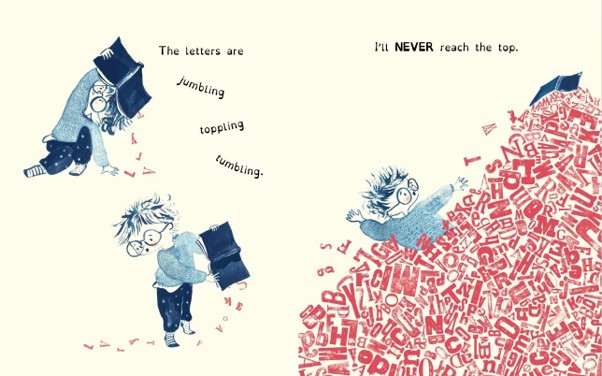 Created by a dyslexic artist, it is notable for making use of two unusual techniques. One is perfectly placed letterpress, with old woodblocks, printed by hand and employing the varied textures of degrees of coverage of red ink. The other is cyanotype, blue printing made with sunlight, to represent the child. The two elements contrast: the red reminiscent of bricks, capturing the feeling for some that reading is like an impenetrable wall of words, while the cyanotype suggests an airy fragility in the character, whose gestures and stance are also expressively off-balance, in a way that is both humorous and vulnerable.
Rolfe has used the phrase ‘visual poetry’ about her work, and certainly much of its power comes from the fact that it operates like concrete poetry. The pile of letters becomes a visual obstacle and loose letters tumble from books as if they, like their meanings, are hard to grasp. The black lettering, too, recalls typewritten text, and so offers the adult who reads to a child the nostalgia of a remembered typeface from the early days of their own reading.
The book is also notable for the number of prizes it has already won. It was Highly Commended for the Macmillan Prize in 2022, and in the same year Runner Up for the Batsford Prize, winner of Student Illustrator of the Year in the V&A Illustration Awards, and New Talent in Children’s Publishing in the World Illustration Awards, winning its category of the same prize in 2024. It also won the Communication Arts Illustration Award in 2026. (I would like to give the artist another special award: for her outfit at the Carnegie ceremony. Her dungarees were covered with the same letterpress printing as appears in the book.)
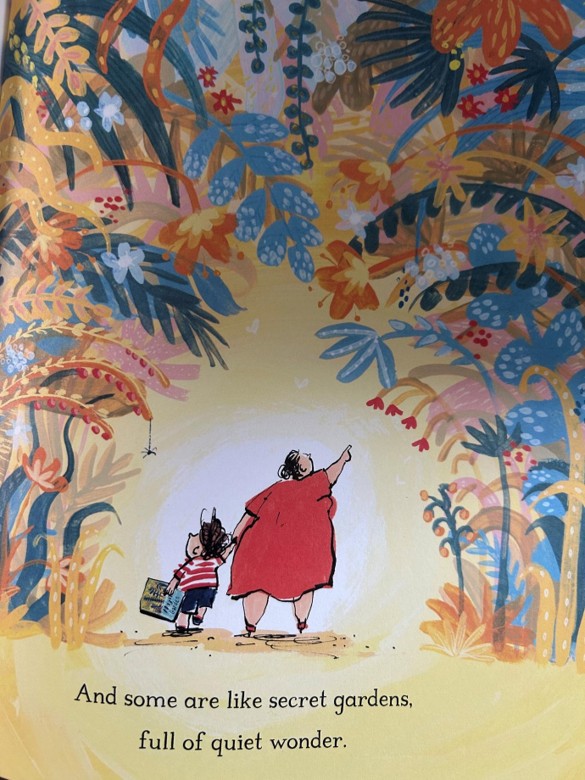
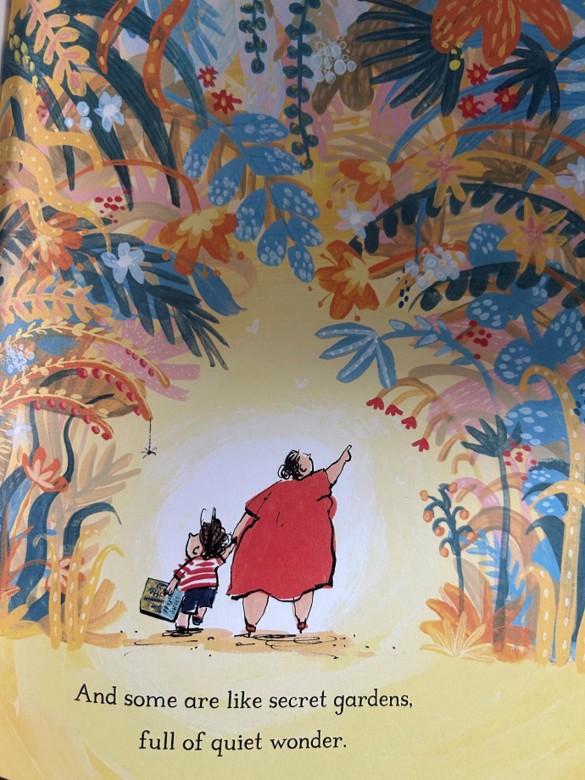 The second illustration is also from a book that tries to overcome a block about reading. By Elina Ellis, from The Truth About Books: A Celebration of the Magic of Reading (again from Two Hoots), it is a response to a boy who asks ‘What’s the big deal about books?’, and offers various visual metaphors in different styles to express the positive things people feel about reading.
The loose inky line is one of my favourite features of this picture. It helps to convey the enthusiasm of the grandmother and how the child is being literally and metaphorically swept along by her. I like, too, the fact that Granny, who may be a keen gardener, is gesturing excitedly at the plants while what happens to grab the boy’s attention is a spider. It demonstrates that all readers can find the details that interest them most in a book, and one person’s enjoyment may be attributable to quite different reasons than another’s.
The flowery garden is extravagant and fantastical, too, reminding us that this is a picture of something imagined, created in the mind by the words on the page. But the quiet wonder, we assume, is in granny’s mind – and these are perhaps her favourite colours, in the kind of pattern she might choose to decorate her house with. It recalls chintz sofa covers more than a deep dark rainforest. So it tells us that the images we conjure when we hear stories are the ones we want to see. Books, this picture says, are all magically tailor-made for every individual reader.
My third choice of a reading-themed image is a lovely bedtime story scene from My Dad Can (Frances Lincoln/Quarto) by Claire Sahara Lemp, illustrating text by Stephen Lightbown. In the wake of Frank Cottrell-Boyce’s final lecture as Children’s Laureate, which stressed the value of bedtime reading (for those lucky enough to have a bed) this seems to me a timely expression of the warmth and togetherness it engenders.
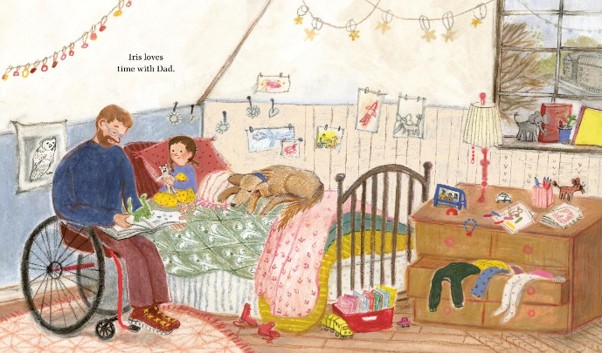 All hand-made in paint and crayon, with bright colours and a childlike style, as well as a sloping roof and fairy lights, this illustration creates a happy place where a child belongs. The theme of the book is not only what the father, a wheelchair user, is capable of, but also what his imagination can do. Books, we understand, have no limitations. And nor does a father’s love for his child.
The child’s drawings, the toys and the crayons demonstrate, in the context of the whole book, how stories can feed into a child’s creativity, and also how familiar objects can take on a new life when touched by the magic of stories. Even with a book about dinosaurs, an adult reading to a child makes a safe space. And just in case there isn’t enough cosiness in this picture, there is a sleeping dog of a particularly cuddlesome kind.
This is a book that corrects misapprehensions about disability, but it also makes it clear that reading is not only for everyone but ties carers and children together. The wheelchair implies that it is about physical differences, but above all, it is a story about books as the means by which we can cultivate mental health – in all members of our families.
Nicolette Jones writes about children’s books for the Sunday Times and is the author of The Illustrators: Raymond Briggs (Thames & Hudson); The American Art Tapes: Voices of Twentieth Century Art (Tate Publishing) and Inspire Me! (Nosy Crow), illustrated by Axel Scheffler.
Books mentioned:
Wiggling Words, Kate Rolfe, Two Hoots, 9781035019717, 32pp, £12.99 hbk.
The Truth About Books: A Celebration of the Magic of Reading, Elina Ellis, Two Hoots, 9781037408502, 32pp, £8.99 pbk.
My Dad Can, Stephen Lightbown, illus. Claire Sahara Lemp, Frances Lincoln, 9781836008859, 44pp, £7.99 pbk.


