This article is in the Letterbox Library Recommends Category
Letterbox Library Recommends We Are Family
In our new column, Letterbox Library recommends books that celebrate equality, diversity and inclusion. Their theme here, the representation of LGBTQ+ family members, who aren’t the parents.
The earliest representations of any minoritised group often conform to a single type, whether as a result of creatives presuming what will best stand a chance of getting published, or publishers prescribing the boundaries of representations.
UK LGBTQ+ picture book representations have tended to favour a two dads/two mums trope. This makes sense. After all, many children’s first knowing encounter with LGBTQ+ people will be their own or their peer’s parents and it remains urgent that these family units are recognised and affirmed.
The difficulty comes only with the limitations of this model. Picture books are rich with extended family members but these portrayals have a heterosexual resolve. Some will argue that their sexuality isn’t asserted but this belies the fact that adult characters in children’s books very often make heterosexual declarations whether through linked arms/handholds with the opposite sex, wedding ceremonies, a background couple portrait, a text’s ‘Mr&Mrs’. Endemic cultural heterosexism also ensures that, in the absence of any evidence to the contrary, characters simply are heterosexual. Which means that to figure as queer in picture books you must not just be visible, you need to double down in order to be seen at all.
Because heterosexuality is so culturally conspicuous, two recent picture books which do represent beyond the LGBTQ+-as-parents mould, but do so through indirect referencing, end up struggling to represent it at all. How many readers of Great-Aunt Margot and Me will guess at Margot’s identity when the two portraits of her with another woman are smuggled into the endpapers, the only other clue being a rainbow flag and badge on the side of a background display case? Likewise, will a reader attribute anything to Grandma’s rainbow bead necklace in Finn’s 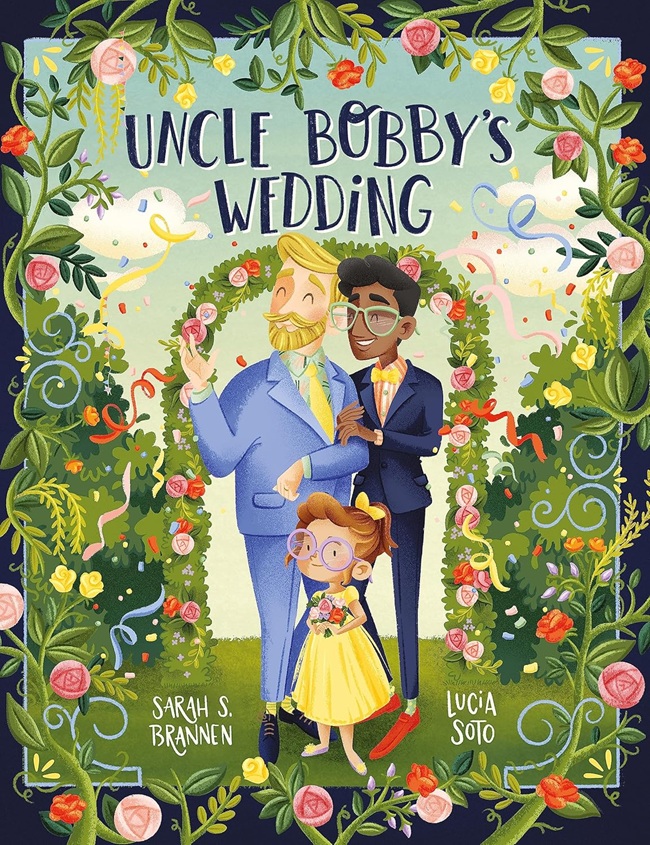 Little Fibs, thinly supported by a single sitting room portrait of Grandma framed with another woman?
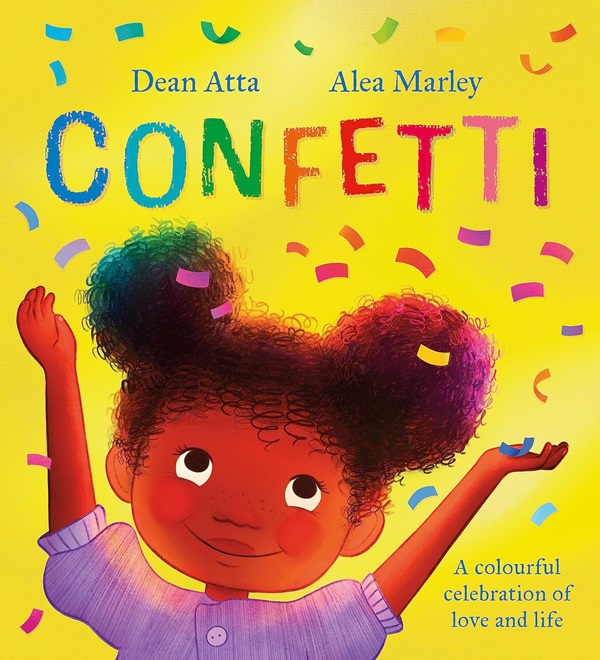 Thankfully these blink-and-you’ll-miss-them queer relatives have been joined in very recent years by a handful of rather more transparent characters who also star beyond children’s immediate families. Gay uncles flourish in Our Big Day and Confetti – interestingly, both through the prism of a wedding ceremony, an out and out proud celebration of romantic love. Also of note is Uncle Bobby’s Wedding which recasts its original 2008 gay male guinea pigs as humans. [As a side note, all of these couples, like their LGBTQ+ parents counterparts, are interracial white/PoC]. Meantime, picture book series character Lulu’s family has grown to include top babysitting couple, Auntie Zari and Auntie Jina [both Black women].
Perhaps most joyfully of all, picture books have just introduced our very first queer elders in the form of grandparents [again, in white/PoC couples]- publishers, please take your cue! This arrival has felt revolutionary on several counts. Firstly, ageism associates our elders with conventionality and, while of course it shouldn’t, this presumes ‘traditional’ hetero. relationships. Secondly it counters popular culture’s overwhelming preference for ageing LGBTQ+ people as a 20-something population. Finally, it refutes the idea that publicly declared or ‘out’ queer identities are a singularly modern phenomenon.
The domestic comfiness of the couple in The Glamorous Grandmas suggests two women who have been together for the longest time. Grandchild Archie says of his handholding Grandma and Nana, ‘When they walked through town, he’d catch people staring or whispering.’ However, in Jodie Lancet-Grant’s trademark upending of where nonconformity resides across her picture books, the grandmas’ subversion 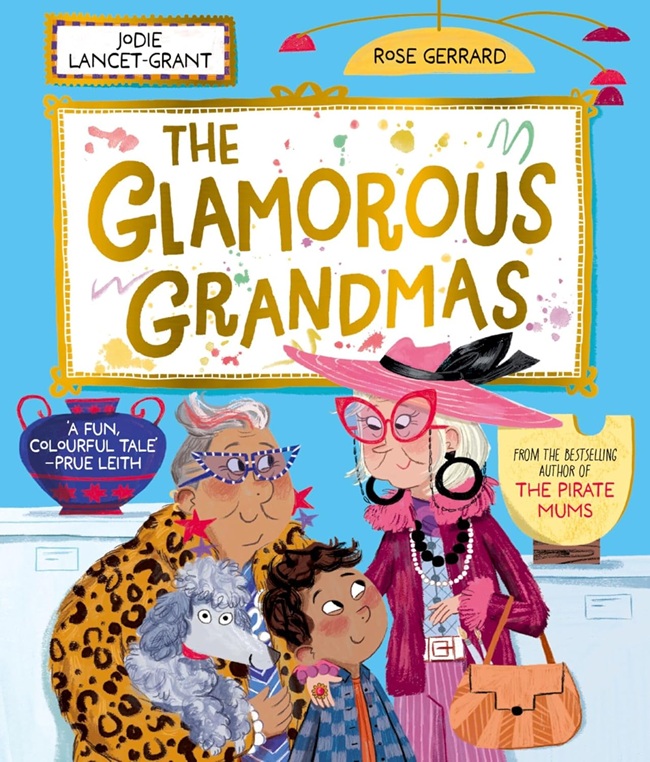 isn’t their public ‘outness’ but rather their ultra flamboyant dress sense and, later, their criminal activity when they break in to a drab gallery space in order to flood it with modern works of art. These loudly-dressed nanas take up and interrupt public spaces.
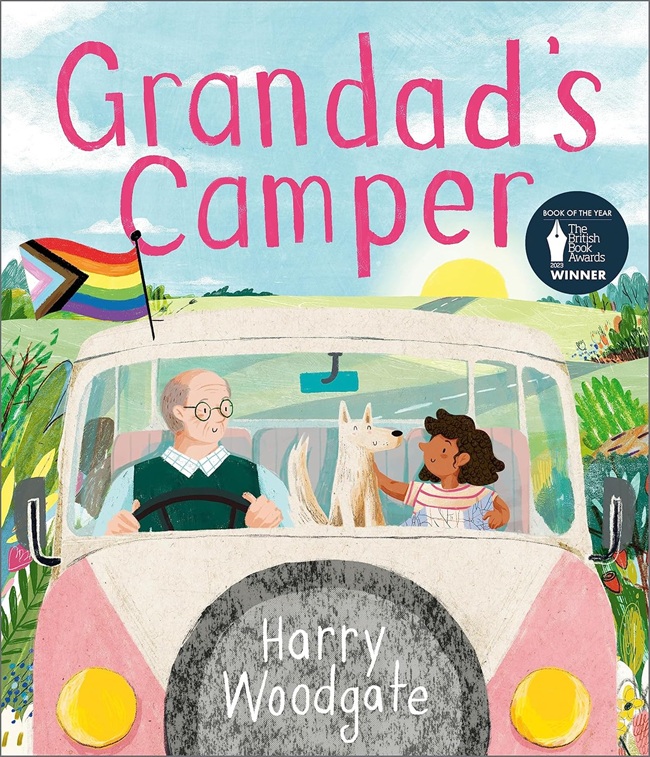
Meantime, Harry Woodgate, inspired by his MA dissertation subject, has an especially strong commitment to portraying LGBTQ+ elders. 2023 Nibbies and Waterstones’ winner, Grandad’s Camper stars a beloved Grandad whose grief at the loss of his long-term partner is relieved by sharing precious memories with his grandchild of his camper van adventures with Gramps. The book’s scatterings of queer iconography and its panels which flash back to tender scenes of Grandpa and Gramps together are all lit up by Woodgate’s confetti-bright, light-soaked palette. Grandad’s Pride extends this overtness thematically and, here, Woodgate uses the character of Grandad to reflect back on a long history of LGBTQ+ activism and protest illustrated as flamboyant panoramas of Pride parades and marches. Queer visibility has rarely been so bold- nor so gorgeous on the eye.
Est. 1983, Letterbox Library is an online children’s bookseller specialising in diverse, inclusive and social justice themed children’s books.
Books mentioned, all available from Letterbox Library:
Our Big Day, Bob Johnston & Michael Emberley (The O’Brien Press, 2022)
Confetti, Dean Atta & Alea Marley (Orchard Books, 2024)
The Big Day, Rachel Plummer and Forrest Burdett (Little Tiger, 2024)
Uncle Bobby’s Wedding, Sarah Brannen (Author), Lucía Soto (Hodder Children’s Books, 2021)
Lulu’s Sleepover, Anna McQuinn & Rosalind Beardshaw (Alanna Max, 2021)
The Glamorous Grandmas, Jodie Lancet-Grant & Rose Gerrard (Oxford University Press, 2026)
Grandad’s Camper, Harry Woodgate (Andersen Press, 2021)
Grandad’s Pride, Harry Woodgate (Andersen Press, 2023)


