
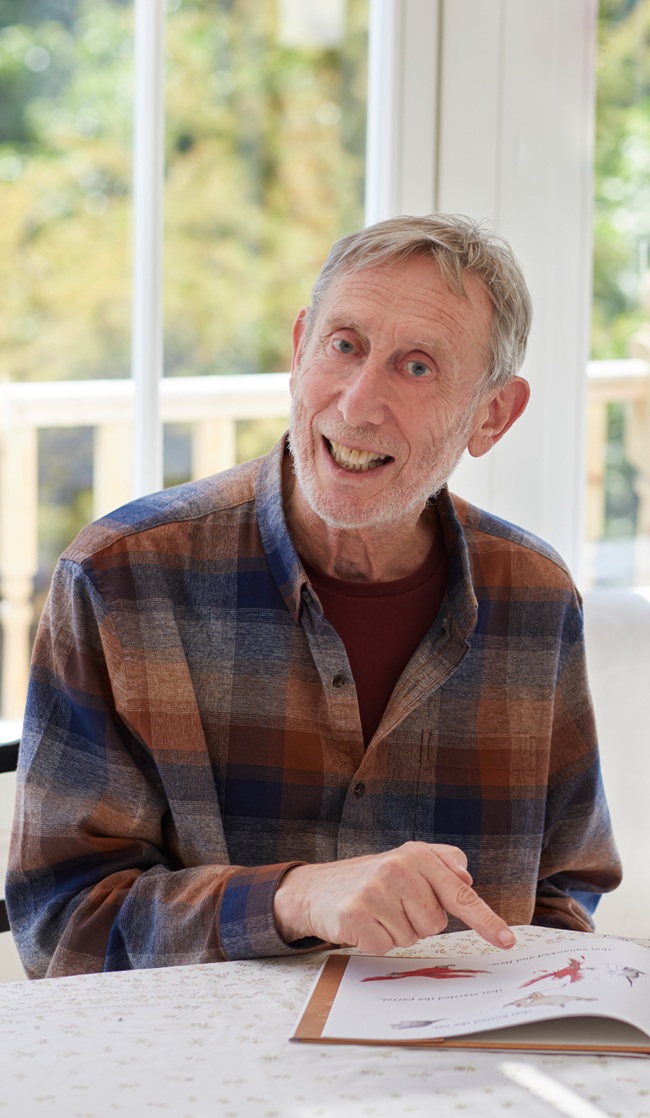
Michael Rosen at 80
Charlotte Hacking interviews Michael Rosen on five decades plus of talking and listening to children.
Few writers have shaped the landscape of children’s literature in Britain as profoundly as Michael Rosen. Poet, performer, broadcaster, former Children’s Laureate and the latest recipient of the Hans Christian Andersen Award for Writing, his work has, for more than five decades, bridged the gap between the spoken and the written word, inviting children not just to read, but to listen, join in, and make stories their own. As he reaches his eightieth birthday, reflecting on that body of work reveals a career rooted not in a single breakthrough, but in a set of enduring influences; most notably, family, performance, and an unwavering attention to the language of children themselves.
 Rosen begins, as he often does, with his upbringing. His parents, both teachers, and his older brother created what he describes as an environment so saturated with language that it is impossible to disentangle from his writing. ‘I can’t separate it from me. It’s in me,’ he says. His mother’s work on children’s speech and writing, later published as The Language of Primary School Children (1974) placed real voices at the centre of education, while his father took on the role of literary guide at home, introducing him to close reading through Understanding Poetry (Brooks and Warren, 1938). Yet it is not simply formal education that left its mark, but the atmosphere itself: a household alive with poetry, parody, storytelling and song.
‘You didn’t know what was hitting you,’ Rosen recalls. Shakespeare might be quoted mid-task, a French song sung in passing, a joke spun into an elaborate performance. His father made up songs and rhymes; his brother, a gifted mimic, performed comic cameos of teachers and acquaintances that left Rosen ‘weeping with laughter.’ These experiences were not incidental. They formed the bedrock of his understanding of language as something dynamic, embodied and shared.
This understanding deepened in his early professional life, particularly during his time working on the BBC children’s programme Play School. As a trainee director, Rosen observed performers such as Johnny Ball and Floella Benjamin bringing songs and poems to life for young audiences. ‘It was quite wonderful to watch the way they did that,’ he says, noting how performance could transform even the simplest material into something compelling. It was here that he saw, in practice, how rhythm, gesture and voice could connect with children; lessons that would stay with him throughout his career.
Another crucial influence came from the poets he encountered beyond mainstream British literary culture, particularly Caribbean writers and performers such as John Agard, Grace Nichols, James Berry and Benjamin Zephaniah. Their work, Rosen explains, demonstrated the power of poetry as something physical and immediate. ‘Seeing the way they embodied poetry in their bodies, I learned a lot from them,’ he says. Alongside this, figures like Louise Bennett showed him how storytelling, rhyme and audience participation could merge seamlessly. These influences reinforced his sense that poetry belongs as much to performance as to print.
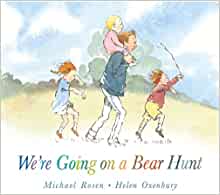
From these combined experiences Rosen’s writing emerges as something inherently oral in origin, even when it appears on the page. This is perhaps most evident in We’re Going on a Bear Hunt, a book that began life as a performed piece. Drawing on a traditional camp song, Rosen developed his own version in front of audiences before being encouraged by Walker Books publisher David Lloyd to write it down. The transition, he admits, was not straightforward: ‘my oral version didn’t work on paper,’ because in performance he relied on sounds rather than words.
Translating the sounds he made for swishing grass and squelching mud into onomatopoeic text was only part of the process. The story had to be expanded, structured, and reshaped for the picture book form. The defining transformation came through the illustrations by Helen Oxenbury. Rosen initially saw the piece as ‘a rollicking party piece,’ but Oxenbury introduced the beauty of the landscape, which Rosen compares to ‘an Impressionist painting,’ as well as adding tension, atmosphere and ambiguity: a family driven forward through uncertain terrain, a baby whose vulnerability matters, a dog who confronts the bear, and, most strikingly, a bear who is not easily defined.
The lasting image of the bear wandering alone on the shore was all down to Oxenbury but is loved by Rosen for its ‘defeated hero’ quality, reminiscent of Norse Myths. Children, Rosen notes, frequently tune into this image and ask what the bear is thinking. His answer is disarmingly simple: ‘I don’t know… they have as good an idea as me.’ It is a response that reflects his broader philosophy: that meaning in a book is not fixed by the author but created in the interaction between text, image and reader.
If Bear Hunt exemplifies Rosen’s playful, performative side, then Michael Rosen’s Sad Book reveals the depth of his emotional  range. Created with Quentin Blake, the book confronts grief directly, resisting the temptation to offer neat resolutions, instead acknowledging the persistence and unpredictability of loss. Written after the death of his son, Eddie, it presents sadness as something that cannot be tidied away. Instead, it comes and goes, often unexpectedly, embedded in everyday life.
For Rosen, writing the book was both a creative and a personal process. Faced with overwhelming emotion, writing allowed him to shape and examine his thoughts: ‘there’s a release element in it… and then when it’s there on the page, you can contemplate it.’ Crucially, he measures the success of that process through authenticity. ‘Is this authentic to the feeling I had?’ becomes the guiding question and one that ensures the work resonates with readers across ages. He addresses the way writing has supported his experience of life and loss, including his own experience of contracting COVID, with a candour that is both striking and deeply considered. Writing, he suggests, provides a way of imposing a kind of order on emotional experience – not a definitive explanation, but a structure through which feelings can be explored and understood. ‘You’re dealing with your thoughts and feelings as if it’s plasticine,’ he says, describing the process of shaping and reshaping emotion through language.
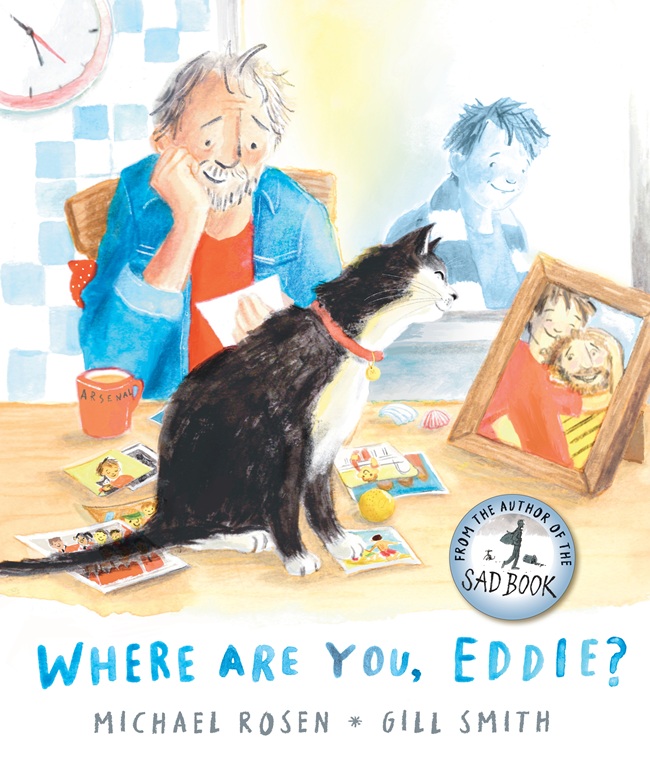 His latest book, Where Are You, Eddie? reflects on the longer-term experience of loss and grapples with how to answer a question often posed by children: where is the person who has died? Rejecting conventional metaphors of heaven or stars, he arrives at a more grounded idea; that people live on in memory, in stories, and in the lives of others. Encounters with people who remembered his son, including a Teaching Assistant he met on a visit to a primary school helped shape his thinking. In sharing a class photo and anecdotes about his son, she showed him that, ‘She owned Eddie,’ along with others he met whose lives Eddie had touched, enabling him to recognise that memory is shared and lives on through the stories of others.
In the book, this idea is explored through the figure of a talking cat, Meg. The use of this folkloric figure allows Rosen to introduce a sense of wonder while remaining grounded in emotional truth. The result is a book that offers readers a way of thinking about loss that is both accessible and deeply considered.
While these works have brought particular attention to Rosen’s writing, they sit within a much broader and more varied output. Early collections such as Mind Your Own Business established the voice that would become his hallmark: humorous, observant, and rooted in everyday experience. His collaboration with Quentin Blake on this book exemplifies the dynamic relationship between text and image that Rosen would come to value so highly. He recalls performing poems while Blake sketched, creating images that not only reflected but extended the meaning of the words.
Rosen has also engaged with explicitly historical and political themes, particularly in relation to the Holocaust and migration, distinctly 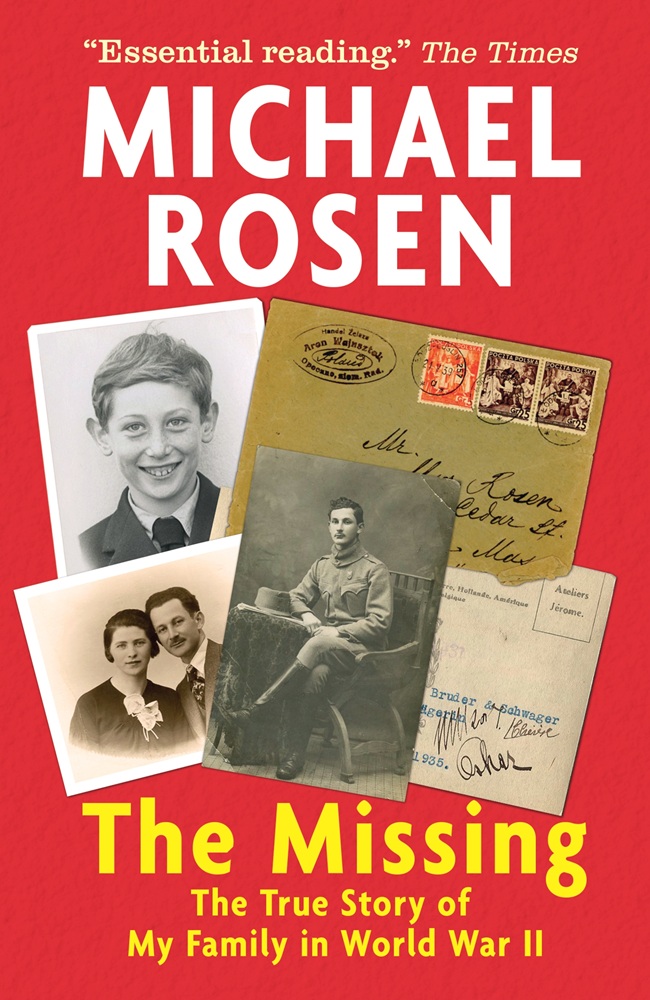 relating to family experience. Books such as The Missing, On the Move, Please Write Soon, and One Day demonstrate his ability to find the right forms, including memoir, poetry, letters and narrative, to make these subjects accessible without diminishing their seriousness. Rather than presenting history as distant or abstract, Rosen brings it into the realm of personal experience, allowing young readers to engage with it on an emotional as well as informational level.
 What unites these diverse books is a consistent respect for the reader. Rosen does not write down to children, nor does he assume that difficult subjects must be simplified. Instead, he trusts his audience to engage, interpret, and respond in their own ways. This trust extends to his understanding of how books are experienced. He is particularly interested in the relationship between oral and written language, and in the ways in which performance can enhance reading. His own practice in reading aloud, encouraging participation and inviting repetition, reflects a belief that books are not static objects but part of a shared, social experience.
As he reflects on his career at eighty, Rosen resists any grand summation. Instead, there is a continuing curiosity about language, performance and the ways in which stories are told and retold. If there is a unifying thread, it is perhaps this: a commitment to the idea that words, whether spoken or written, are not static objects but living, shifting forms of connection.
And in that sense, Michael Rosen’s work, like the voices that shaped him, continues to speak, echo, and invite response from each new generation that encounters it.
Charlotte Hacking is the Teacher Engagement Lead at the Helen Hamlyn Centre for Pedagogy at UCL and the Research and Curriculum Lead and Teacher at Herne Hill School. She is also a children’s poetry editor on titles including The First Year and The Final Year by Matt Goodfellow and The Poetry World of John Agard.
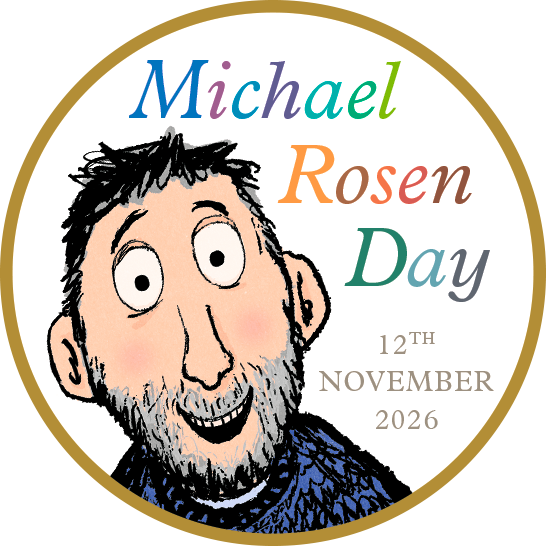 This year’s Michael Rosen Day will take place on 12 November – find out more at www.walker.co.uk
Books mentioned:
We’re Going on a Bear Hunt Michael Rosen, Helen Oxenbury, Walker Books, 9780744523232 £7.99 Pbk
Michael Rosen’s Sad Book Michael Rosen, Quentin Blake, Walker Books, 9781406317848 £7.99 Pbk
Where are you Eddie? Michael Rosen, Gill Smith, Walker Books, 9781529522877 £12.99 Hbk
The Missing: The True Story of My Family in World War II Michael Rosen, Walker Books 9781406395594 £6.99 Pbk
On the Move: Poems About Migration Michael Rosen, Quentin Blake, Walker Books 9781529504361 £7.99 Pbk
Please Write Soon: An Unforgettable Story of Two Cousins in World War II Michael Rosen, Michael Foreman, Scholastic 978-0702303180 £12.99 Hbk
One Day: A True Story of Survival in the Holocaust Michael Rosen, Benjamin Phillips Walker Books 9781529515985 £12.99 Hbk


