
We’re going to make a friend
Karen Sands-O’Connor interviews Darren Chetty, her co-author on the Beyond The Secret Garden column about his debut picture book, I’m Going to Make a Friend.
When we write our column, ‘Beyond the Secret Garden’, together, we are always thinking about representation of minoritised communities. Do you think about representation when you are writing picture books? What did you think about when you wrote I’m Going to Make a Friend?
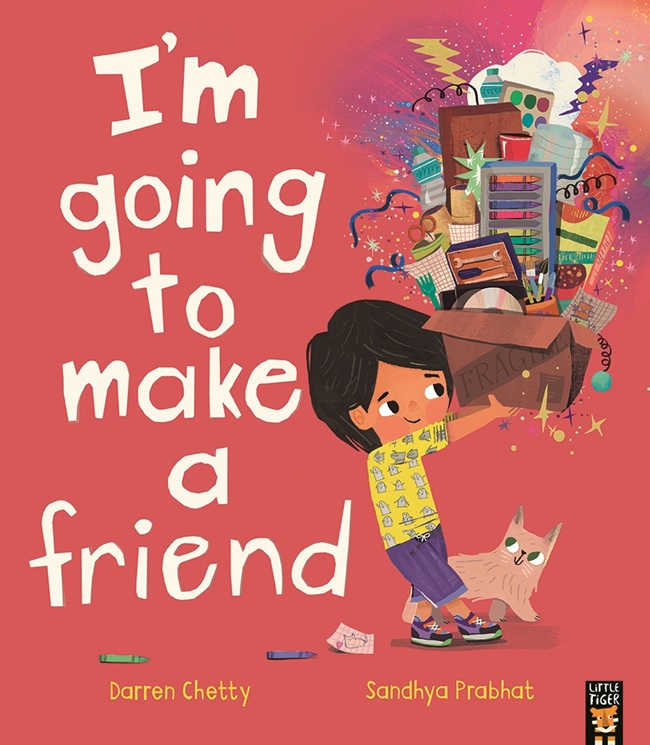 I tried not to think ‘representation’ too much as I wrote I’m Going to Make a Friend. And yet it’s very much there. I wanted to write about a brown child but I didn’t want to make them into a hero or even an aspirational character. I’ve nothing against those stories but they’re not the ones I gravitate towards as a reader or a writer. It made sense to me that they would befriend a Black child. It seemed to chime with particular memories and experiences. When I switched back into ‘analytical’ mode I saw that it prevented the story being read as an assimilation tale. And I was happy about that.
How would you describe your approach to writing picture books?
Well, it’s early days for considering myself a picture book author! I have a bunch of ideas at various levels of completion. But one thing I hear from my agent is that some of my ideas are far from where the market is currently. I guess I start with ‘I wish there was a book about…’ It’s a great motivator. But perhaps sometimes it takes me down a journey of discovery of why there isn’t a book about that very thing!
Most of the advertisements of your book mention that you are a philosopher, and I know you’ve used your training in Philosophy for Children (P4C) in your teaching. The blurb on the American Amazon site goes so far as to call I’m Going to Make a Friend ‘a funny, philosophical take on the pursuit of friendship’. How do you see philosophy figuring into this book or your writing in general?
Yes, it always feels like a grand claim to say a book is philosophical. But yes, I’ve being doing P4C for nearly 30 years and it was the subject of my doctorate and in some ways my way into writing about picture books. I like the idea of leaving space for thinking and for embracing ambivalence and ambiguity. I tried to use words sparingly in the book and leave space for Sandhya to explore the imaginative world of the child. Children have tended to have lots to say about each page – about what exactly is going on, and how they themselves would answer the questions the child asks themselves. The end papers show two children, a cat and a homemade robot. Children have lots of views about how many friends are in the image!
Tell me about creating your main character. Obviously, you wanted a character with a big enough imagination to ‘make’ a friend. What other factors did you consider? Why did those things matter to you?
Well, I think I spent a lot of time reading and imagining as a child. Often people get rose-tinted about their childhoods. But for me, reading and imagining were often something I did out of boredom more than anything else. And I moved house to completely different parts of the UK twice before I reached my teens. So, there was some isolation in there too. I don’t think that’s at all uncommon – even if technology makes it harder to be bored these days.
The book deals with emotionally stressful experiences (moving, making new friends, sharing with others). Was it difficult to depict anxieties and their resolution in the limited word count of a picture book? Why was it important to you to do so?
Yes, that’s something I thought about a lot. Some of the reviews have described the book as ‘quiet’. But to me, feeling alone and isolated is a profound, dramatic experience for children. We see how an active imagination can help you get through difficult moments and how making a friend is a creative act. We tend to expect picture books to have a resolution. But I didn’t want that to be too neat. In fact, it’s not completely clear that the happy ending is not also part of the child’s imagination. I like that ambiguity.
In your essay in The Good Immigrant (‘You Can’t Say That! Stories Have to be About White People’, reprinted in Beyond the Secret Garden), you talk about how the children you taught hesitated to use names from their family in stories, yet none of your characters in I’m Going to Make a Friend are named — was there any reason for this? And do you think children today still think stories have to be about white people, or has that changed?
I wanted to try and withhold some information from the reader – the child’s name and their gender, for example. Partly this was an attempt to keep the child as a bit of a stranger to the reader too. I’m not sure whether I was entirely successful – but I’ve had some really interesting conversations with children about this, so maybe it was. I think children’s views on who stories should be about depend on their reading experiences, and their writing experiences. We’ve seen an increase in books featuring Black and brown characters since the start of the CLPE’s Reflecting Realities research. But we know that there’s a difference between a book being published and a book being marketed and publicised so that it gets the attention of book buyers and lenders.
What’s next for you in terms of writing for children?
I’ve a Welsh history book coming out that I coauthored with Professor Martin Johnes, who also contributed to Welsh (Plural), a book I co-edited. And a children’s novel written with Adam Ferner with whom I wrote How to Disagree. I’m also working on my next picture book with Little Tiger plus a couple of other books that I can’t say much about just yet!
Karen Sands-O’Connor is a Visiting Professor of Education at the University of Sheffield. Her book British Activist Authors Addressing Children of Colour (Bloomsbury 2022) won the 2024 Children’s Literature Association Honor Book Award.
Darren and Karen’s book Beyond the Secret Garden: Racially Minoritised People in British Children’s Books is out now, published by English Media Centre.
I’m Going to Make a Friend, by Darren Chetty, illustrated by Sandhya Prabhat, is published by Little Tiger, 978-1801046619, £7.99 pbk.


