
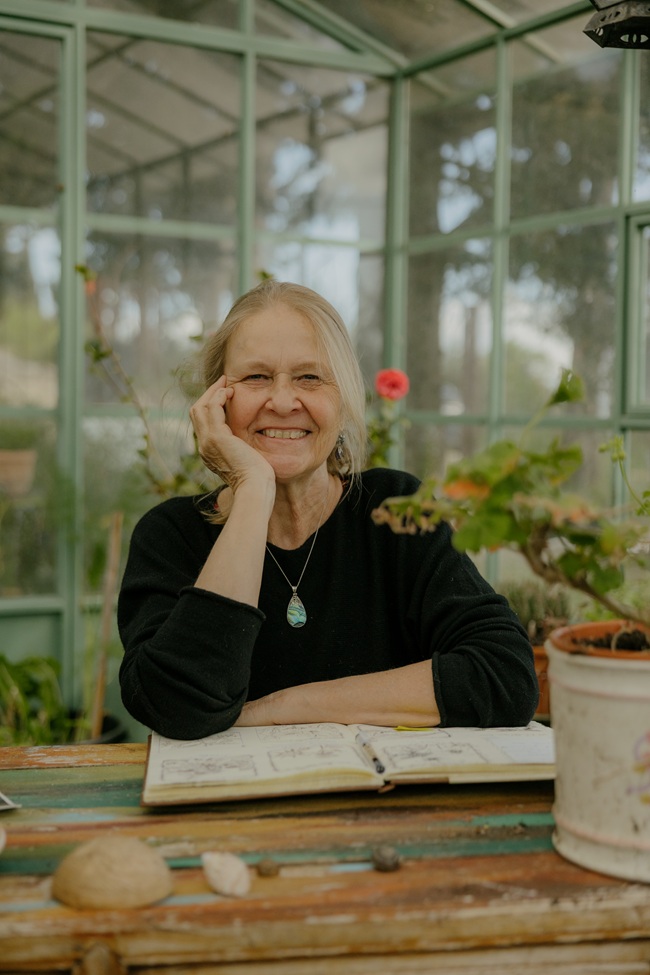
Cornelia Funke and The Green Kingdom
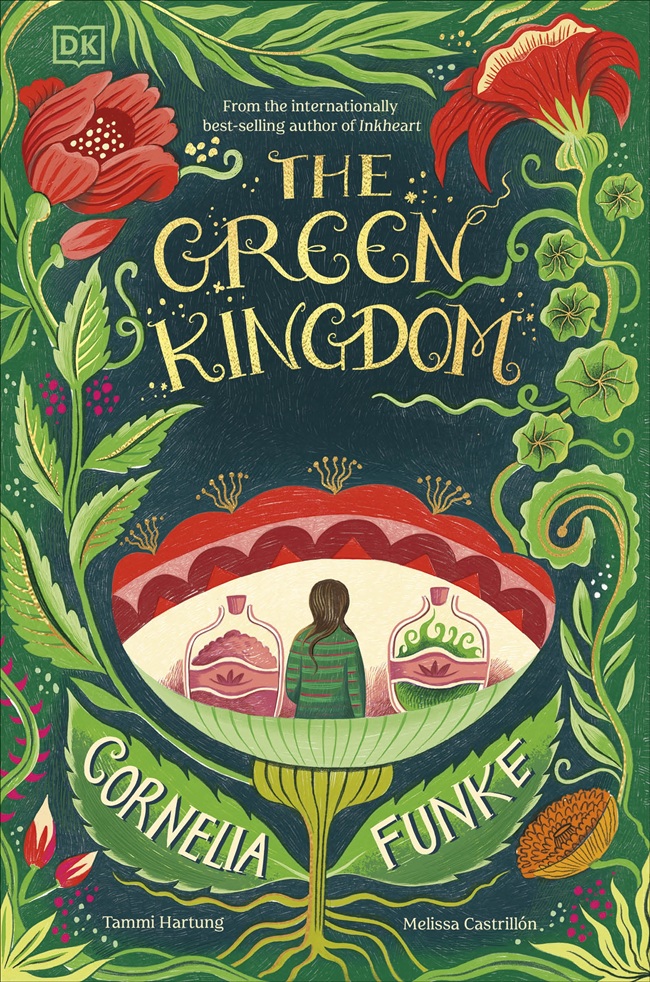 Set in New York City, the newest adventure from Cornelia Funke, award-winning author of Inkheart and Dragon Rider, is a mystery story that leads to the discovery of the magic of the green kingdom all around us. Michelle Pauli spoke to Cornelia for Books for Keeps about The Green Kingdom.
The Green Kingdom is quite a departure from your fantasy work. It’s rooted in the real world of plants and botany – Caspia discovers letters from the 1950s written by a blind girl to her sister, each containing riddles about different plants. What sparked the idea for a book about botanical riddles? And why was it important to set this botanical adventure in New York City rather than somewhere more obviously ‘green’?
I cannot say that I planned it this way – as always, the story surprised me at every turn, especially with the motif of growing roots in a new place. Of course, that is a constant motif in my life as I have lived in several countries now and love getting to know a place so well that it becomes home. So, maybe this story just made me understand a bit more about that part of my life; they often do. I sometimes wonder whether we tell stories to learn things about ourselves and the world that a part of us already knew? For sure, The Green Kingdom was for me as much an adventure as it was for Caspia.
As for the urban setting, Tammi [Cornelia’s ethnobotanist collaborator] and I decided on that as we thought nowadays most children do live in such environments and we wanted them to fall in love with plants even though they might never have noticed them before. We had a wonderful helper with the real Caspia, after whom we named our heroine. She is the daughter of a German friend in Brooklyn and, together with her mother Juliane, they became our eyes and ears, suggested where Caspia would stay and told us that picnics are not allowed in the Brooklyn Botanical Gardens…
You co-wrote The Green Kingdom with ethnobotanist Tammi Hartung, who has more than 40 years of experience working with plants. How did this collaboration come about, what made you want to work with a botanist, and what was the collaborative process like?
I had read a few of Tammi’s wonderful books on plants and was very impressed by how well she describes and evokes the magic of the green kingdom. I reached out to her through her blog and she came to visit me in California. We talked about how we could create a book together that would instill our passion for plants in younger readers. At first we thought of non-fiction. Tammi’s husband Chris advised us to do fiction instead right from the start but it took us quite a while and many notebooks filled with drawings and ideas until we finally realised he may be right. We decided on the list of plants together, with Tammi making the best suggestions, of course, and from there we discussed the story several times but I wrote it, as I have to run with a story and allow it to surprise me. Tammi contributed all the expertise to the letters and riddles and it was a very comforting feeling to have her vast knowledge by my side!
The illustrator, Franziska Blinde, was working at your Tuscany farm during the editing process – you mention it was the first time you’d edited a book while the illustrator was literally next door. How did that proximity change the creative process?
Yes, sadly these illustrations are only in the German edition as DK went another – very wonderful! – way with their magical edition and illustrator. For me these weeks of Franzi drawing my characters in the room next door while I was polishing the text was unforgettable! And I wonder how often her fine ink lines changed and strengthened my words. At night we met for dinner and watched the 11th Doctor Who (now I call her Pondy after Amelia Pond) and during the day we often visited each other to have a peek at what the other did. I have just started a project called The Halloween Girls where Franzi’s child self is the heroine.
I have by now done several collaborations with visiting artists and I hope I’ll have that magical experience many more times! One of them, Ayesha Gamiet, a wonderful British illustrator, just inspired a heroine of a new picture book of mine – which is another kind of collaboration!
The book feels quite different in tone from your epic fantasies. Would you agree, and was there something freeing or more constraining about working within the real world of plants rather than creating entirely fantastical worlds?
I have written a series in German called The Wild Chicks that is also based on our everyday human-centric world and is hugely successful
Cornelia Funke
there. I think Caspia is a bit like the girls I describe there. I loved to go back to this ‘everyday’ writing as I call it. For me it always is a very light-footed experience. Even the plant research is nothing compared to the research I had to do for The Colour of Revenge or Reckless. I have just finished the second draft of The Green Kingdom 2, which is set in Cornwall, one of my favourite places in the world and oh, it was a dance among plants and abandoned mines! And on very steep cliffs!
You began your career as a social worker and book illustrator before becoming a novelist. Do those earlier careers still influence how you approach storytelling for children?
I believe that I wouldn’t be half as good a writer without the children I met as a social worker. There would be no Thief Lord, no Wild Chicks no… anything probably. I am from a stable lower middle-class background and had grown up very sheltered in a small town in Germany. I went to a school I loved, lost myself in libraries and learned about the grim aspects of the world only through my work for Amnesty International, which was my first awakening. I became a social worker although my parents wanted me to study art. But I believed the world needs saving, and it was only when I told stories to children who came from very difficult homes and usually wouldn’t touch a book that I realised that being a storyteller and illustrator may actually be my contribution to making the world a bit better. Now I support many initiatives and founded my project for young artists in Italy – and I think I owe that sense of direction to the children I met being a social worker. The Adventure Playground I worked at where children learn to live in community, build huts and find shelter for a few hours still exists and blooms and I just did a reading there, which was deeply touching.
Are there plans for more books with Caspia, or was this always intended as a standalone story? And what other creative projects do you have lined up that your readers can look forward to?
As I mentioned before, Book 2 is done! I also am doing the last polishes on a story I collaborated on with my daughter Anna. It’s a story I wrote for the first time 30 years ago and it became a bestselling and much beloved book in Germany. Anna felt that the story has not been fully told and that we could try another version set in England. So we did and oh we had so much fun! That will be coming soon to UK audiences.
The last project on my table, which now goes into the third draft, is the fifth book in the Reckless series, a book that means very, very much to me.
Michelle Pauli is a freelance writer and editor specialising in books and education. She created and edited the Guardian children’s books site.
The Green Kingdom by Cornelia Funke and Tammi Hartung is published by DK Flip, 978-0241699768, £8.99pbk.


 Dina Reaume