
Like a Brother: an interview with Nathanael Lessore
Michelle Pauli talks to award-winning author Nathanael Lessore about his latest novel.
Nathanael Lessore’s new novel for teens, Like a Brother, is ‘horribly based on unfortunately true events,’ the author writes in the acknowledgements. It’s not an understatement.
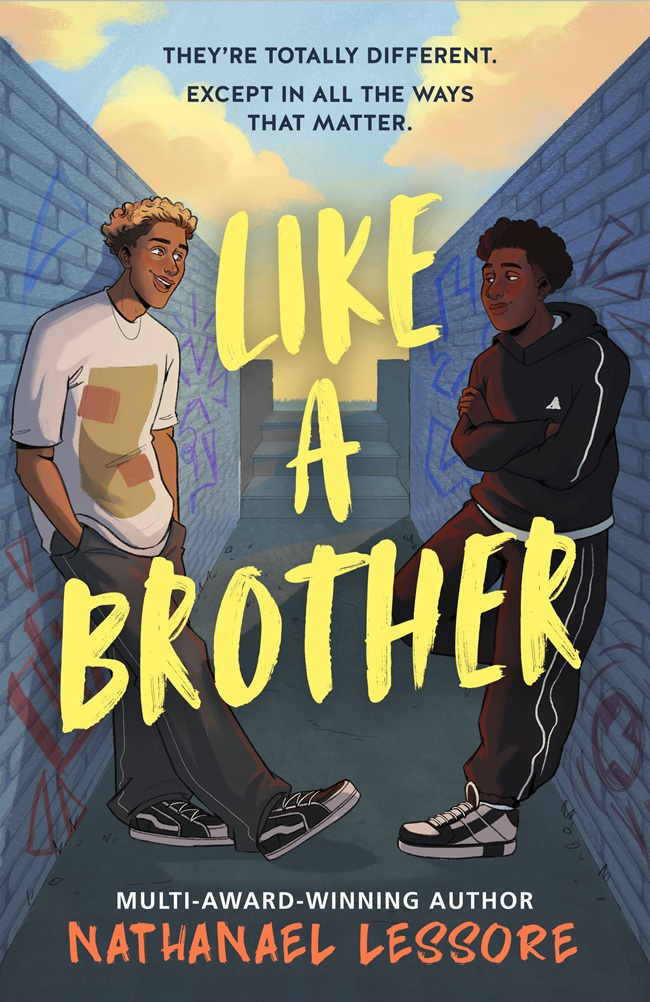 Like a Brother follows Owais, whose chilled-out, popular life in south London gets upended when his estranged cousin Abass arrives from Birmingham for the summer – he’s loud, unpredictable, picks fights and ruins parties. As a teenager, just like Owais, Lessore had to share his bedroom when his parents unexpectedly took in a boy who’d just lost his mother and was being abandoned by his authoritarian father.
‘He was a nightmare,’ Lessore recalls – always trying to fight, blasting music and shouting at people in public. Over time, however, ‘he became part of the family. We call him a cousin’. But a few years later, to the distress of the family, Lessore’s cousin was groomed by a gang and went to prison for four years. The story is heartbreaking – but also, in fictional form, compelling and full of Lessore’s trademark warmth and humour.
In Like a Brother, as the boys get to know each other, Owais starts to see there’s more to Abass than chaos, and more to himself than just coasting through life. The book is full of characters drawn closely from Lessore’s life and his home turf – he grew up in Peckham as one of eight children to French and Madagascan parents. Owais, he admits, ‘was how I wish I would have been as a teenager’ – the more popular, confident version of himself. Lara, Owais’s little sister, is based on Lessore’s own sister: ‘absurd and weird and gross and very loving.’ And Savio, the older friend who supports them both, is a tribute to a schoolmate who passed away a few years ago – a boy who was Caribbean and gay in the early 2000s, and who ‘by year 11 was a kind of grizzled soldier’ after enduring relentless homophobia.
While there are many hard-hitting parts to the story, not least the devastating impact of Abass’s menacing father, there’s also a lot of tenderness. We see how Abass slowly relaxes into the family and learns to trust again, and Owais’s struggles with feelings of inadequacy in the holiday art club he’s forced to attend. In late-night whispered conversations in their room after lights out, both boys reveal vulnerabilities.
As with Lessore’s previous books, from his debut, Steady For This, which won the Branford Boase Award and his second, King of Nothing, which won the Waterstones Children’s Book Prize, the Carnegie Shadowers’ Choice Medal and the Jhalak Prize, a highlight is Lessore’s sharp ear for authentic teen dialogue. It’s quickfire, often hilarious and always sounds real. How does he do it? He listens – properly. On buses, on trains, and to his South London nephews and nieces. But the secret lies less in trying to copy the words teens use but instead tapping into the rhythm and the cadence.
‘Their language evolves so much that I could write what they’re saying now and by the time the book comes out, it’s outdated already,’ he explains.
A pet peeve is writers who don’t put the effort into teen-speak. ‘I’ve read books where an adult will just tag the word ‘fam’ onto the end of a random sentence and it sends a cold shudder down my spine because I’m like, “Have you not listened to any teenager ever?”’ The answer, he says, is simple: ‘I was taught quite early on, don’t condescend your reader. I’m not condescending to teenagers. I write what I find fun and then I’m almost writing for myself.’
That Lessore is writing books at all still seems slightly unreal to him. After leaving school and becoming a builder (scuppered by a fear ofheights), working in McDonalds, living in France and becoming bored enough working in a call centre to apply to university through clearing, he studied creative writing at university in his mid-twenties. Dismissing it as a career – ‘My thought process at the time was having a creative writing degree if I want to be a writer, that’s like having a music degree and thinking I’m going to be Beyoncé’ – he went into marketing instead, writing copy about plug sockets and medical software.
Then Covid happened and, just to feel like he’d completed a project, he bashed out a manuscript in a few weeks and showed it to non-reading friends who surprisingly said it was good. After getting ‘a little bit squiffy’ one night he emailed a handful of agents he found on Google. One asked him to tone it down for teens. He did, sent it back, and forgot about it for months. When she finally offered representation, there was another long delay and he forgot about it again. Even when publishers expressed interest, it didn’t feel real. Then she told him it was going to auction, which meant it would definitely be published.
‘At that point I was living in a tiny, dingy flat and she told me that over the phone and I went outside, sat on the kerb and just stared at the sky for two hours,’ he says.
Lessore’s assessment of his career trajectory is characteristically modest: ‘I won the lottery when I got signed by an agent and then I won the lottery again when I got published. And then thankfully the books that I write are popular enough that I’ve won the lottery again again.’
‘I feel like if I did have to stop right now, I think I’ve done my part in that I’ve got reluctant readers reading, which is probably the best thing I’ve ever done with my career,’ he adds.
Lessore takes his responsibility to young readers seriously, especially in school visits. When he sees secondary school kids struggling to imagine their futures, he doesn’t soft-pedal, telling them directly: ‘The best way to not grow up as a loser is read a book sometimes.’
He emphasises practical benefits: ‘Reading changes lives, you are going to earn more money, you’ll see more of the world, you’ll have better mental health. I really, really want that to be the lasting image from the school visit because a lot of them just don’t think that they can.’
But Lessore is quick to share credit. ‘I constantly shout out librarians and booksellers. I find it a bit weird when people are like, ‘Oh, thank you for writing the books that you write.’ Librarians change lives every single day – entire classrooms of lives. I don’t think any one job in this industry is more important than another in this fight to get kids reading.’
What does Lessore hope readers take from Like a Brother? ‘The most important thing is character and kindness,’ he says. All the happiest people he knows are kind; all the unhappiest are intolerant. ‘It’s not that being open-minded makes you happy. Being kind does. Owais’ dad is a bit like my dad. He’s the happiest person in the world without a lot. And I think that’s obtainable to everyone.’
As for his real cousin, Lessore tried to visit him in prison but never managed to. He’s out now, whereabouts unknown, though Lessore gets occasional updates from a local contact.
‘I’m sure I’ll see him again because South London is a small world,’ he says. ‘Maybe this is the dreamer in me but I can’t wait to take him back to my parents’ house because I feel like that reunion with my mum will be something else. For her, she lost her son when he went.’
As for whether he’d like his cousin to read Like a Brother, ‘I think so. As a reminder that he’s loved and he’s part of the family. His family are still here.’
Michelle Pauli is a freelance writer and editor specialising in books and education. She created and edited the Guardian children’s books site.
Like a Brother by Nathanael Lessore is published by Hot Key Books, 978-1471418235, £8.99pbk.


