
Ten of the Best Books about Trees for Young Children
As Spring approaches, Ann Lazim makes a leafy selection.
The significance of trees in our world is explored in books extending far beyond identification guides. Research that demonstrates the interconnection between trees and fungi in ways that are co-operative rather than competitive is filtering through to children’s literature, joining the many books that show the relationships between humans and trees. The variety is so good and wide-ranging, narrowing the selection proved difficult so I’ve chosen to focus on titles, particularly picturebooks, with appeal for younger children. However, many will speak to older readers too.
The Tree
Neal Layton, Walker, 978-1406373202, £7.99pbk
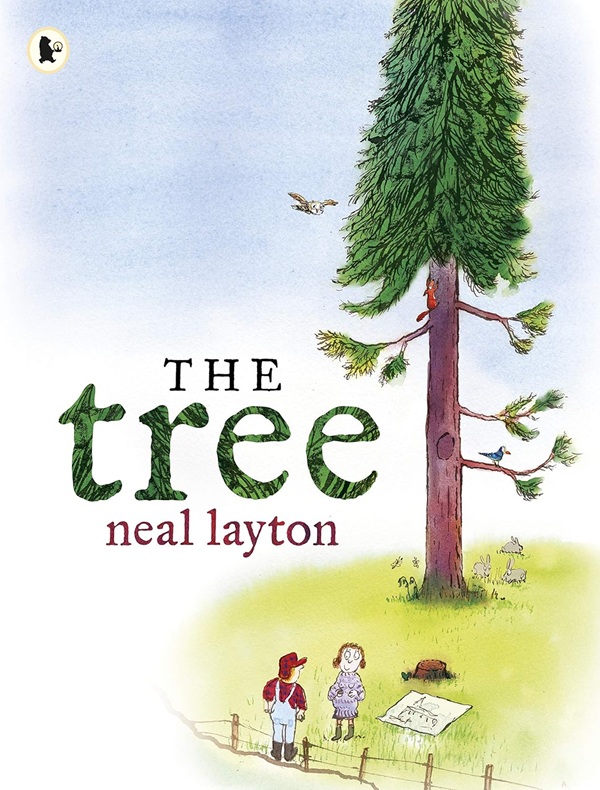 The minimal text in this picturebook, begins with ‘a tree’ opposite a picture of a lone tree next to a fence and a sign saying ‘Land for Sale’. Then the animal homes within it are named, while the pictures portray their occupants. Along come some new arrivals – what changes might they bring and will they be for good or ill? There’s a wonderful wordless central moment when the protagonists realise what they have done and before they are galvanised into affirmative action uniting the tree’s inhabitants.
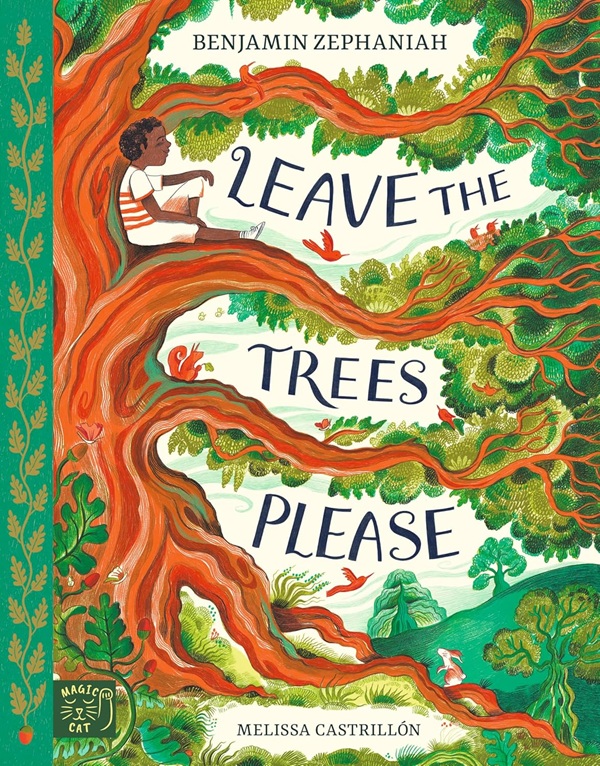
Benjamin Zephaniah, illus. Melissa Castrillon, Magic Cat 978-1915569202, £12.99 hbk
A simple heartfelt plea from the much-missed poet reflecting on the interconnectedness of nature and begging humankind to recognise the vital role that trees play in this, and leave them alone to play their part. In this picturebook Melissa Castrillon places an oak tree at the centre of her illustrations that complement and extend the words in the poem, using a limited but very striking palette of greens and reddish browns and portraying children at the heart of protests to protect the trees.
Ken Wilson-Max, Otter-Barry Books, 978-1913074319, £12.99 hbk
 One of this author/illustrator’s picturebooks encouraging environmental awareness in young children. Eve’s home is near a forest and of all the trees she especially loves the Baobab. On her birthday, her grandmother gives her a Baobab seedling for her to plant and care for, continuing a family tradition. Eve’s own growth is likened to that of a tree, graduating from being called a ‘sprout’ to a ‘sapling’. Her family aid her curiosity and growing understanding about communication between trees and their importance in Earth’s ecosystem. Facts following the story include information about Wangari Maathai’s environmental work planting trees in Kenya.
The Girl Who Planted Trees
Caryl Hart, illus. Anastasta Suvorova, Nosy Crow 978-1788008914, £7.99 pbk
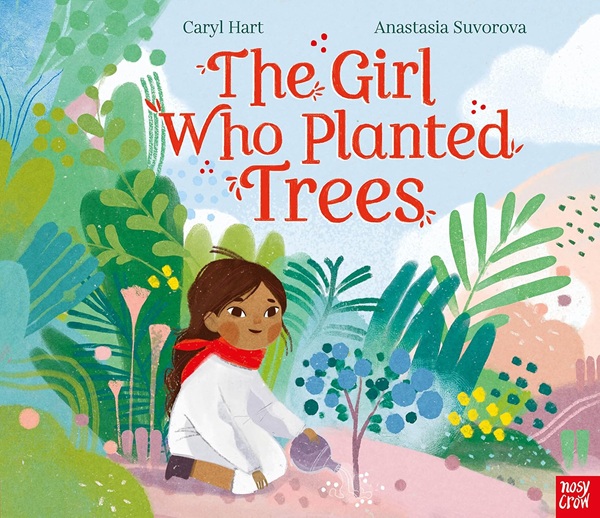 A small girl lives ‘in a dry little village at the foot of a great grey mountain.’ A picture in a book shows her that the mountain was once covered in trees but gradually these have been cut down leaving it barren and bare. She determines to restore the trees. She experiments with planting fruit pips and, by trial and error, and with patience and the advice of her grandfather and ultimately the help of their whole community, she succeeds in turning the great grey mountain green again. The setting is not specified although the illustrations in this picturebook suggest an Asian location.
These Olive Trees. A Palestinian Family’s Story
Aya Ghanameh, Viking, USA 978-0593525180, £15.99 hbk
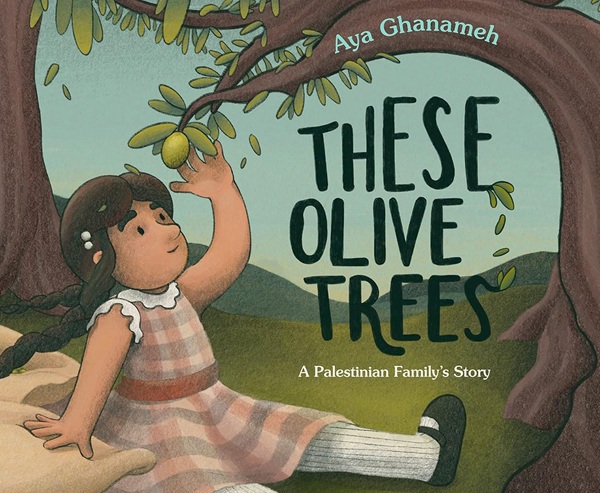 The significance of the olive tree in Palestinian culture, history and survival is shown in this picturebook that begins with a small child tasting its fruit and learning the many uses of this tree and how long it takes to grow. Over the years, her family is forced to move to different refugee camps, always planting and tending olive trees where they can and seeing them as a symbol of return. The story is based on the life of the author/illustrator’s grandmother, Oraib, born after the 1948 Nakba.
Lydia Monks, Andersen Press, 978-1839131905, £7.99 pbk
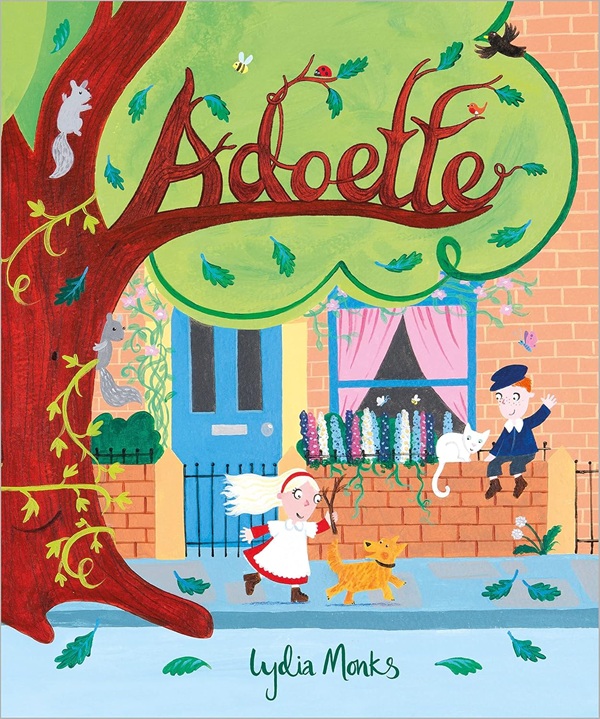 Changes in a city street over a period of a hundred years are envisioned as though seen by a tree that has been growing there all that time. Adoette – a French word for a big tree – sees families grow and people come and go in a microcosm of social and political history. When Adoette’s presence is considered to be a problem plans are hatched to chop her down and the local community gathers in protest. Inspired by a real situation in Sheffield where Lydia Monks lives, this picturebook draws on environmental concerns, especially consideration of the importance of trees, and demonstrates the power of people and community. Nominated to the IBBY Honour List 2024.
What Did the Tree See?
Charlotte Guilliain, illus. Sam Usher, Welbeck 978-1913519292, £6.99 pbk
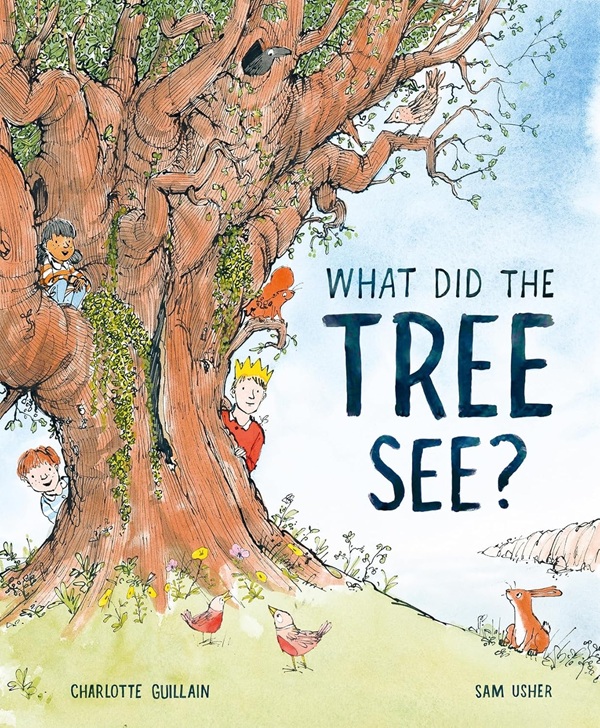 A rhyming text describes the changes that occur as an oak tree grows from an acorn and concurrently what it sees over many centuries from the place where it grows overlooking a bay by the sea. A fascinating narrative about how the histories of humans and trees intertwine. Appendices include a timeline about historical events that have taken place during the tree’s lifetime and a description of its life cycle. The idea of an oak tree bringing history to life is also explored by Julia Donaldson and Victoria Sandøy in The Oak Tree (Alison Green Books 978-0702324352) while Rob and Tom Sears inhabit the persona of a thought-provoking ancient yew tree in A Tree is a Time Machine (Laurence King 978-1510231207).
What Do You See When You Look at a Tree?
Emma Carlisle, Big Picture Press, 978-1800784383, £8.99 pbk
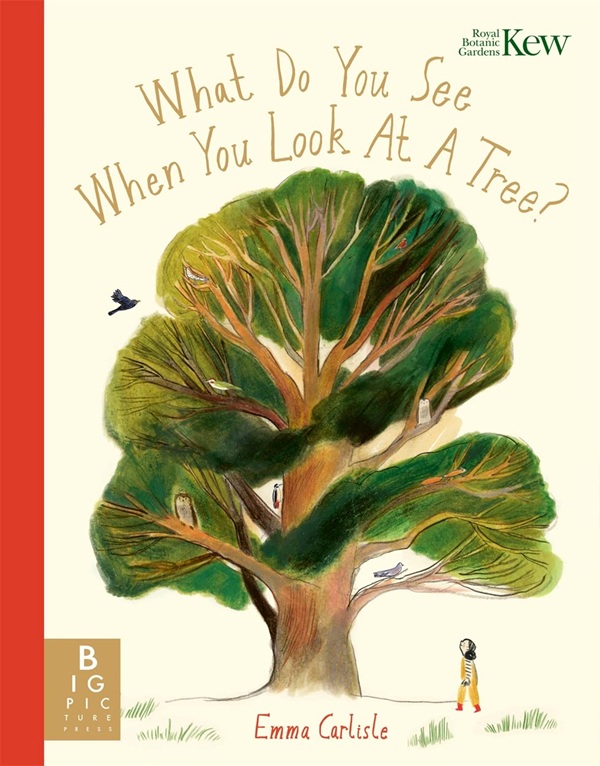 Endorsed by the Royal Botanic Gardens, Kew, this poetic picturebook celebrates the interconnectedness between trees and human beings and inspires the deepening of that relationship. Readers are encouraged to realise that ‘Trees are all different, special, unique…’ as well as consider their history and the wildlife that lives within and around them and learn ‘How to Be More Like a Tree.’ An endnote acknowledges the ‘wood wide web’ communication network that functions amongst trees and fungi. A warm palette predominantly of greens and browns has been used in creating illustrations that are broadly representational of some of the species of trees mentioned.
A Family of Trees: My First Book of Forests
Peggy Thomas, illus. Cookie Moon, Phaidon 978-1838667817, £12.95 fold out board book
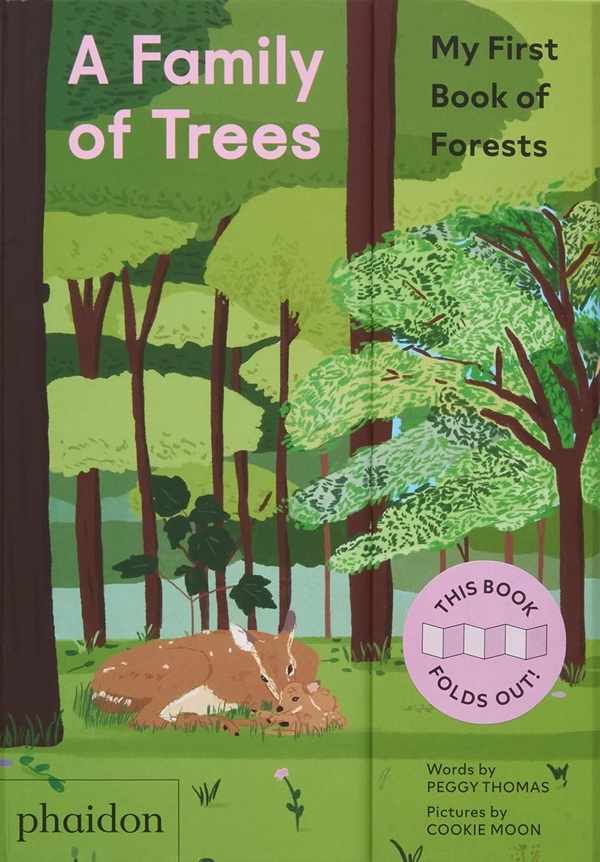 ‘A group of trees is called a forest… and a forest is a family’. Thus begins the text in this foldout board book which then goes on to expand on this analogy by showing how trees care for each other and share this with nature more widely. On the reverse a map opens an exploration of imaginatively described ‘Forest Families Around the World’ with an example of each kind. Selected for the 2025 Bologna Ragazzi Award: BRAW Amazing Bookshelf in the Sustainability category.
My Heart Was a Tree. Poems and stories to celebrate trees
Michael Morpurgo, illus. Yuval Zommer. Two Hoots 978-1529094800, £12.99 pbk
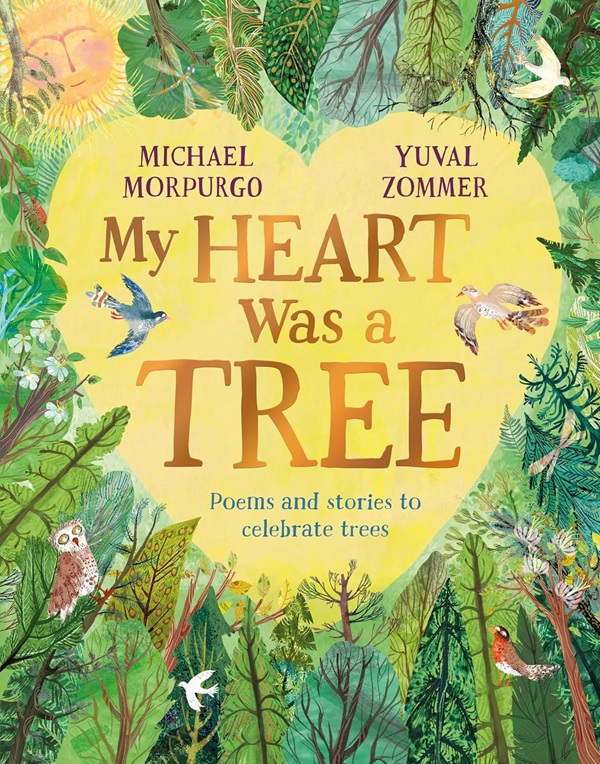 Inspired by a Ted Hughes’ poem, Jean Giono’s The Man Who Planted Trees and the bluebell woods near his home, Michael Morpurgo has written this collection of stories and poems that celebrate the close links between trees and humans. Some are told by trees themselves, such as the red oak tree that begins the first of its nine lives in a Nova Scotia forest and the ancient alder that observes teeming riverside wildlife. Others are full of meaning for people, whether it’s the apple tree that witnesses the exchanges between a grandparent and grandchild or the weeping willow tree which is reborn in a new land when a family flees Ukraine. Full grown trees stand tall and leaves are scattered in Yuval Zommer’s accompanying illustrations.
Plus a mention for Once I Was a Tree by Eoin McLaughlin, illus. Guilherme Karsten (Nosy Crow 978-1805130406) which received a recent 5 star BfK review.
Ann Lazim was librarian at CLPE (Centre for Literacy in Primary Education) for 29 years. She is a committee member of the UK section of IBBY (International Board on Books for Young People). She edits reviews of children’s and YA books for Historical Novels Review and is on the jury of the Indian NEEV Children’s Book Award.


