
Price: N/A
Publisher:
Genre:
Age Range: Books About Children's Books
Length: 112pp
Buy the Book
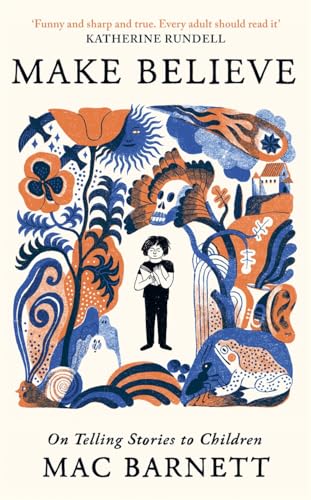
Make Believe: On Telling Stories to Children
‘Why do adults accept – and expect – mediocrity from children’s literature?’ Mac Barnett asks in Make Believe: On Telling Stories to Children, contending that children deserve better writing. It’s an essay reminiscent of Katherine Rundell’s Why You Should Read Children’s Books, Even Though You Are So Old and Wise – but if that sometimes felt like a breathless puff-piece for children’s books, Burnett is on the attack. Whilst Rundell plays the angel, asserting that children’s books ‘speak of hope’, Barnett is the devil’s advocate, excoriating an industry that sometimes perceives itself as beyond critique.
To a point this is great fun. It’s hard not to agree that there is a lack of rigorous reviewing of kids’ books and that ‘if we want to ensure that our children have good things to read, it behooves us to think deeply about their literature.’ When he digs into politics, Barnett is witty and invigorating: ‘I know this may seem like an overblown way to characterise a book about an anthropomorphic banana who learns to share. But I’m serious: to understand the distorting effects of adults’ power over children’s books, it might be useful to think about the literature produced under a totalitarian regime.’ His idea of kids’ literature as ‘propaganda for adulthood’ is an intriguing provocation, though when Barnett continues to argue that ‘they’re prosocial messages masquerading as stories, designed to promote good behaviour, glorify grown-ups, and get kids to sleep on time’, you do start to feel like he’s mainly talking about picture books, and doesn’t seem to realise he’s living through a golden age for middle-grade.
Still, there’s lots to enjoy in his ire. Children’s books are bad, according to Barnett, in ‘so many different ways’ – treacly, preachy, bland, badly rhymed, by celebrities, starring the snowman from Disney’s Frozen. He compares the way books fail to the ‘three aunts you get seated next to when you are a kid’. The first aunt becomes a completely different person – her voice gets loud, her eyes widen, she says ‘oopsie woopsie’ and is ‘painfully zippy’. She is like the books with ‘wacky fonts’ and ‘stuff kids like’ such as unicorns, poop and football (I was reminded of my own pet peeve: novels that put every eighth word in SHOUTY CAPITALS). The second aunt is sermonizing and self-important. Good books are like the third ‘cool aunt’ who ‘treats you like a person’. But who are Barnett’s ‘cool aunts’? Certainly they include Margaret Wise Brown and Maurice Sendak, whose experimental works he considers ‘the equivalent of Ulysses and The Collected Poems of Emily Dickinson’ – his dissection of Goodnight Moon is one of the highlights of the book.
His contemporaries are more easily dismissed though. At one point, in reference to sci-fi writer Theodore Sturgeon’s law that ‘90% of everything is crud’, Barnett suggests that ’94.7 percent of kids’ books are crud’. Unsurprisingly, this increase on Sturgeon’s already snobby and overinflated figure has not gone down well on social media. When it is incredibly hard to get published, advances are at record lows, and booksellers and librarians are trying to encourage reading for pleasure and a diversity of voices – not to mention fighting book bans – it seems unjust to assert that the vast majority of children’s books are rubbish, and, indeed, worse than adult books, on the basis of snark and vibes. No wonder so many in the industry felt personally insulted. In the aftermath of this quote circulating, it was saddening to see how many authors assumed that Barnett was talking about them – though perhaps he was. He asserts, brutally, that ‘every aunt thinks she is the cool aunt’.
Barnett has since apologised, admitting his assertion was ‘hyperbolic and glib’. Ultimately, like many of the best polemicists, it feels like he was having too much fun to admit the complicated reality of the children’s book world, which lies somewhere between Sturgeons’ assessment and Rundell’s – at about, I’d guesstimate, half crud and half hope. But then, as Barnett’s dedication reminds us, the feelings of grown-ups were never his primary concern: this impassioned- argument is ‘for the kids’.


