
Price: N/A
Publisher:
Genre:
Age Range: 8-10 Junior/Middle
Length: 336pp
Buy the Book
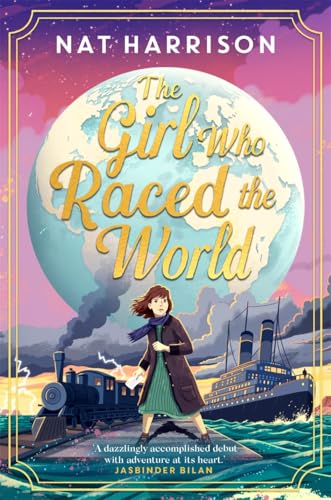
The Girl Who Raced the World
This fast-paced reimagining of Jules Verne’s Around the World in 80 Days retells the story from the perspective of Maggie, a determined young girl with a mysterious link to Phileas Fogg by way of his French servant, Passpartout.
Young Maggie arrives in London with a letter from her mother and little else. She is immediately swept into a world of trouble when she bumps into Detective Fix and loses her letter! Maggie finds herself destitute and in dire need of employment at precisely the moment when Mr Fogg intends to begin his epic adventure around the globe in time to win a handsome bet with his peers at The Reform Club. Luckily for her, Fogg is persuaded of the benefits of taking on another manservant: Maggie has her ticket to adventure!
Maggie’s travels are exciting and breathless, as the group lurch from one disaster to the next. From a Calcutta courtroom, to joining a circus, and various episodes of getting lost, Maggie proves herself stoic and resourceful in a fix. She relies heavily on the kindness of strangers, though, who tend to arrive just in time to provide sage advice when Maggie needs it most. The most compelling is Valentine – a fearless and sharp-witted woman who acts as a guardian angel for Maggie and a catalyst for the story. There is also Jack – a hungry boy working on a ship – who offers loyalty and humour near the start of Maggie’s journey. These characters, and a handful of others, add a pleasing variety and originality to the familiar feel of Fogg, Fix and Passpartout.
As Maggie accompanies him on the journey, she grapples with the moral quandary of whether to believe Phileas Fogg is capable of the theft of which he is accused. Is he a villain, or a misunderstood adventurer with a heart of gold? He bribes guards, hands out cash to the needy, and is constantly on the run—but it is never quite clear what for. Maggie’s determination to find out one way or the other adds a level of intrigue to the story (for those readers not familiar with Verne’s original).
The pace of the story is somewhat frantic. In order to fit an entire global circumnavigation into just a few hundred pages, descriptions of atmosphere and location sometimes feel underdeveloped, and there is rarely time to take in the scenery or savour the cultural richness of Maggie’s adventure. Encounters with helpful (and unhelpful) characters happen so frequently that the world begins to feel oddly small, with familiar faces repeatedly popping up in far-flung places. The book makes a valiant effort to modernise some of the themes from Verne’s classic novel. Maggie learns that doing the right thing often means breaking the rules—but also that money has a curious way of smoothing everything over. Fogg’s immense fortune repeatedly saves them from trouble, offering a less-than-ideal message about how problems are solved.
The Girl Who Raced the World is an ambitious retelling with a cast of fearless female characters. It stays true to the spirit of Verne’s original, but it rarely gives readers the time or space to enjoy the journey. A final twist opens the door for new adventures for Maggie, Fogg and the team which, though a pleasing notion, does beg the question: wasn’t Around the World in 80 Days exciting enough already?


