

A Q&A Interview with Sara Pennypacker
Set in Lamorlaye in Occupied France in 1944, The Lions’ Run, Sara Pennypacker’s first historical novel, is a powerful story of heroism and the importance of standing up for what is right. Sara answered our questions on her book.
You say in your author’s note that historical fiction is your favourite kind of novel: what is it that you like so much about it?
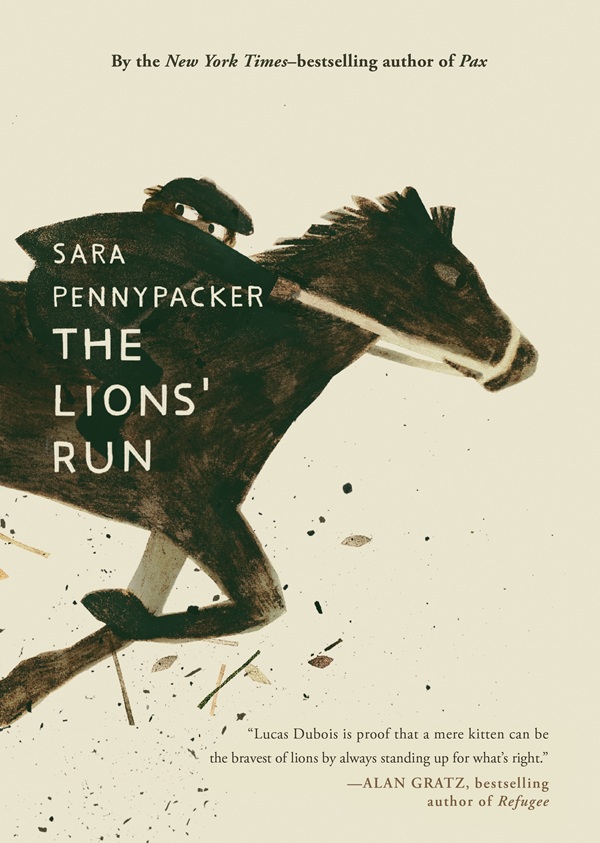 I love thinking about how ordinary people’s lives might have been affected by well-known historical events, especially when the changes in their lives are not directly related to those events. At the end of The Lions’ Run, several people’s lives will have been permanently changed, not because of the Nazi occupation of their town, but in defiance of it.
And what is it about historical fiction that makes it appealing to young readers?
All books are wonderful at connecting readers to the human tribe through time and space. Historical fiction can be especially comforting when it shows that hard times are nothing new, other kids have endured them and thrived, and (most importantly for me) they are temporary! Things can get better! It’s important for authors to take extra care in making their main characters relatable in spite of the different times. Right in the first chapter, I want my readers to think, That’s how I feel too!
This is a wartime story. Can you tell us what drew you to write about this particular bit of history (occupied France, 1944)?
Practical reasons. I’d learned about the Lebensborn Program several years earlier, and knew I wanted to include it in a book for kids one day. Of the occupied countries that had Lebensborns, the one I was most comfortable with was France. I felt I had to visit my setting in person, so I wanted to be able to navigate as easily as possible. It also helped a lot that my sister lives in Paris and was available to help me with translation.
World War II is the setting for many other excellent novels for children. What is it about this particular period of history that makes it so popular with writers and readers do you think?
One factor is that WWII has always been seen as a clear battle of Good vs Evil, more so I think than any other war of our era. But it also coincided with what is called The Second Golden Age of Children’s Literature, where books for kids became more creative, thoughtful and beautiful than merely instructive. WWII was a fresh reference point for the many children’s authors growing up and then working in the second half of the century. Myself included: My own father was a pilot in WWII, so even though I was born after it, I was familiar with that war; it was personal and real to me.
Please tell us about your central characters, Lucas and Alice. How did they come about, what makes them such interesting people to write about?
One trick of novel-writing is to make your characters exactly the people most likely to be negatively affected by the plot elements. Since Lucas will have to question his courage, I made him someone seen as a coward. I made him an orphan so he would be particularly upset by things he learns in the Nazi maternity home. I wanted to talk about how horses are often seized to be worked to death on battlefields, so I made Alice love horses, and own one who is at risk. Since the book talks about freedom, I made both Lucas and Alice suffer under a lack of freedom. All this can make writers seem pretty callous, but it’s for the best—readers want our characters to endure hardships. And there are always wonderful things about them, too: I can’t help giving my characters some of the finest elements of real kids I know.
The Lions’ Run has some upsetting scenes and explores issues around the Nazi’s Lebensborn programme. How do you approach writing about these things for young people?
Just one rule: If my characters are affected by and care about something, I will write about it—in the language and depth that they would be experiencing it. For instance, heroic people hid Jewish children during those years. There were many elements to that, many issues, many dark episodes and certainly many practical things those kids needed. But Lucas’s main concern is: what can I give those kids that will bring them a little happiness? And my characters are not alone during the hardest things I wrote; they are surrounded with helpers.
Many readers will love Bia, Alice’s horse, and will imagine themselves in the saddle as Lucas. Do you ride, and how much did your love of Black Beauty feed into this book?
I barely ride, though I always dreamed of it! So once I knew I wanted to include this element—how animals suffer when humans war—I engaged a horse expert to help me with all those scenes, and I made sure to visit some of the stables still in that town in France, and talk with trainers there. I did love Black Beauty, but it was actually The Black Stallion I was thinking about as I wrote The Lions’ Run. The extraordinary bonds children can make with animals moves me. It was a joy to have Alice and Lucas actually read The Black Stallion in my own book.
There is nothing in the way of Lucas at the end of the book. Might he have further adventures?
You are right, I left things wide open for Lucas (and for Alice, who might join him in a few years.) As of now, I have no plans to check in with them again; I feel they are on their own. But I never know! It was many years after writing Pax that I felt there was a sequel. So, I’m not saying no…
The Lions’ Run by Sara Pennypacker is published by Hodder Children’s Books, 978-1444978780, £12.99 hbk


