
A Return to the Riverbank
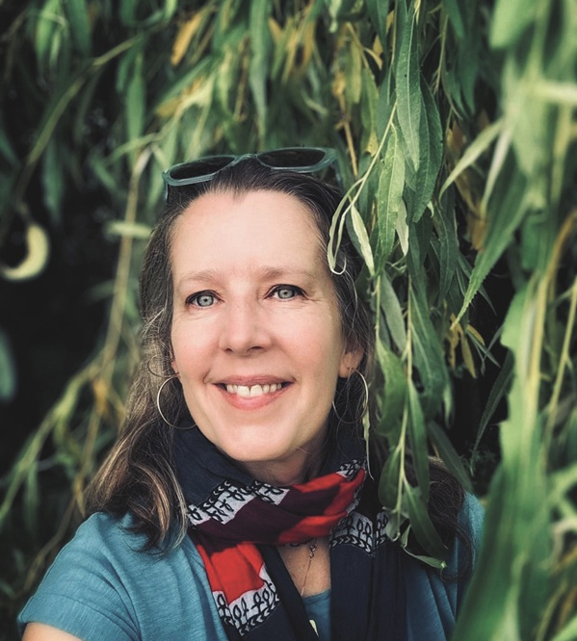
Nicolette Jones interviews Polly Dunbar about illustrating M.G. Leonard’s new The Wind in the Willows story.
The Wind in the Willows was a childhood favourite for Polly Dunbar so when she was asked to illustrate the spin-off by MG Leonard it ‘stirred all the memories.’ The book is The Adventures of Portly the Otter: Untold Stories from The Wind in the Willows (Farshore).
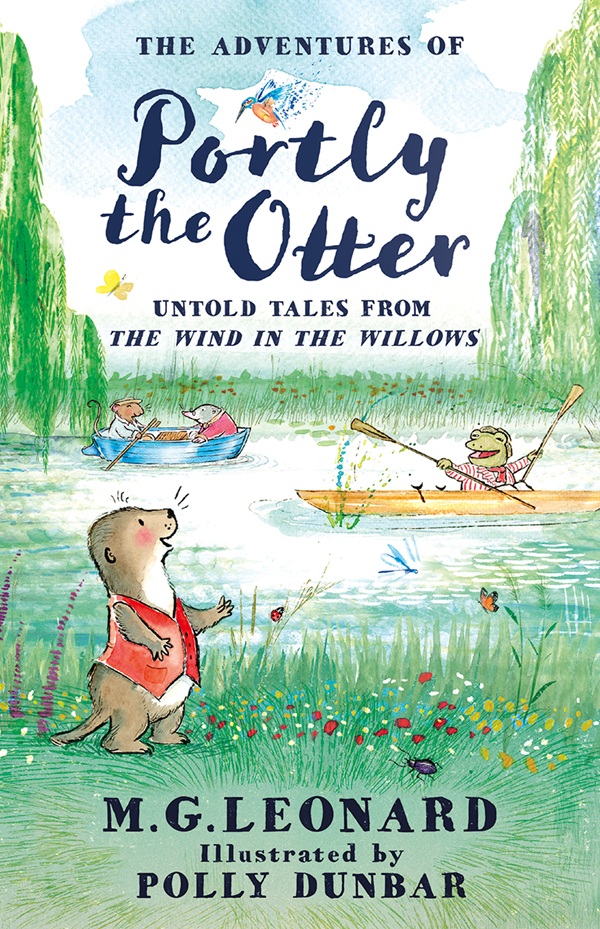 ‘I wasn’t sure I would want to touch it because it’s a precious thing in my childhood and my memory.’ And being asked to follow in E H Shepard’s footsteps (in the 100th anniversary year of the first Winnie-the-Pooh book) was for Dunbar ‘a cross between, Ooh, what an honour, and, Oh, can I do this? Is this allowed? But,’ she says ‘I think the way that Maya has done it is a beautiful tribute, but also a thing in its own right, so it doesn’t feel like it’s stepping on any toes.’
Familiar characters wear Shepard’s costumes in Dunbar’s pictures, but ‘I didn’t overthink it,’ she says. ‘Shepard’s drawings are so much a part of my visual memory that I didn’t study them overly because I didn’t want to try to be emulating his style. I’d rather just respond as myself. Otherwise it would have not been authentic. What I’ve learned from Shepard is the character and the love that he puts into his drawings. That has always been something I’ve tried to do as an illustrator anyway. That’s my whole career, what I’ve been trying to get at: that 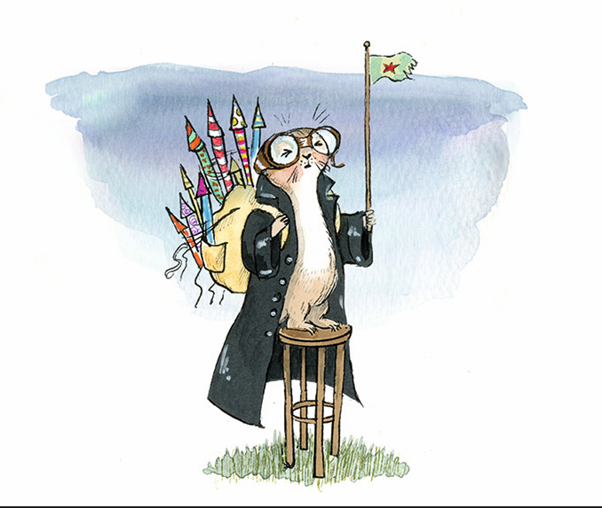 sort of warmth and body language.’
Of course other illustrators of The Wind in the Willows have since followed Shepard, including, Robert Ingpen and Inga Moore, and even Raymond Briggs illustrated the Dulce Domum chapter for a Christmas anthology. Dunbar loves the version by John Burningham who ‘did what he liked.’
‘I wanted to take to it that sort of confidence in expressing the feeling rather than thinking about what this is going to look like in a long line of illustrators. And that’s also what’s important to children, isn’t it? Because they don’t have that history. You have to speak to them without all your baggage of who am I to step in here? It’s more like, what would they enjoy seeing most of in the moment? And how can I express that joyfully?’
Dunbar’s schedule was also short: two months over the summer. ‘So I had to just get on and throw all the energy and the spontaneity at it.’
The climactic story in the new book is the most obviously untold one: what happened to Portly the baby otter before he was found in the lap of the god Pan in the chapter The Piper at the Gates of Dawn (outrageously omitted in some editions). In Kenneth Grahame’s book, Mole and Ratty do not remember what they have seen, and Portly’s memory is wiped too. In Leonard’s version, weasels and stoats are involved, and Pan keeps Portly safe.
This mysterious chapter was Dunbar’s favourite in the original and the scene with Pan is the first she tackled. ‘There’s the hustle and bustle of the river and the picnics and the motorcars, and then there’s that magical stillness. I always felt it was like childhood itself. Magical, but hard to grasp. It slips through your fingers. Like the magic light of dawn that fades. You sort of remember it and want to get back there, but then it goes, and you’re back on with the hustle and bustle, and you don’t really remember, but you feel the presence of it. So I was so keen to do that spread and then built around it all the others. I wanted that atmosphere.’
The illustration for this chapter that was most vivid in her mind was Arthur Rackham’s picture of Pan, which is echoed in Dunbar’s image, though she replaces the direct gaze of Rackham’s Pan with closed eyes, so the scene is dreamy and restful and less disconcerting.
‘I sat outside last summer and painted it [with watercolour, later inserting the background with Photoshop] and there were actually magpies flying about. And so they became part of the picture, which was a lovely thing.’ Staying at a friend’s countryside lodge she worked for a week at a table on a little verandah, ‘trying to be present for the kids, but also do the work. And there was a gypsy caravan opposite, which was amazing. I was just like, oh, I’m here! I’m here!’
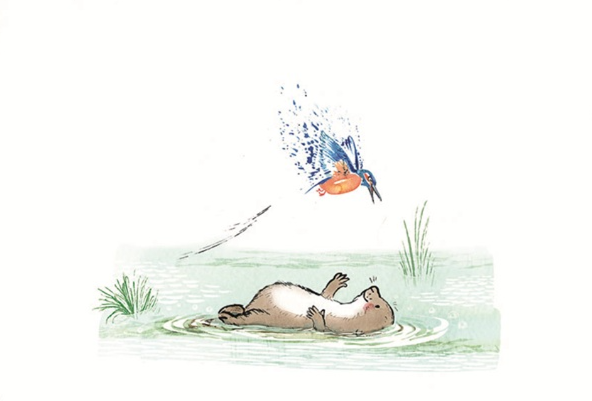 Dunbar lives with her partner and two sons by the river in the Waveny Valley in Suffolk, which was also an inspiration. ‘We do have otters locally and I have seen them but not enough to observe them and draw. More like, oh my goodness, there’s one and then it’s gone.’ So Dunbar also depended on a book of otter photographs as a source, and watched otters playing online. ‘It was a gift really that the main character is an otter because they are quite like children in their movement and they’re very expressive.’
Leonard’s text sometimes has the events of the book we know going on in the background, such as Toad’s imprisonment, and sometimes it invents completely new episodes. In one, for instance, Toad decides he can explore the stars using a backpack full of rockets. Dunbar enjoyed depicting him not getting far off the ground, and says ‘I do love Toad’s extravagant fabulousness.’
Leonard’s writing also accurately celebrates nature, in a way that Dunbar was eager to capture: ‘It’s joyful, and encourages you to look at the detail.’ It helped that Dunbar was walking her young dog twice a day. ‘It felt fortuitous that this text landed in my lap when I was spending my spare time by the river connecting with nature in a way that I haven’t really done for quite a while. Having a dog makes you live in the moment a bit more.’ She confesses, though, that she is in trouble with a son for making Toad green. Toads are brown, he insists.
One significant development in the spin-off stories is that female characters are introduced into a famously male world: Mrs Otter, a roe deer, and Molly, an otter friend for Portly, who aspires to see the sea and is likely to be his companion in a further series. There is also a human girl, Jennifer, described romantically by Leonard: ‘Jennifer’s skin reminded Portly of a dog rose: pale with a blush of pink on her cheeks. She had a nose like a button mushroom and hair the colour of honey. She was wearing a blue dress with a collar of white lace.’ Dunbar says ‘I was delighted when Jennifer stepped in and that was maybe projecting myself onto her because I thought oh, I am in the book as a seven- or eight-year-old. And I think if that had happened in the original, goodness, I would have been so excited.’ Especially since Jennifer looks, she admits, the way she would have liked to look. Perhaps her image of Jennifer is a self-portrait – with a touch of Alice. After all the dedications in this book by author and illustrator are to their childhood selves. (Dunbar’s is to ‘Madeline, aged seven’, since that is her first name.)
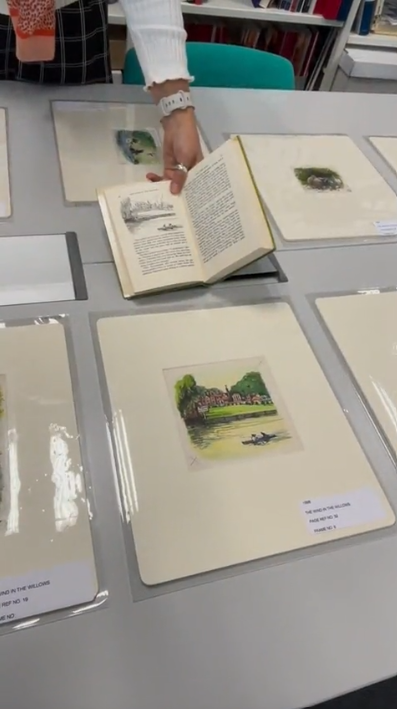 Dunbar had to be accepted as the illustrator of this book by the Shepard Foundation, to whom she submitted a sheet
 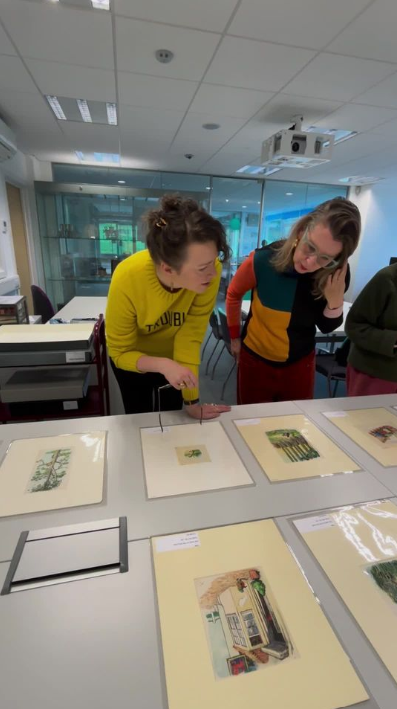 of drawings of otters for approval and permission to use of a version of Shepard’s original map. And she and Leonard made a pilgrimage to the Shepard archive at Guildford University. ‘That was a very moving experience. The human touch of it all, the splodges and the mistakes, like a little pencil question mark or a crossing out. All those things that signalled the human hand brought you immediately closer. The things that you don’t see in the book made it special for us. Shepard did very loose and squiggly roughs, and that was lovely to know as well. And I don’t know how, I came away with a feeling of, what a nice man.’
‘I think, especially now everything is being ironed out with computers and AI it’s the humanity that’s the beauty. As you become a more professional illustrator, you get better, but you become more stylized and lose the truthfulness, like the unself-conscious children’s drawings. That’s why John Burningham’s one of my favourite illustrators, because he never, ever polished his humanity away. It’s always there. And I feel it’s more important than ever to hold on to that.’
Nicolette Jones writes about children’s books for the Sunday Times.
The Adventures of Portly the Otter: Untold Stories from The Wind in the Willows by M.G. Leonard, illustrated by Polly Dunbar, is published by Farshore, 978-0008667771, £14.99 hbk.


