Alexis Deacon: saving the world with picturebooks
An interview by Nicolette Jones.
Alexis Deacon’s career, he thinks, has had two parts. After studying at Brighton, he had early success with his picturebooks Slow Loris, Beegu, Jitterbug Jam and While You Are Sleeping, but from about 2006-10, in his late 20s/early 30s, his hypermobility joint syndrome, which caused tension in the body, led to a physical breakdown. He spent much of his time in bed, trying to get better through his own remedies, until he was helped by ‘a really talented physiotherapist who was very brutal with me.’ When he came back to work, he illustrated chapter books, including Soonchild and Jim’s Lion for Russell Hoban, and created his own graphic novel series, Geis. He also taught at Anglia Ruskin from 2009, until he moved a year ago to teach full-time on the Illustration MA at Goldsmiths, which he describes as ‘superfun.’ Nevertheless, despite successes in this second half of his career, he says ‘I was never able to pick up the momentum that I’d established in the first half.’
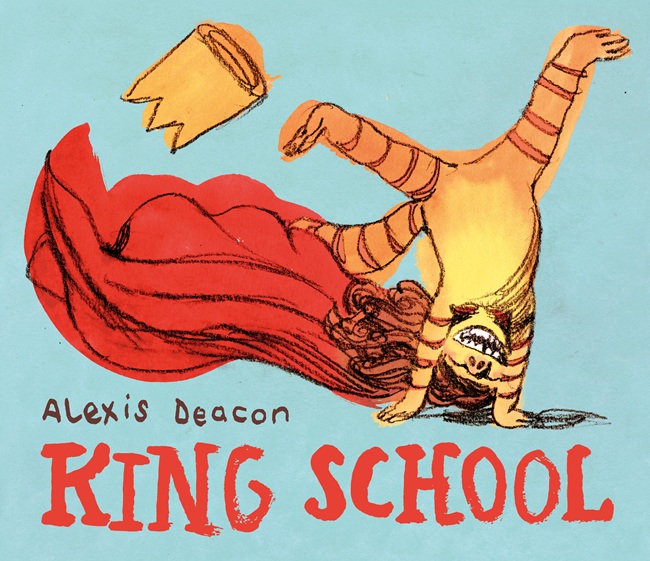 His new picturebook King School deserves to gather momentum. It is a picturebook with a philosophy to live by. The title sounds timely, in this era of ‘No Kings’ protests, and certainly Deacon agrees that with ‘the rise of the strongman/patrician overlord’ it resonates in its exploration of different kinds of authority. But his original idea emphasised schooling over royalty. It concerns a young king who is crammed with information by his advisors, until he rebels and teaches them instead to have fun and enjoy nature.
‘It just flowed out of working with schools, and seeing the pressure teachers are under to deliver a certain sort of learning, which doesn’t seem to have the child at the heart of the experience. I felt frustrated that there’s so much data to support the fact that reading for pleasure and self-enterprise are much more effective ways of getting people to learn. And yet we keep imposing artificial structures which are target-driven and use as many measurables as possible because things have to be quantified, graded, assessed in order to know whether we’re succeeding or not.’
Deacon says his books come out of personal experience ‘to an extent which is embarrassingly revealing.’ Slow Loris for instance, was made when he was a student and therefore ‘night active.’ ‘A lot of my contemporaries were crushingly boring during the day, but very, very engaging at night.’
His own childhood seems to have a bearing on King School. He ‘absolutely loved’ his primary education at a small South London school with a family ethos that was ‘very free and play driven’ until his year became the first to take a formal 11-plus exam. ‘I remember seeing the change in the behaviour of the teachers, how the stress and inhibition of the feeling of somebody looking over their shoulder suddenly came into everything that they were doing. And not only did my experience deteriorate, but I started to learn a lot less and value my time there less.’ The feeling continued into his private secondary school which followed a very formal system.
Deacon wanted to put the fun, and also the observation, back into learning. ‘This is not a story that’s trying to devalue education. I really value learning, and that’s precisely why I think it deserves to be something joyful. I just wanted to espouse the value of being present and engaged with the world and still open to looking. Rather than the king having to assimilate everything that everybody else has learned before.
‘And that’s come out of my own experiences as an art teacher. It’s a little bit like what’s going on with AI right now. It becomes garbage very quickly because it just starts recycling and recycling. Like our water system: by now it’s Prozac and cocaine or whatever. At some point, you need to go back to source and start observing for yourself.’
The characters, both king and advisors, in King School, are creatures with tusks, bulbous noses, and tails, reminiscent of Maurice Sendak’s Wild Things. Deacon sees another influence. ‘There’s a character in The Muppets called Sweetums, the giant shaggy thing. For some reason, that archetype has always really, really spoken to me. It’s like an inner self.’ Sweetums, Deacon admits, is his daemon.
‘The Wild Things have that quality as well. This massiveness, the ratio of head to body, the quantity of fur or feather or hair really speaks to me. And therefore if I’m given the opportunity I will tend to draw things that way.’
Sendak, though, is Deacon’s ‘gold standard’. ‘And my best friend down the street had cardboard cutouts of the Wild Things all along the top shelf in his mum’s studio. They made such an impression on me, these huge characters. I get a lot of joy from drawing things that look like that.’
King School, though, is ‘100% digital in the conception’. Deacon explains: ‘We’ve moved to a graphic aesthetic which is shape-based and colour-based and line is playing less of a role. But that’s never really been my grammar.’ He loves ‘the feeling of rhythm and energy and pace and speeding up and slowing down and lingering. That almost calligraphic way of drawing where we’re looking at physicality and emotion and motion. Line can do a lot of very complex things very quickly.’ But he started working on this book purely digitally ‘because I wanted to think about that grammar of shape and colour. I planned everything out on the computer, in very simple flat colour paintings. And then I used that as a light box for the drawing, so I knew where all the shapes were meant to go. I replaced the digital originals with gouache artwork. So everything is tactile, physical media, but planned and conceived in the computer first of all.’ It seems the opposite way round from the technique of a lot of illustrators who digitise their handmade artwork and manipulate it afterwards.
Meanwhile Deacon ‘100% and thoroughly and entirely’ believes that picturebooks can save the world. ‘I think that stories are the most important cultural pillars, and when we think about the rise of the right at the moment, something that is not engaged with enough is that it’s essentially a grieving for a lost narrative. Lost narratives of masculinity, of culture, of identity, of self-worth, of national worth. People are grieving for lost stories that gave them a sense of meaning in their lives. The story or stories exist somewhere that can unite us again, for sure. Not necessarily picturebooks per se, maybe something that’s more aimed at an adult audience, but a picturebook is an adult story in seed. And I do think that the story exists somewhere.’
King School seems a good place to start.
Nicolette Jones writes about children’s books for the Sunday Times and is the author of The Illustrators: Raymond Briggs (Thames & Hudson); The American Art Tapes: Voices of Twentieth Century Art (Tate Publishing) and Inspire Me! (Nosy Crow), illustrated by Axel Scheffler.
King School by Alexis Deacon is published by Otter-Barry Books, 978-1915659712, £12.99 hbk.


