
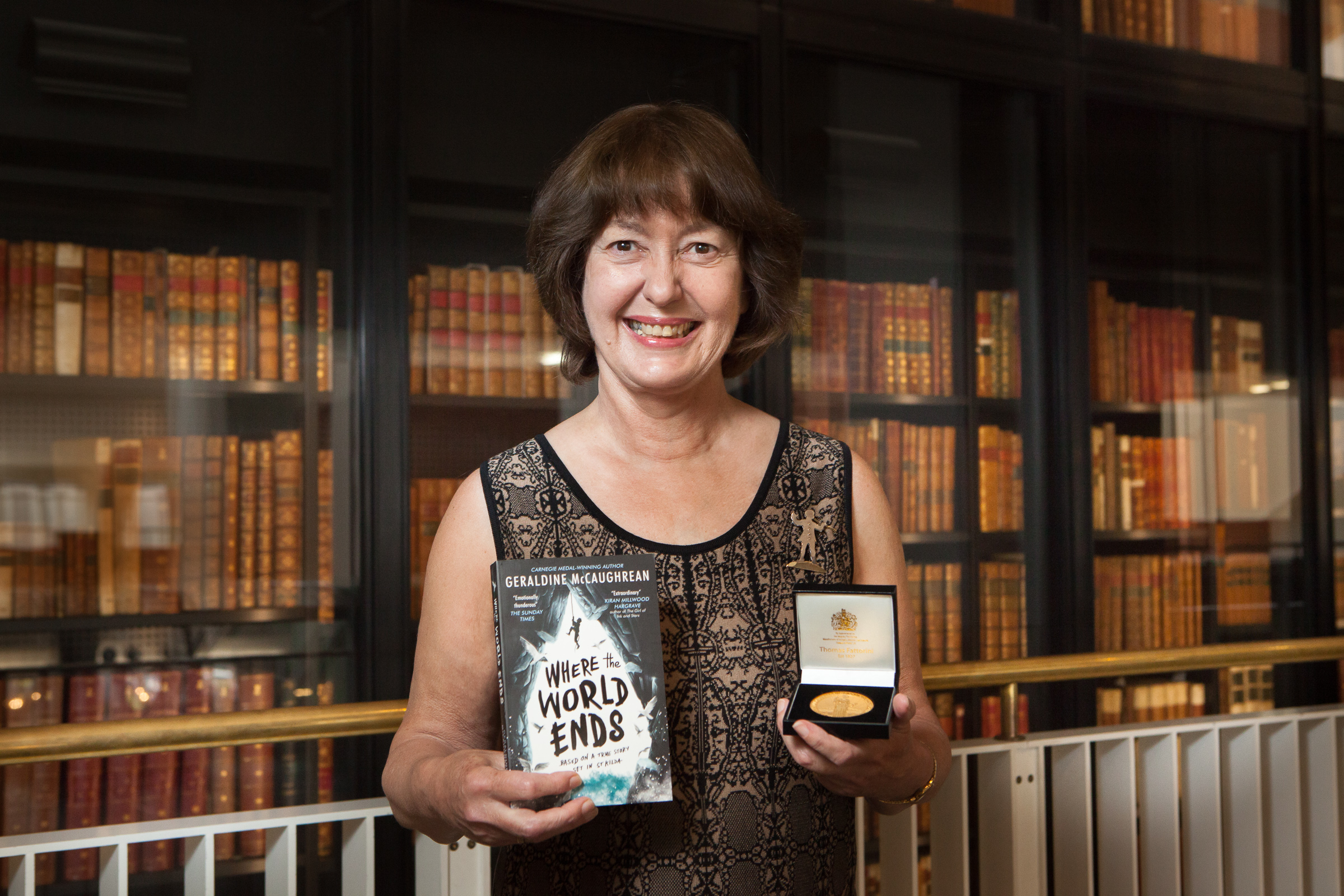
An Interview with 2018 Carnegie Medal winner Geraldine McCaughrean
 Geraldine McCaughrean has just won the CILIP Carnegie Medal, arguably the most prestigious of all the UK children’s book awards, and for the second time. 30 years after she won it with A Pack of Lies, her book Where the World Ends has been awarded the prize. Nicholas Tucker interviewed Geraldine about her win for Books for Keeps.
Geraldine is arguably the finest children’s author of her generation. Each of her many novels explores radically different themes and scenarios; every plot unfolds with that overall sense of ‘Yes! This is exactly what should have happened!’ however unexpected such turns of events may have seemed immediately beforehand. She was awarded the Carnegie Medal in 1988 for A Pack of Lies, a haunting set of stories inspired by a rundown antique shop. She has now won it again with Where the World Ends, a fabulous story of hardship coupled with hope, well deserving adult along with older child readers.
It tells the true story of small group of senior boys accompanied by three men making their annual boat trip in 1727 to gather gannet chicks and eggs for winter consumption. The nesting home in question is the formidable Warrior Stac, an uninhabited rock standing on its own surrounded by miles of sea. The group set sail from their home on remote and impoverished Hirta, one of the isles of St Kilda off the West coast of Scotland. Spoiler alert now: seemingly abandoned once there, the group manages to exist over nine months in terrible conditions before a rescue boat finally arrives. All this is compellingly described down to the last detail. So has Geraldine actually visited either rock or island?
No, I haven’t. The trouble with Hirta is that you can go all the way to Scotland and catch a boat and then find there’s a good chance you won’t be able to get off because of unfavourable local conditions. But my daughter went and came back with so many photos and memories that she got me all excited about it. So I set out initially to write a kind of positive Lord of the Flies, showing how a group of mostly young people left on their own decide to construct an ideal society. But this didn’t work; there was no tension and no villains. So I had to take a different direction.
There are many descriptions of climbing in the book – inevitable for those stranded on an almost vertical rock. Are you anything of a mountaineer yourself?
Not at all. Climbing scares me, and I needed that element of fear to get the writing going.
Have you ever tasted a baby gannet?
No. Apparently it has quite a fishy tang to it, and I like my meat to taste of meat!
Going back to Lord of the Flies, one difference in your story is that there were three men in the party. But it is one of them that turns out to be the chief danger. Are you saying here that any group finding itself abandoned on an island faces evil from inside, whether there are adults there or not?
Yes, in a sense. But having an adult villain also has the effect of getting the boys to pull together in the way they eventually did after the bad character in question escapes from the island with most of their provisions. Left to cope on their own, they then mostly do.
You don’t have much good to say about those claiming to speak in the name of religion here. They also get short
shrift in your previous book set in Noah’s Ark, Not the End of the World.
I attack religious zealotry, rather than religion itself. I have another character in my novel who also has religious visions but he does not use them to try to control others. It makes him a little bit of a pain to be with, but fundamentally he remains completely sound.
There is a lot about the healing power of story in the book, with Quill, the main boy character, taking on the story telling role as one way of keeping spirits up. But there can be malign stories too, in the shape of those told by Col Cane, the older man and a self-serving religious bigot. So where does that leave us with the whole idea of the validity or not of stories in themselves?
There always are pernicious stories from the past that seem to be telling people what to do now. But in this novel all I really wanted to do was say what a consolation stories can offer and what an escape from the occasionally almost unbearable.
Quill and the love of his life still manage to come together in the end despite many obstacles. What is your story telling us at this point?
It had to have an up-swing in the end! I am a dyed in the wool Ron Heapy disciple. He always had this fundamental belief that you could not leave child readers in a hopeless universe when finishing a story, whatever ghastly places you are taking them too beforehand. I would never write a story that ended without a sense of hope.
Ron Heapy was for many years the inspirational head of Children’s Books at the Oxford University Press where Geraldine worked as a young woman. It was he who first suggested she should try her hand at writing stories, and it is a shame he missed this one after dying only last year. But Geraldine, still in her late sixties but looking much younger, remains an unstoppable force even after over 160 titles. And the good news is that yet another novel has just been finished, set in a flood and focusing on the manipulation of public opinion through fake news. Can’t wait!
Nicholas Tucker is honorary senior lecturer in Cultural and Community Studies at Sussex University.
Where the World Ends is published by Usborne, £6.99pbk.


