
Animal characters: check your bias
Melanie Walsh of University of Washington shares her investigations into the subtle gender imbalance often at play in picture books featuring animal characters.
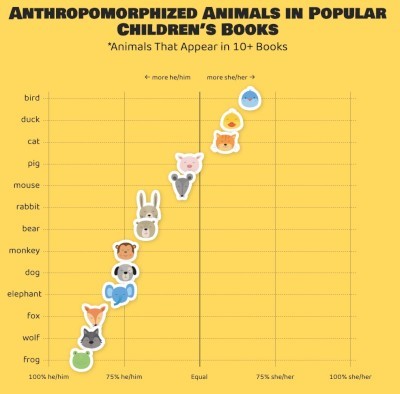
I recently published a data analysis with The Pudding, a digital publication known for data-driven storytelling, about animal characters in picture books. We read approximately 300 popular English-language picture books from the past 70+ years and noted the gender of any anthropomorphized animal character that was important to the story.
We found that male animal characters were twice as common as female characters across all the books. Some strong animal stereotypes also emerged: frogs and dogs were boys; birds and cats were girls. Even more surprising, according to our data: this disparity is not obviously improving, even over the last 25 years.
Our study was small and focused on the most popular books on Goodreads. But when I started digging into the research and talking to experts, I found out that this sneaky bias has been dogging animal characters for many decades—and it may be a bigger problem than it seems.
In 2011, a study led by Janice McCabe, now a professor at Dartmouth, analysed the protagonists of more than 5,600 children’s books throughout the 20th century. The researchers found that representation of female main characters was steadily improving over time. But this was only true for the female human characters. For the female animal characters, representation was not improving.
Why are animal characters so, well, stuck?
The study pointed to an idea that has long shaped children’s publishing: animal characters can help us sidestep pesky human problems. Back in the 1970s, one children’s book editor told researchers that animal characters just make things “easier”: ‘You don’t have to determine if it’s a girl or boy—right? That’s such a problem today.’
Decades later, agent Marcia Wernick, whose clients include children’s book author Mo Willems, echoed the same logic in the Washington Post in 2016. ‘Anthropomorphized characters have always been in the forefront of children’s books,’ Wernick said, ‘because they enable the creator to not have to make decisions about is this a tall or short, black or white… character.’
Feather Flores, an editor at Atheneum Books for Young Readers, says that ‘universal’ animal characters can be powerful but also problematic. ‘Anthropomorphized animals can be extremely useful as a vehicle for fable, allegory, satire, or social commentary,’ she said. But, Flores continued, ‘Attempting to build relatability or universality by stripping away the ways we are embodied and experience the world as humans does not always—or, I would argue, usually—make for the most emotionally resonant stories.’
Beyond emotional resonance, the data suggests that when we create animal characters, that’s often when we most faithfully reproduce—and even exaggerate—the cultural norms we think we’ve left behind.
Even gender-neutral animal characters are often assumed to be male. In a classic 1987 study, mothers reading aloud to their children referred to ungendered animal characters as male 95% of the time. One of the only feminine designations was for a duck pictured with two ducklings—’Mrs. Duck.’ We similarly observed that many female animals were moms, background characters for male leads.
And, lest we forget, all this matters. ‘Differences in representation really matter, whether characters are human or animals,’ says Megan Fulcher, a professor of cognitive and behavior psychology at Washington & Lee University, who focuses on gender role development in children. This lack of female representation not only provides girls with few models, but it also prevents boys from practicing cognitive skills like empathy.
Fulcher and her lab have found the same problem in toys for children. ‘Boy toys’ like action figures and Legos often include few or no female characters, which makes ‘women and girls invisible in boys’ pretend play’ and leaves their imaginative worlds ‘void of girls.’
If we apply this logic to picture books, the view is rather bleak. Because animal characters obscure all kinds of human difference. A 2020 U.K. study found that there were more animal protagonists in British children’s books than Black, Asian, or ethnic minority protagonists. And, recently, animal characters have been used to represent transgender people, which writer Parrish Turner has argued can fall flat or worse.
So much for sidestepping human problems. Animal characters don’t just reflect our biases; they often deepen them.
I asked Fulcher if she was surprised by the lack of progress in gender parity among animal characters. She wasn’t. In new research, her lab is finding that gendered traits in toys have barely budged in the past 30 years. So it wasn’t a shock that books reflected the same stagnation.
As she reminded me, it takes time to move the needle, both in the publishing industry and at home. ‘Parents provide books to kids that may be new or old, so it will take a minute to trickle into kids’ lives even if the gap [in representation] disappears today,’ she said.
For now, it may be worth looking twice at your animal characters, and looking into the data.
Melanie Walsh is an assistant professor in the Information School and an adjunct assistant professor in the English department at the University of Washington. She uses data to analyze contemporary culture, especially literature and publishing. She is currently at work on a book, When Postwar American Fiction Went Viral: Protest, Profit, and Popular Readers in the 21st Century, which follows the surprising social media afterlives of five iconic American authors.
©PWxyz, LLC. All rights reserved. Reprinted by permission. This article first appeared on PublishersWeekly.com on August 5, 2025.


