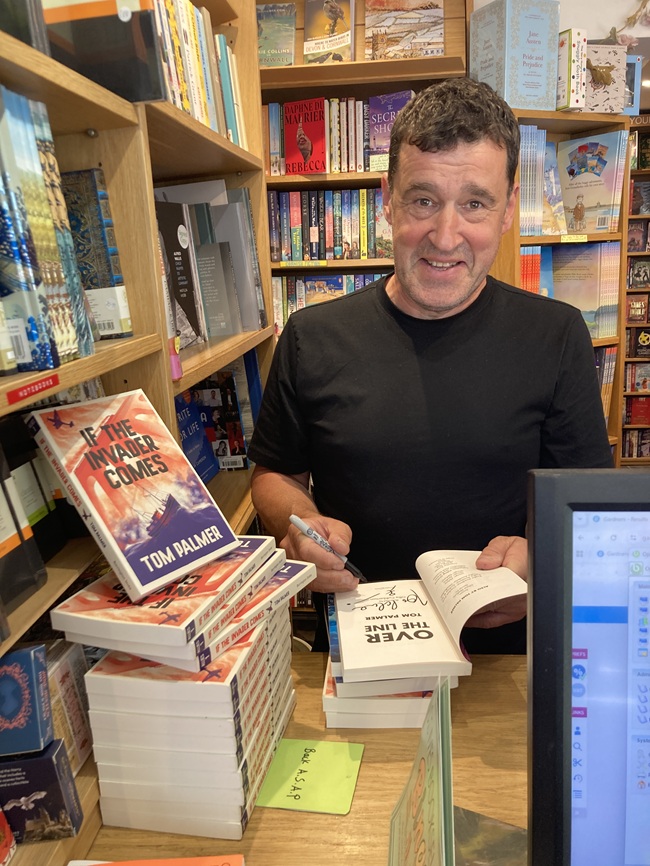
Authorgraph number 279: Tom Palmer
Tom Palmer interviewed by Damian Kelleher
It’s been quite a week. On Monday the Prime Minister resigns, on Tuesday England cling on in the World Cup, and a heatwave kicks in to test the nation’s mettle (which is already starting to buckle). It’s only Wednesday, and I’m talking to award-winning children’s author Tom Palmer.
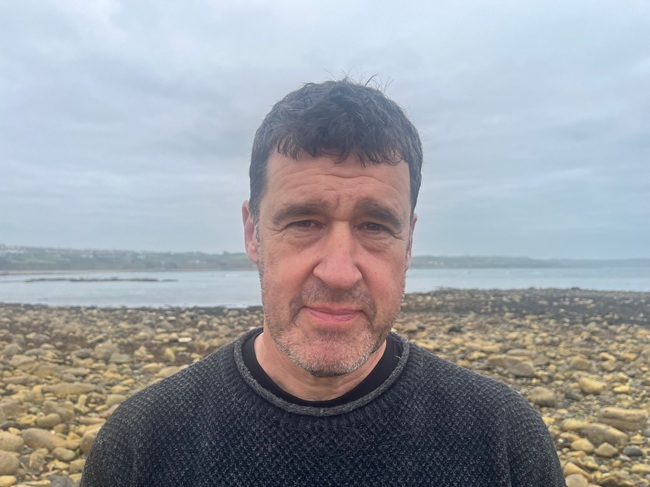 Tom is taking it all in his stride. Yorkshire born, he can turn his talent to sport or historical fiction (‘I like alternating’) but we’re holding off from football for the minute to talk about his latest novel If the Invader Comes. Set in Cornwall in June 1940, war, it’s the first in a new Allies trilogy for publisher Barrington Stoke and marks a new departure for Tom. He and his family have moved from West Yorkshire to Cornwall, and he’s been working with Mylor Bridge Community Primary School in writing this book.
‘We made the move down to Cornwall five months ago,’ Tom explains. ‘I’ve been in West Yorkshire all my life so it’s quite a change, but in a good way. We have been coming to Cornwall for years and we wanted to move here, and part of that was that need to work in schools in Cornwall. We love it here; we love the history, the scenery. I wanted to write a trilogy set in Cornwall and I have to say a huge thanks to Barrington Stoke for letting me do it. Without that, we couldn’t have moved.’
Palmer’s career in publishing began in the 1990s and he reflects on changes in children’s books over recent decades.
‘There was a really strong vibe about publishers nurturing authors and caring for them. I sense, from talking to a lot of people in publishing and other authors, that that is no longer the case, but I really do get that love from Barrington Stoke and I love them back.’
‘The other factor in all this is my editor Ailsa Bathgate. She’s extraordinary and she makes me work really hard on these history books. One of the reasons why they work is because she pushes me and pushes me. I always tell kids that being edited is like working with a football coach; you have natural talent but you need to be guided and trained, and over about fifteen, twenty books she has really taught me and challenged me in so many ways.’
With Palmer’s historical fiction, an integral part of the writing process is his contact with local schools for comments on plot, characters and 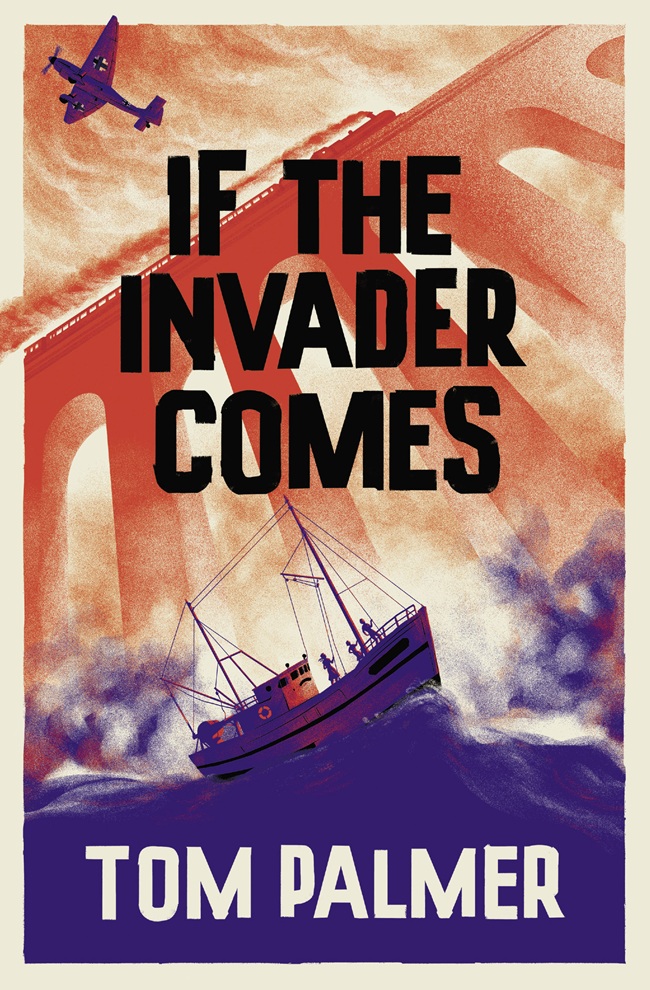 more. ‘The input and feedback from those interactions is invaluable’, he says. If the Invader Comes focuses on three children, Bobble, Cilla and Cadan, whose parents are involved in top secret war work. During the course of the story the children – the Allies of the title – find themselves playing their own vital parts in the fight against the enemy forces. These roles emphasise to readers how different life was at a time when ‘Careless Talk Costs Lives’.
‘It’s hard to imagine,’ says Tom. ‘Even now with the world swept up with war, most of us haven’t got a clue what it was like. But you talk to people in their 90s who were there and who lived it and you realise it was very temporary – they didn’t know what was coming. Life wasn’t easy. If people couldn’t say what they were doing, people bitched and gossiped about them. What a horrible situation to be in.’
The book’s title is a direct reference to a Ministry of Information leaflet circulated in 1940 that informed the British population of what to do in the event of a German occupation.
‘There’s a line that says if the invader comes, stay in your homes because if you run away you will be machine gunned from the air as were the citizens from Holland and Belgium.’
Books two and three in the trilogy will reflect the titles of government information posters designed to help the war effort.
One of the advantages of working so closely with schools when writing historical fiction is that Tom has his own ‘sensitivity readers’ on hand to ensure the material is suitable for a younger audience. Telling Second World War stories requires authenticity and honesty but where do you draw the line when it comes to actual descriptions of the horrors and injuries that inevitably take place during wartime? One scene that Tom describes in the book is Cilla discovering a German airman trapped in a burning Messerschmitt.
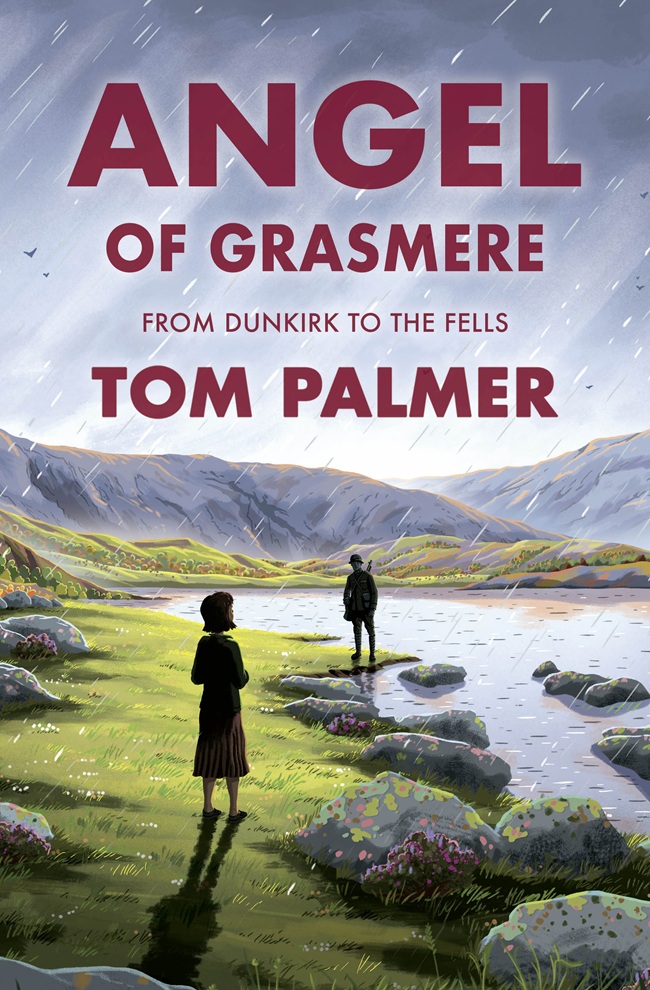 ‘Scenes like that are based on real events: there was a girl who was cycling along who actually witnessed that. But I work with schools a lot – when I was writing Angel of Grasmere, it was Grasmere School in Cumbria and for If the Invader Comes it was Mylor Bridge Community Primary School in Cornwall – and with the teachers and the kids, we work out how far to go. But the children want to know – they want to learn stuff and they don’t want to be talked down to. They don’t want stuff hidden from them, but they don’t want to be traumatised either. With the teachers’ help, we worked closely together on that scene to make sure it’s honest but it wouldn’t freak kids out too much. You’re always treading a fine line.’
It’s a line that also needs to be carefully negotiated during Tom’s numerous school and library visits. He’s worked with all the leading literacy charities – Book Trust, the Reading Agency, the National Literacy Trust – to support reading for pleasure and campaigns to encourage readers of all ages, backgrounds and abilities. And to remind his audience that authors are real people – real ‘live’ people!
‘I never had an author coming to me when I was at school,’ says Tom. ‘Some kids have even told me, “I thought you were dead!” But I hope that when we authors go into schools, we open people’s eyes and help them realise it’s not just this elite posh thing, it’s through all of us, reading and writing.’
Going into schools to meet younger audiences to talk about historical fiction reminds authors like Tom that it’s not just about reading books – the ability to read a room is also key.
‘They get the echoes with what’s going on with the world today – Ukraine, they get that. They are interested in it.’
‘It’s so hard to imagine in this country being bombed or being made to live hundreds of miles from where you’re from, or having family members on the other side of the world – possibly dead – and all the other hardships that come with it, evacuation and so on. I had a child from Ukraine in my class in Launceston a couple of weeks ago, and the kids there know that she’s been through stuff. I was asking who likes history and who doesn’t like history and she put up her hand and said “I don’t like history.” And when I asked why she said, “Because we’re supposed to learn from it, and we never do.” That was right at the beginning of my event. And the whole thing was about war! So I really toned it down and spoke about the process of writing instead because it’s like, Christ, what has she been through?’
‘There was another event I did in Liverpool a few years back. I was talking to them about my book Resist and Audrey Hepburn being bombed in the town that she lived in. And I said, ‘bombed’ and one boy in the front row sort of twitched and he put his head down. I didn’t know where he was from. Then the second time I said ‘bomb’ he put his arms around his head. So I completely stopped and changed tack. It transpired he’d come from Syria – and there’s me glibly talking about bombing. But I do believe books help kids understand what their classmates have been through. It’s all about empathy.’
When did the fascination with history first kick in? Was it back in school? I ask. Tom shakes his head.
‘I didn’t like reading until I was about 17 and I really struggled with it at school. I wasn’t allowed to do English literature, French or History throughout secondary school. But my mum and dad used to take me to castles and museums and they got me into history. Unfortunately they both died when I was in my early 20s. Maybe it’s just me trying to make sense of the past but I think they instilled that love of history in me. And once they weren’t here, I went to seek it out.
‘Growing up, I thought writers were nothing like me. I thought they were fabulously wealthy, highly intelligent, usually from London! I had this idea in my head that someone from Leeds couldn’t be an author and then Tony Harrison, the poet appeared. I thought, “Oh my God. There’s someone from Leeds who writes about Leeds!”’
For Tom, the next books to hit the shelves will be sporting titles.
‘I’m doing some sports fiction for Barrington Stoke’s Underdogs series, but I’m also doing some of the Ultimate Football Heroes books, England, Real Madrid and Liverpool. It’s nice mixing it up. These emotional stories are so heavy that you want something a bit lighter. It’s a break from the ‘meat’ and you still earn money.’
Damian Kelleher is a writer and journalist specialising in children’s books.
Books mentioned, all by Tom Palmer.
If the Invader Comes published by Barrington Stoke, 978-0008802226, £7.99 pbk
Angel of Grasmere published by Barrington Stoke, 978-1800902169, £7.99 pbk
Underdogs series, published by Barrington Stoke, various, £7.99pbk


