
This article is in the Beyond The Secret Garden Category
Beyond the Secret Garden: Partition in Children’s Books
In their latest column in this long-running series, Darren Chetty and Karen Sands-O’Connor consider a topic that initially proved difficult for authors to write about.
For decades after the Partition of India in 1947, there was a silence in children’s books about the topic. A brutal, seemingly random line was drawn across a country by a man, Cyril Radcliffe, who had never been to India before the British government sent him to decide on the Partition. Radcliffe used out-of-date maps and focused on trade routes (railways and rivers) rather than people, religions, or communities to make his decision. Over fifteen million people moved from one part of the country to another, and up to two million were killed during the sectarian violence that followed Partition. Many people who experienced the worst travesties of Partition did not want to remember or talk about what happened to other adults, let alone write about it in books for young people.
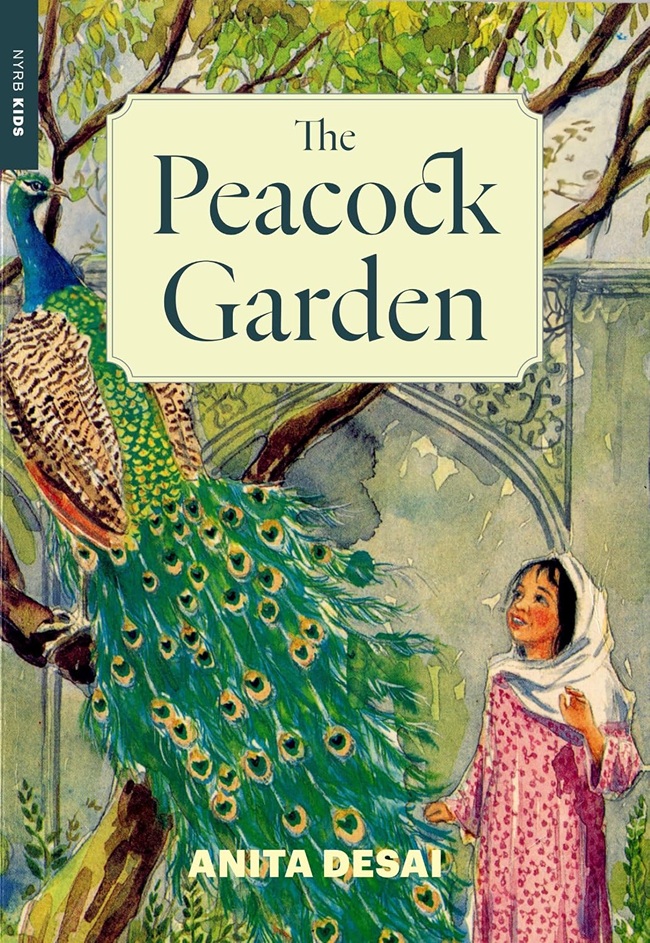 One of the earliest UK published children’s books to deal with Partition is The Peacock Garden by Anita Desai. Originally published in 1979, with illustrations from Mei-Yim Low added in 1991 (Mammoth), it tells the story of Zuni, a young Muslim girl. Her father does not wish to leave the village for Pakistan and so her family seek refuge in the local mosque in Punjab. There is a sense of the turmoil taking place ‘out there’ and of the anxiety it provokes in the family. The cover and the final scenes feature a peacock, both the national bird of India and a symbol of renewal.
In 1992, Jamila Gavin was born in India in 1941 to an English mother and an Indian father and brought to England by her mother after she heard reports of massacres after the 1947 Partition – wrote The Wheel of Surya, one of the first British novels for children to address Partition. In the novel, two Sikh children, Marvinder and Jaspal, become separated from their mother during the mass movement of people between India and Pakistan. Gavin doesn’t pull any punches – the children witness violence that destroys their village and results in the death of their uncle and are nearly part of one of the ‘massacre trains’ in which one religious group would kill the trainful of people trying to escape to the other country. They survive only because they got off the train when it stopped, and are later rescued by soldiers and taken to a refugee camp. Eventually, the 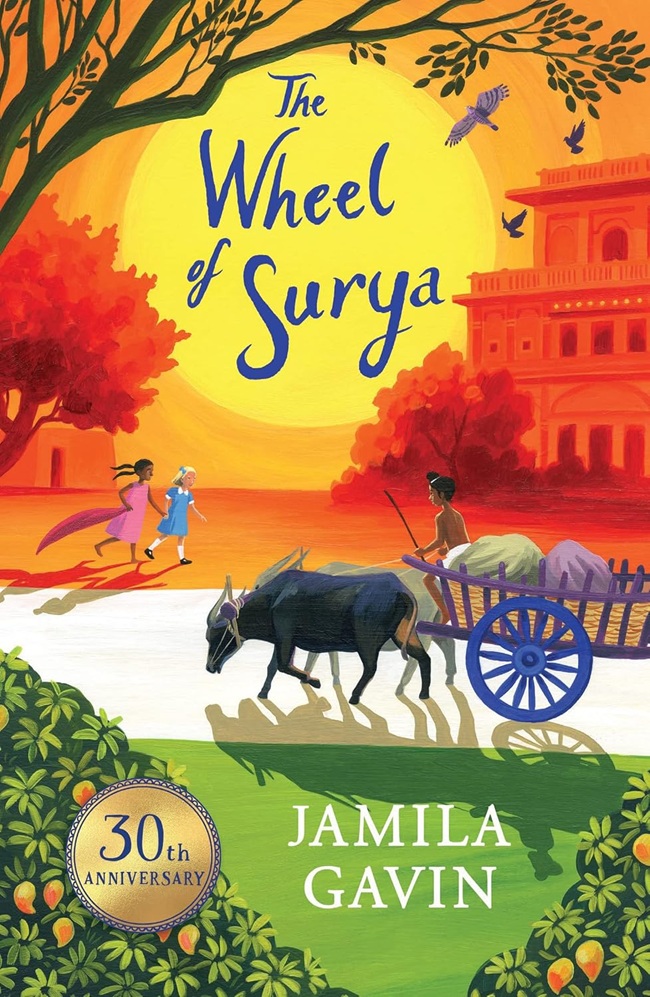 children appeal to missionaries, who bring the children to England, but not before they witness extensive violence that will go on to affect their lives forever, especially Jaspal’s. Gavin’s trilogy of books (The Wheel of Surya, The Eye of the Horse, and The Track of the Wind) were all shortlisted for the Guardian Children’s fiction prize.
Irfan Master’s critically acclaimed A Beautiful Lie (Bloomsbury 2011) explores how the personal is political. Bilal’s father is in his final days and Bilal works to keep the realities of partition from him for fear it will break his heart, The story shows how large political events impact human lives and raises interesting  questions about truth, information, silence and denial.
Since the 75th anniversary of Partition in 2022, there has been an upsurge in books for young people, mostly authored by children and grandchildren of people who experienced the separation of India and Pakistan. The fact that the authors and illustrators come from all over the global Indian diaspora demonstrates the effect that Partition had beyond India. Two picture books about Partition demonstrate the way that the movement of people due to Partition extended well beyond its borders. Author Namita Moolani Mehra was born in Nigeria, and currently lives in Singapore; illustrator Beena Mistry is based in Toronto, Canada. Together they produced Veena and the Red Roti: A story of hope during Partition (Kids Can Press 2024). British-Indian Swapna Haddow has lived in both the UK and New Zealand, and she wrote The Line (Scholastic 2026) as part of her Creative New Zealand Children’s Writer-in-residency. The book was illustrated by British-Pakistani illustrator Farah Shah. All the creators of both books thank parents or grandparents for inspiration and support in writing about their heritage countries. Both Veena and the Red Roti and The Line are hopeful stories, and focus mostly on the separation rather than the violence of Partition. Both also showcase children who take imaginative action against the sadness that Partition causes: Veena, to stop her mother from crying, goes to the kitchen in the refugee camp to offer to make roti out of the hard red ragi (also known as finger millet). The child in The Line is inspired by her mother’s singing of familiar songs as they walk an endless line to their new home. She imagines drawing a different kind of line than the one that separated the nation, a line that would bring people together rather than separate them, and a line that would turn into alphabets so that stories could be written.
 The Line followed Swapna Haddow’s more harrowing version of Partition for older readers, Torn Apart: The Partition of India (Scholastic 2021). Like Jamila Gavin’s novel, Torn Apart does not shy away from the massacre trains, the religious divisions and the violence. But Haddow was keen to write a story that demonstrated the similarities between the two protagonists, wealthy Muslim Ibrahim and Hindu street child Amar. Both boys love the cinema, both have lost loved ones due to the violence. They need each other to survive. And although (or perhaps because) Haddow’s research suggested that many people, including children, did not survive, she leaves the ending of the novel open: the two boys have separated, and Amar says that he never hears from Ibrahim again – but he does see him a couple of times, and wonders if Ibrahim eventually made it across the border. Despite Haddow ending the novel with Amar hearing news of another massacre train, she leaves it to the reader to decide whether or not Ibrahim was on it.
Janeen Hayat’s Evie and Maryam’s Family Tree (Guppy 2025) focuses on another kind of friendship, not between Muslim and Hindu but between Indian and English girls Safia and Kathy. Theirs is a lopsided friendship – Kathy does not think about how her rule-breaking weighs more heavily on Safia than on her, and Safia recognizes that Kathy is selfish. They disagree about the fate of India (Kathy tells Safia it is her ‘Father’s job to try to keep people from breaking the law’ when Safia protests that Gandhi is not a criminal for protesting the salt tax). And yet, the friendship lasts, not only when Kathy leaves for England, but down the generations when modern-day schoolgirls Evie and Maryam uncover their shared history through their grandmothers. Friendship, in both Hayat’s and Haddow’s books, transcends politics.
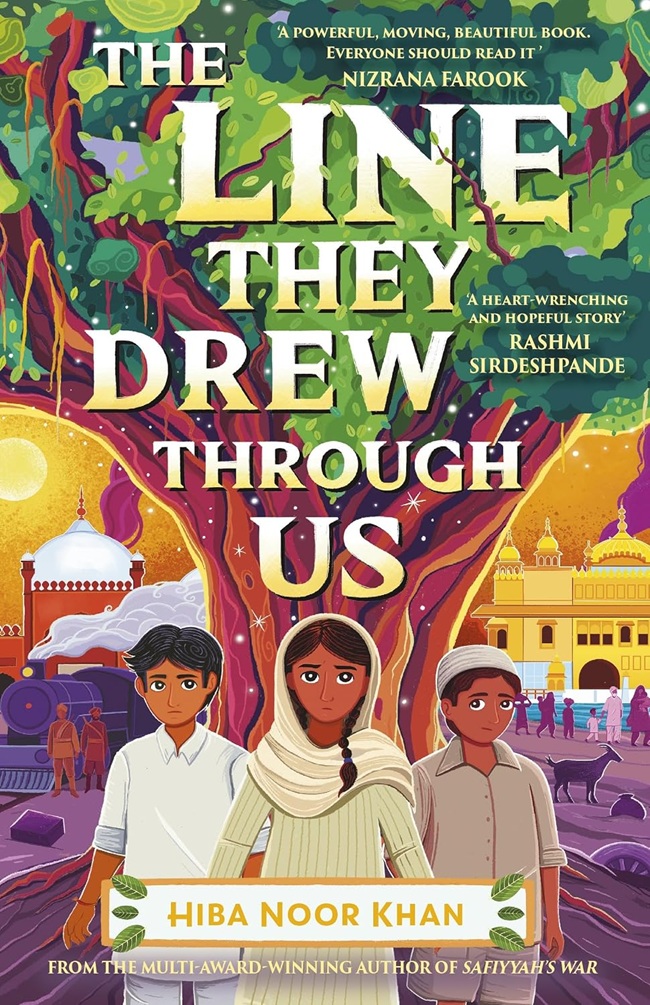
In The Line They Drew Through Us (Anderson Press, 2025), Hiba Noor Khan, who describes herself as a second-generation British Pakistani, offers a child-centred story that shows the violence associated with partition. Her opening chapter, Kismat, introduces us to three children born on the same day in 1935. There are clear similarities with Salman Rushdie’s Booker Prize winning Midnight’s Children. Here though, the children reach the age of twelve at the time of Indian independence and the establishment of Pakistan. There is a greater breadth of scope in this book than in many others centred around partition. We learn of the Bengal famine, the Amritsar massacre and Indian indentureship in the Caribbean for example. Whereas some children’s books portray partition as a consequence of almost a lack of interest on the part of the British, Khan explores how British interests drove the project just as they had driven events in India for many decades before.
Most recently, Iqbal Hussain’s The Night I Borrowed Time (2026) employs a magical time-travel element where Zubair moves between contemporary life in Lancashire and 1947 India. There is a rich contemporary story – Zubair is desperate to save his parent’s marriage – while at the same time we come to understand Partition not merely as an event in the past but as something that continues to reverberate in the lives of people today.
Dr Darren Chetty is a writer and a lecturer at UCL with research interests in education, philosophy, racism, children’s literature and hip-hop culture. He contributed to The Good Immigrant, edited by Nikesh Shukla, and has since published six books as co-author and co-editor, the latest being Our Wales: A People’s History. On social media he is @rapclassroom.
Karen Sands-O’Connor is a Visiting Professor of Education at the University of Sheffield. Her book British Activist Authors Addressing Children of Colour (Bloomsbury 2022) won the 2024 Children’s Literature Association Honor Book Award.
Darren and Karen’s book Beyond the Secret Garden: Racially Minoritised People in British Children’s Books is out now, published by English Media Centre.
Books mentioned
The Peacock Garden, Anita Desai, NYRB Kids Books, 979-8896230601, £11.99 pbk
The Wheel of Surya, Jamila Gavin, Farshore, 9781405291743, £7.99 pbk
A Beautiful Lie, Irfan Master, Bloomsbury, 978-1408805756, £8.99 pbk
Veena and the Red Roti: A story of hope during Partition, Namita Moolani Mehra, illus Beena Mistry, Kids Can Press, 978-1525307355
The Line, Swapna Haddow, Farah Shah, Scholastic, 978-0702328848, £7.99pbk
Torn Apart: The Partition of India, Swapna Haddow, Scholastic, 978-0702300417, £4.99 pbk
Evie and Maryam’s Family Tree, Janeen Hayat, Guppy Books, 978-1916558410, £7.99pbk
The Line They Drew Through Us, Hiba Noor Khan, Andersen Press, 978-1839134722, £7.99 pbk
The Night I Borrowed Time, Iqbal Hussin, Puffin, 978-0241742624, £8.99 pbk


