
Exploring Worlds of Wonder
Daniel Hahn introduces a new celebration of great children’s books.
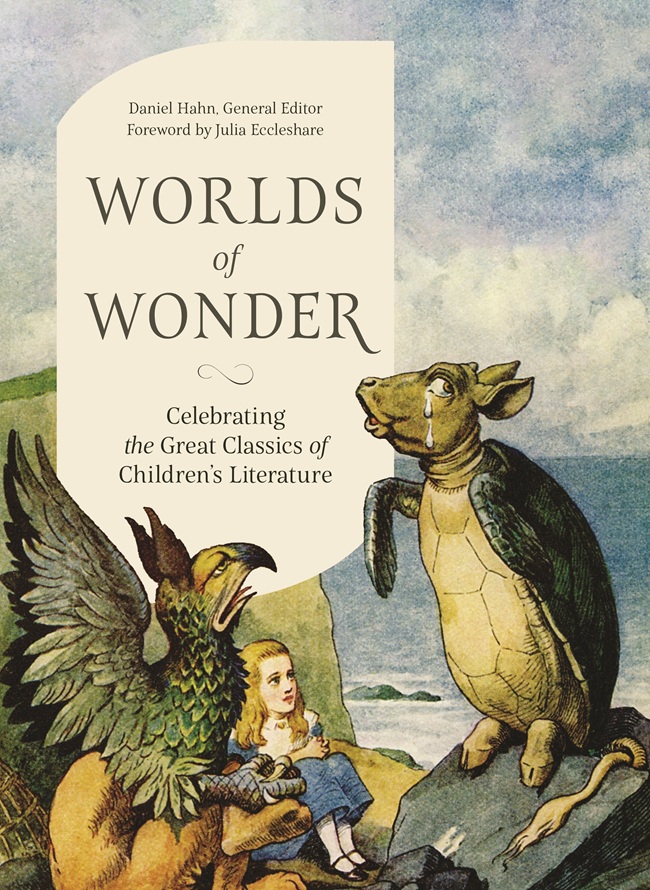
I’ve been lucky recently to have had an overseeing role for Worlds of Wonder, a beautiful volume that has just come out from Princeton University Press. Worlds of Wonder is a celebration of great classic children’s books, though it is not itself principally for children. The seventy-something pieces we commissioned are written by adults, often in retrospective mode – many of these will be books we first read long ago as children ourselves – so it is not altogether without affectionate nostalgia. But it’s clear-eyed about a lot, too. The contributors are enthusiasts, but they are also critics – children’s literature academics, reviewers, etc. (Contributors from here in the UK include Nick Tucker, Kim Reynolds and Peter Hunt; the foreword is by Julia Eccleshare, likewise well known to all Books for Keeps readers.)
Now, I mentioned in passing a moment ago that we are writing about classic children’s books, and I used that word ‘classic’ as though it wasn’t contentious. It is, however – rightly so. Though I feel that at least a few books are shoo-ins for that label. That’s an inelegant mixed image, incidentally, and you wouldn’t catch one of the world’s great Ursula Le Guins or Salman Rushdies using it. Le Guin’s A Wizard of Earthsea did seem like an obvious contender, by the way; Rushdie’s Haroun and the Sea of Stories needed to be in too – I love it. Or do you disagree?
Given the potential scope – any great books for children from anytime (in practice, we’re talking about the last couple of centuries), and from anywhere – we needed some artificial constraints, of course. So the first determination: one book per writer, so if Charlie and the Chocolate Factory is there, then no BFG; Five Children and It precludes The Railway Children. The focus would be roughly (these things are always blurry) on fiction that creates a world, though this might be a real world; and which sits somewhere post-picturebooks and pre-YA, which meant turning down Where the Wild Things Are, which was especially painful. We allocated ourselves a somewhat arbitrary cut-off date for publication ten years ago (even ten years ago feels recent enough that the latter choices were particularly tricky), so we had favourites that fell foul of that rule – we had to lose the superb The Murderer’s Ape, and The Cat Who Saved Books, among others. The books we covered could come from anywhere in the world – and the more range the better – but they needed to be available in English (written in, or translated into), more about which in a moment…
Oh, and because Worlds of Wonder was always intended to be a beautiful volume, every book we included needed to have some strong potential for visual representations (whether illustrations, beautiful jacket designs, stills from an animated adaptation or whatever). When you see the beautiful work done by the team at Elwin Street who produced the book, you’ll understand why that last one was so important.
All these things helped to narrow our choices down, if never making them actually easy. But there were other constraints that were beyond our control, too, and they’re revealing. Worlds of Wonder exists to remind readers of books they might have loved, and I hope to introduce them to new things, too. But our readers are the readers of the English-speaking world specifically, which also determined not only the inclusions but also some of the omissions. I’m very proud that our selection includes work spanning about twenty countries and a dozen languages of origin, but the limitations of our publishing world were perforce our book’s limitations, too. I’m a translator, and feel particularly keenly the absence of books by writers in the ninety-something percent of the world who don’t speak English. Whole swathes of the globe were a challenge; yes, French and Japanese are represented better than most, but even then… And perhaps you know loads of children’s novels from the languages of South Asia, or from South-East Asia, or from Spain, but I struggled to find things the English-speaking market had bothered to notice. The inclusions were thrilling, no question; I can’t pretend some of the gaps weren’t a little dispiriting, though. I’d like to imagine a future edition that might reflect some improvements.
In the meantime, of course, we won’t be running out of remarkable English-language books to celebrate anytime soon. I wrote just a handful of Worlds of Wonder’s little essays myself, and alongside the brilliantly translated Tintin, I got to write about Winnie-the-Pooh, A Wrinkle in Time, Pig-Heart Boy and (best title ever) The Great Piratical Rumbustification – and I agreed to do these mostly because it gave me an excuse to read them again, a pleasure I hope to share with our readers, in turn.
Daniel Hahn is a writer, editor, and translator. His work has won the International Dublin Literary Award and the Independent Foreign Fiction Prize, and has been shortlisted for the Man Booker International Prize.
Worlds of Wonder is published by Princeton University Press, 978-0691274638, £25.00 hbk


