

Gifts and Books: Children’s books as gifts, and stories of generosity in children’s books
In this article adapted from her chapter in Gifts and Books: From Early Myth to the Present, Maria Sachiko Cecire demonstrates how books for young readers are intimately bound up with the gift relationships between adults and children, and with ideas of childhood as a kind of gift itself.
Children come into the world without possessions, and so most things they own – including books – must be given to them, usually by adults.
That’s true of material items, but also of knowledge, beliefs, and stories. For as long as children’s books have been around, they have acted both as gift objects and as vehicles for education and socialization.
Children’s tales also often contain important or magical gifts – from Harry Potter’s invisibility cloak to Lyra Belacqua’s alethiometer. These help young protagonists to navigate their worlds, and show them that they have the power to change their stories and societies.
 Children’s literature didn’t really exist as its own category until the eighteenth century, but as book production became cheaper and as Romantic ideas about childhood as a precious life stage became widespread, publishers offered more affordable works for small hands. Some were even explicitly marketed as gifts, including Christmas annuals: volumes including stories, poems and pictures in beautifully bound editions, such as the long-running Peter Parley annuals.
The nineteenth century also saw an explosion of books for kids, including interactive ones like foldout panoramas, pop-ups, and dissolving-view books. Novelties like A Visit to the Country, with its intricate stand-up pictures, encouraged children’s curiosity and desire to play. This copy was given at Christmas 1891 to a girl called Marjorie, who has coloured in the title page to match  its bold cover design.
As well as children’s gift and ‘toy’ books, book series invited children to collect the set; these included the fairy story books compiled by Scottish writer Andrew Lang with his wife Leonora Blanche Lang, filled with tales promising fun and education.
 ‘The Twelve Dancing Princesses’, from the Langs’ Red Fairy Book (1890), rewrites the version by the Brothers Grimm for a younger audience. In Grimm it’s an old soldier who discovers how the princesses wear out their dancing shoes every night, but the Langs’ protagonist is Michael, a dreamy young garden boy who wins the affections of the youngest princess, Lina. In his deference to the princesses, Michael is a very Victorian hero. But his later elevation to royalty, and Lina’s declaration that she would rather ‘marry a gardener’ than see Michael in danger, suggest that at this time of empire and industrial growth, any British boy might dream of becoming a gentleman through a combination of high feeling, impeccable behaviour, and shrewd action. (Well, almost any boy, as I will discuss below.)
Beyond the gifts of entertainment and learning, many books for children emphasize generosity, even making literal the idea of ‘giving of yourself’. Oscar Wilde’s classic The Happy Prince is one example. It features a golden, bejewelled statue 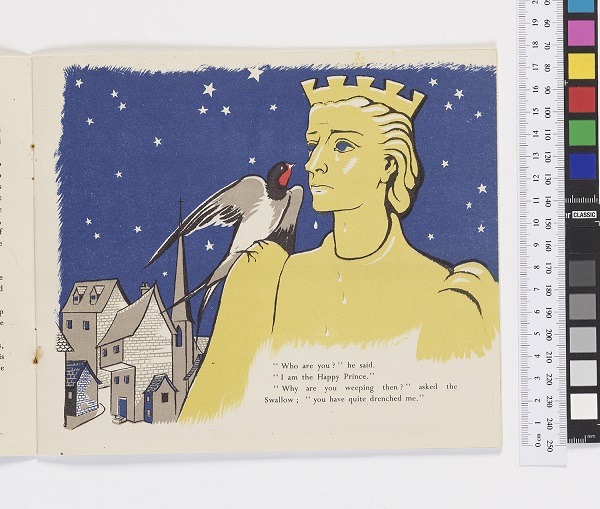 of a prince, who weeps at the state of the desperate people in his city. The prince convinces a swallow to pluck out his jewels to deliver to the needy on successive nights: ‘Swallow, swallow, little swallow… will you not stay with me one night longer?’
The swallow eventually peels off the statue’s gold leaf to deliver to hungry children. When the frost and snow arrive, the swallow, who has delayed his migration south to stay with the prince, freezes to death. The bird kisses the statue’s mouth before dying, and the Happy Prince’s leaden heart ‘snaps right in two’. The fragments of heart and the bird’s body are later chosen by an angel as ‘the two most precious things in the city’.
The continued popularity of this tale of same-sex, cross-species love, despite Wilde’s social ruin for acts of so-called ‘gross indecency’ with other men, speaks to how strongly the public understood his writing to artfully convey important values such as generosity and sacrifice.
There are many positive connections between books and giving in children’s literature, including the idea of children as themselves precious gifts. But in the eighteenth and nineteenth centuries Black and Brown children could – and often did – function as an entirely different sort of gift. As property in British and other colonies and the United States, enslaved children were often passed down within families, including to other (White) children. Meanwhile, Anglo-American notions of ‘the child’ have always been implicitly raced White, excluding other children from the category of childhood in ways that continue to have painful effects today, including disproportionate punishment of Black and Brown youth in school and legal contexts.
Such racial exclusion from childhood appears throughout children’s literature; for example, Michael is not the only boy to appear in the ‘The Twelve Dancing Princesses’: the princesses’ magical castle is staffed by ‘negro boys’. The fates of these unnamed ‘black pages’ are not discussed when the spell breaks and the princesses leave that land forever.
The omission, silencing, and servitude of Black and Brown characters mean that the gifts of enjoyment, knowledge, and cultural inheritance that children’s books often represent for White children can take on very different meaning for readers outside this constructed racial category. In response, many authors have creatively adapted the norms of children’s literature to be more representative of the people and histories in the Anglo-American story.
Canadian-American author Zetta Elliott’s 2017 middle-grade novel The Ghosts in the Castle is one engaging example. A fantasy-loving Black girl named Zaria from New York visits her family (descendants of the Caribbean-born Windrush generation) in London. There she learns about the painful history of colonialism that hovers behind the real-world castles, royal jewels, and noble titles in her favourite books.
On a tour of Windsor Castle, she meets the ghosts of Prince Alemayehu of Ethiopia and Sarah (Sally) Forbes Bonetta Davies, from what’s now Nigeria. Both were brought as children to Victorian England. While Sally’s ghost can travel between locations from her remarkable life, Alemayehu, who died aged 18, sorrowfully haunts the castle buildings at Windsor, where he was buried – and remains today, despite requests from the Ethiopian government to repatriate his body.
Sally tells Zaria and her cousin Winston to help Alemayehu ‘hold onto that which binds him to home’. The children buy gifts for Alemayehu: an Ethiopian-made shamma cloth, scented oil, and a popular Ethiopian snack called kolo.
As Alemayehu revels in the scent of the oil and recalls tales of his homeland, he regains the joyful qualities of his childhood self and finally, with the shamma cloth wrapped around his shoulders, walks off with Sally – presumably to the land from which he was taken so long ago. Zaria and Winston’s adventure teaches them that African legends, objects and experiences can hold their own potent magic; and that celebrating and sharing their places in the Anglo-American world can be part of the larger work of acknowledging and repairing deep colonial harms, whose effects still resonate today.
Choosing a book to give to a child recognizes their interests, desires, and potential. It can also have lasting educational benefits: the size of children’s home libraries has been correlated with greater literacy, numeracy, and technological skills. But above all, by introducing children to stories that reflect values like generosity and courage, the gift of a book also invites young people to engage with what their societies hold dear – and encourages them to take part in rethinking and rewriting those values for future generations.
Maria Sachiko Cecire is associate professor of literature at Bard College in New York, and currently serves as a program officer in Higher Learning at the Mellon Foundation. Her publications include Re-Enchanted: The Rise of Children’s Fantasy Literature in the Twentieth Century (University of Minnesota Press 2019).
This article is adapted from a chapter in Gifts and Books: From Early Myth to the Present, ed. Nicholas Perkins, Bodleian Library 2023, 978-1851246106, £40.00.
 The book is linked to the Bodleian Library’s free exhibition Gifts and Books, open every day until 29 October 2023. It showcases some of the Bodleian’s greatest treasures, and its section on children’s literature includes original material by J.R.R. Tolkien, Philip Pullman (his own alethiometer!), Shirley Hughes, Kenneth Grahame, and Patience Agbabi.


