Local Gods, Universal Truths: an interview with Melinda Salisbury
Joanne Owen interviews Melinda Salisbury about her latest novel.
‘The whole town is a tinder box; it could go up at any moment, and for all the townsfolks’ talk of wanting it to recover, to survive and heal, they just don’t care, don’t seem to understand their actions and their behaviour might have consequences. A spark is all it needs.’ Such is the thrilling folk horror context of Melinda Salisbury’s Local Gods, an exquisitely crafted YA novel that fulfils the author’s desire to ‘tell the most truth that I can’ through her fiction. Think The Wicker Man meets Carrie, with a liminal teenage girl at its heart, and themes of scapegoating, persecution, and othering coursing through its veins.
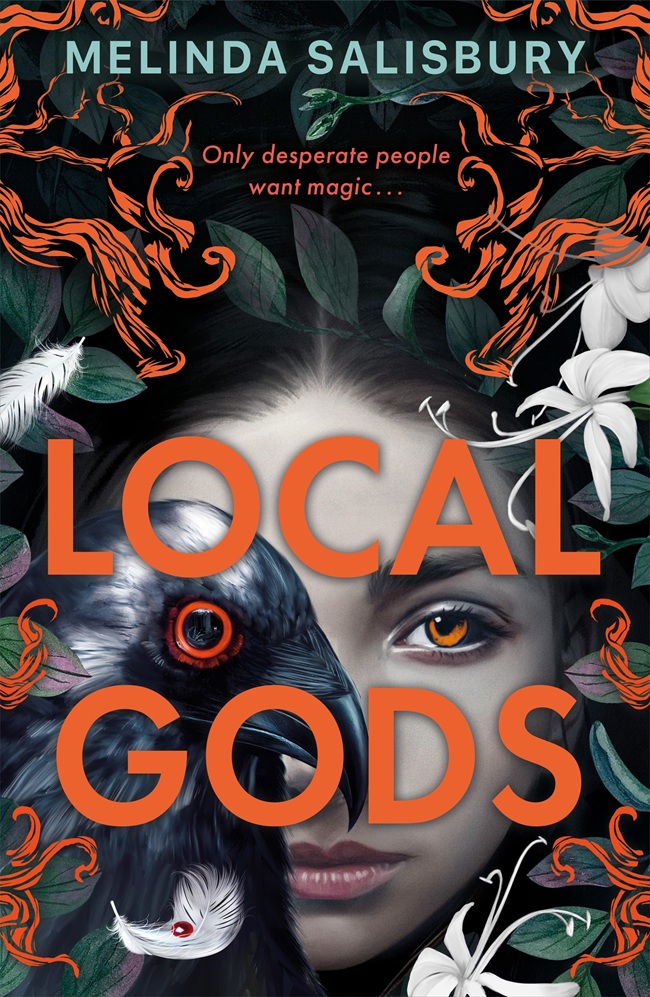 Written in an arrestingly lucid style, and laced with a wolfish sense of foreboding from the outset, Local Gods tells the bone-powerful story of seventeen-year-old Sylvie. Once the privileged sweetheart of her town, Sylvie has fallen from grace as a result of her father, formerly the ‘goddamned prince of Pine Ridge Hollow’, committing crimes against the folks who live in their isolated community. Blamed for her father’s misdemeanours and the town’s demise, Sylvie lives alone as a persecuted outsider in the West Woods, an eerie realm of uncanny white animals located on the edge of town. While counting down to the time she can leave Pine Ridge Hollow for good, a dying god appears to Sylvie in the form of a horned being named Illican, to whom Sylvie is drawn in a profoundly elemental fashion, and from whom she learns about the raw magic of the West Woods. A magic that might just save Pine Ridge Hollow.
As is usually the way with Melinda’s process, Local Gods was sparked by an image. In this case, ‘the image of a horned being slumped in front of a tree’. Less usually, Local Gods took Melinda ‘a really long time to figure out. I had the feeling of it, and I was carrying it, and I knew thematically what it was, and what I was trying to do with it, but I couldn’t quite find the plotline’. In time, though, the story sprang from the fortuitous coming together of what Melinda calls the ‘four pillars’ of the novel, Carrie, The Crucible, the recent revival of Oklahoma! and The Wicker Man: ‘When I had these four pillars, I found the story I wanted to tell. I have a teenage girl who accidentally comes across magic and realises she can use it. I have a community that is willing to enact horrors to support itself. I have the folk horror setting of a town that’s refusing modernity. And then the development of the story came very quickly.’
As for the story, while Melinda points out that Local Gods ‘wasn’t directly meant to be a commentary about how we are treating people who are “othered”,’ she acknowledges that ‘that must have fed into it. Everyone wants someone to blame, and perceived outsiders are very easy targets, which is exactly what happens to Sylvie’. Indeed, belonging versus otherness cuts to the core of Local Gods, and to the human condition. As Melinda expresses it, humans have a ‘fundamental desire to want to belong. We are a social species as a rule. We’ve organised our lives in a way that structures us around societies. And I think in Local Gods, while it’s partially about belonging and wanting to be part of society, it’s also about not wanting to be where Sylvie is. So, you go along with the horror’, which is exactly what comes to pass in Local Gods.
When we discuss the folkloric elements of Local Gods, it’s fascinating to hear how the central elements of Melinda’s otherworldly West Woods world came from real life: ‘The reason the animals are white is because I literally saw a white deer in the woods and I was entranced by it. White animals shouldn’t exist because it makes them highly visible, it makes them very vulnerable, it makes them outsiders. The crow came about from real life, too. I was on my way to a meeting with my editor and ended up walking through one of the London parks, and there was the leucistic crow.’ As for the West Woods’ owls, ‘lots of folklore has owls being liminal creatures, not truly occupying either world’.
The liminality of owls chimes with another central facet of Local Gods in that the story is centred on a teenage girl who occupies a liminal space, as are all Melinda’s novels: ‘The nature of being a teenager is that you’re on the literal threshold of adulthood. I think being a teenager can’t be anything other than liminal’. Thinking of Sylvie, alongside having the ‘innate liminality of being a teenager’, Melinda adds that ‘she’s also living in this in-between place, in woods, which are not part of the town. She’s living in an in-between period. She doesn’t know what’s going to happen next in her life. She’s in this holding place, waiting. And then, of course, she finds magic, and magic is pretty liminal in and of itself’.
On moving to talk about the magic of Local Gods, Melinda shares her belief that magic is ‘about people wanting power. I think to women, particularly, one of the large draws of magic is finding power in a world that would deny it to you’. For Sylvie, her life used to be ‘organised in a way that meant she never needed it, and now she’s on the outside. Now she has no power. Now she has no resources. Now she has no allies. Magic is the only avenue left for her to kind of try to pursue some agency in her life’.
Melinda’s conjuration of Sylvie’s character showcases what gives her writing its emblematic depth. Having previously spoken of her dislike of the ‘Western storytelling rule which means that, by and large, a protagonist has to be a different person by the end of a book’ and ‘declared “likeable” by the last page’, in the case of Local Gods, Sylvie’s story journey is very much on Melinda’s terms. That is to say, while Sylvie ‘very definitely ends up changed, she doesn’t necessarily become a hero. She does what’s right for her, and she does what is right for the woods’. Melinda also sagely notes how the Hero’s Journey ‘feels disingenuous to the human experience, which I think storytelling is supposed to speak to in a really fundamental way’. This belief marries with Melinda’s reason for writing per se: ‘All I want as a writer is to tell the most truth I can, and to make it as direct and as honest and as pure as I can,’ a desire that’s certainly accomplished in Local Gods. Though its focus is on a local community, this extraordinary novel unearths universal truths through a story that’s pure, honest and potently haunting.
Joanne Owen is a writer, reviewer and workshop presenter. With a background in children’s publishing, she’s the author of several books for children and young adults, among them the Martha Mayhem series, the Carnegie Medal-nominated Puppet Master, and You Can Write Awesome Stories.
Local Gods, Melinda Salisbury, David Fickling Books, 9781788452762, 352pp, £9.99 pbk.


