
Authorgraph number 280: David Solomons
David Solomons interviewed by Joanne Owen.
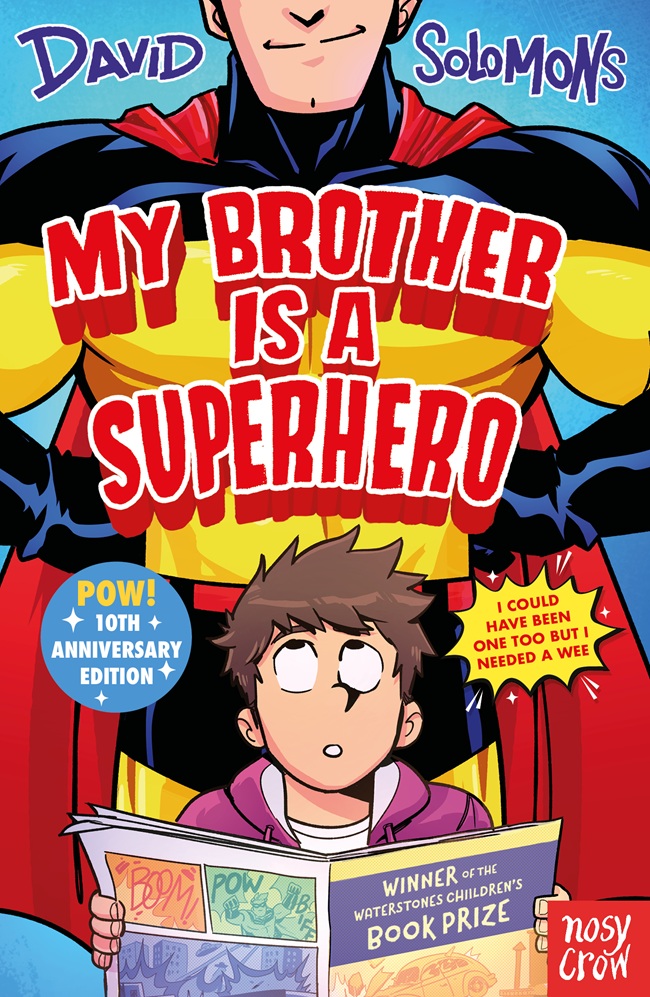 ‘We are story monsters and we want to read a great story.’ One of several striking lines David Solomons delivers when we meet to discuss his work, this also reveals why his novels have struck such a chord since the publication of My Brother is a Superhero in 2015. That is to say, he’s unwaveringly devoted to writing wildly entertaining fiction of the kind kids can’t help but devour. As it happens, David’s journey as a children’s writer began when he was struck by a single line that contained the hallmarks of his novels to this day: ‘My brother is a superhero, and I could have been one too, except that I needed to go for a wee.’
Pitch-perfect for his 9+-year-old readership, and propelled by witty humour (described by David as ‘damp Scottish self-deprecating humour, kind of Jewish nebbish’), David’s instinct for character-driven comedy, exquisite pace, and pleasing pay-offs that reflect his screenwriting background are at the heart of his writing arsenal, even when writing older and darker (more on that later). His signature scenarios also typically blend iconic character types (superheroes, aliens, spies, and galactic princesses) with everyday dynamics and experiences. Think sibling rivalry and the fear of missing out. Think having to crush your cosmic enemies while having to hand in your homework. Impactfully visual (‘Rows of glinting caravans sat baking in the heat, like giant toasters ready to pop out sunburned holidaymakers’ is a memorable line from Spyglass: Mastermind of Mayhem), his writing is the real 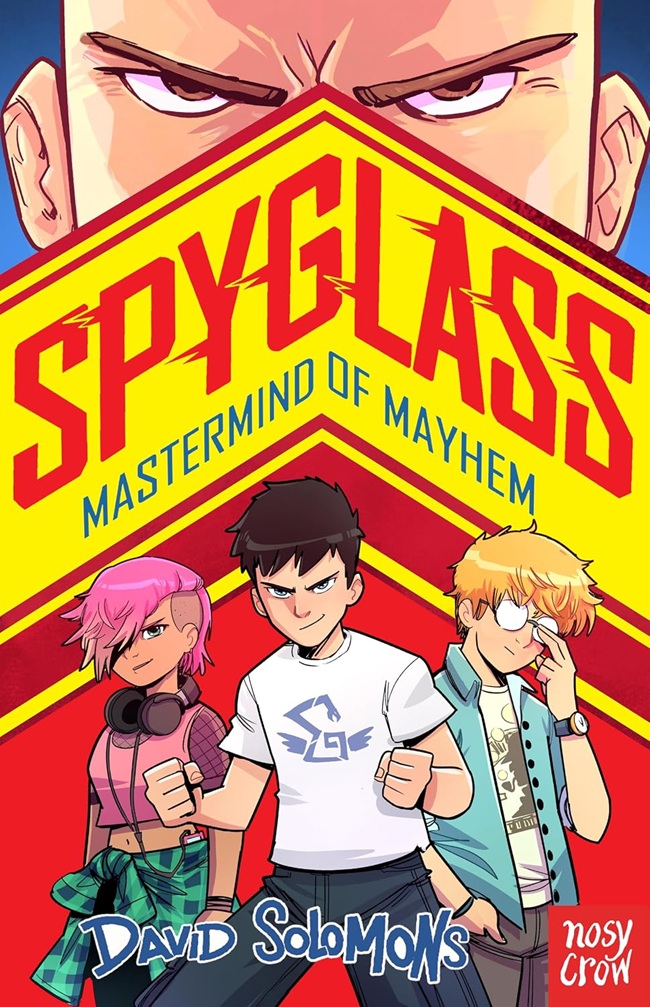 deal. While there might be outlandish action and gadgets galore, there are never gimmicks.
Another stand-out Davidism is trusting and understanding his readers. Speaking of the five-strong Superhero series, he notes that ‘a lot of kids relate to this notion of missing out. This notion of being the one standing there and the lightning bolt hitting the person next to you. It’s that feeling that we’re all living kind-of humdrum lives and somebody else gets the big break. Luke, the main character, feels that when the superpowers are bestowed, he doesn’t get them. He’s standing next to the chosen one.’ Reflecting on the success of the series, and whether his approach changed while writing it, David notes an irony: ‘The ridiculous thing was that the whole premise is about the one who missed out, the one who didn’t get the powers, the one who didn’t make it. And of course, that first book won all the prizes and I was suddenly the one who did make it. That was fantastic, but I remember making a joke about it: “well hang on. I’m not the outsider anymore”.’ In another irony, on the last page of the Superhero series, ‘Luke actually realises that he didn’t miss out, and that’s the big thing. One can go through life thinking it’s all going to other people, but actually Luke’s journey, and I hope the journey of readers who enjoyed the series, is realising you haven’t missed out.’
Considering David’s obvious fondness for his characters, I wonder whether leaving the Superhero story world was hard: ‘It was a huge wrench, so much so I put myself into the final book as a visiting author to the characters’ school and he gets to, and I get to, say goodbye to my characters on the page. Without going onto the therapy couch, I think there was an element of those five books saying “Let me poke at some stuff in my own life”. On so many levels, the books are associated with my children being born. So, for me, there are certain paragraphs, and certain characters and sections, that I know are there because of something in the real world.’
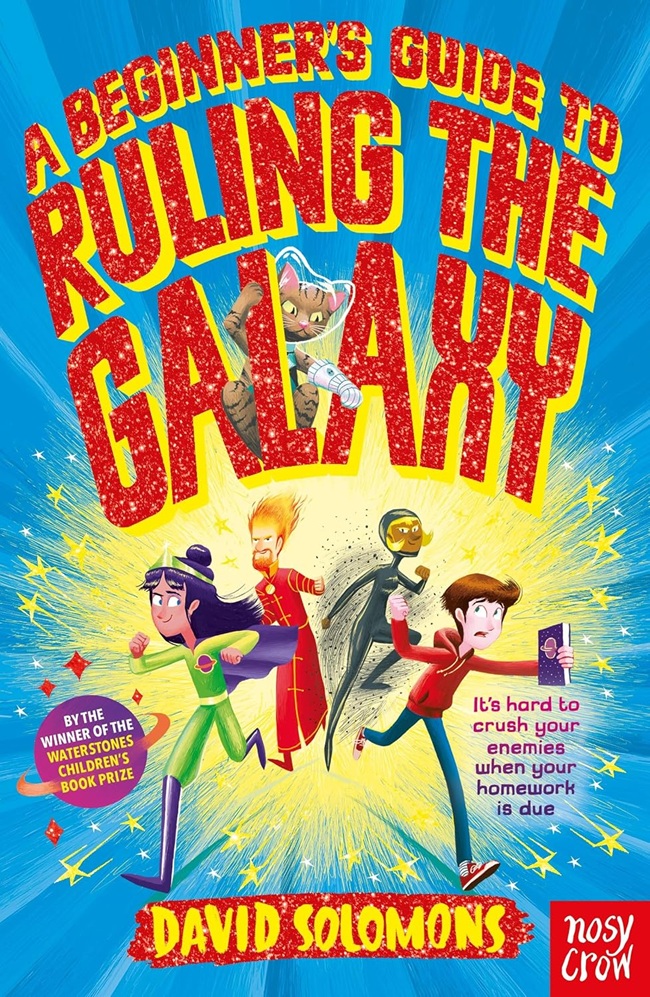 After Superhero came A Beginner’s Guide to Ruling the Galaxy (Nosy Crow, 2022), David’s homage to The Hitchhiker’s Guide to the Galaxy, which sees him flip the everyday context of divorcing parents into a fight to save the world through making said parents the extra-terrestrial leaders of opposing sides of a galactic conflict. Described by David as ‘the collision between the cosmic and the suburban, when the suburban setting is suddenly invaded by cosmic danger and challenges’, this once again reveals his knack for transforming relatable everyday situations and experiences into outlandish, comic contexts that remain emotionally resonant.
Given the slickly entertaining nature of David’s writing, I wonder how he approaches integrating themes into his story-development process. ‘I don’t know there’s necessarily a conscious thread of, “right, these are the themes that I’m interested in. How do I get them in?”.’ Rather, David touches on themes ‘in a way that I’m comfortable with, and maybe as a by-product, which means readers can look at these things in a way that’s safe. There’s humour, with underlying deep emotion.’ What’s more, ‘the cosmic works when it’s utterly grounded.’
Talking of themes leads us onto The Ministry of Manners (Piccadilly Press, 2026). Though something of a departure for David in that it unpacks propaganda, censorship, surveillance and subversion through a shift to the realm of Orwellian dystopian fiction, the novel remains true to his trademark talents: it’s an entertaining, reader-oriented adventure, albeit for a slightly older readership. On that subject, David shares that while My Brother is a Superhero was ‘almost written as a response to becoming a dad for the first time,’ The Ministry of Manners is ‘on one level a response to so much uncertainty in the world, and the fact that I’m a father sending my children out into that world.’ At the same time, he’s clear that while The Ministry of Manners is underpinned by a ‘serious impulse,’ his job is ‘to write, first and foremost, books that a child would put down his or her phone to read. That’s the big thing. It has to be compelling. I love action thrillers. I love fast-moving movies. My background is screen writing. I love cliff-hangers at the end of every chapter, so my craft and instinct is to write a really compelling, fun, exciting book.’
David’s latest series, Spyglass (Mastermind of Mayhem, Nosy Crow, April 2026, and Coldfinger, Nosy Crow, October 2026) certainly 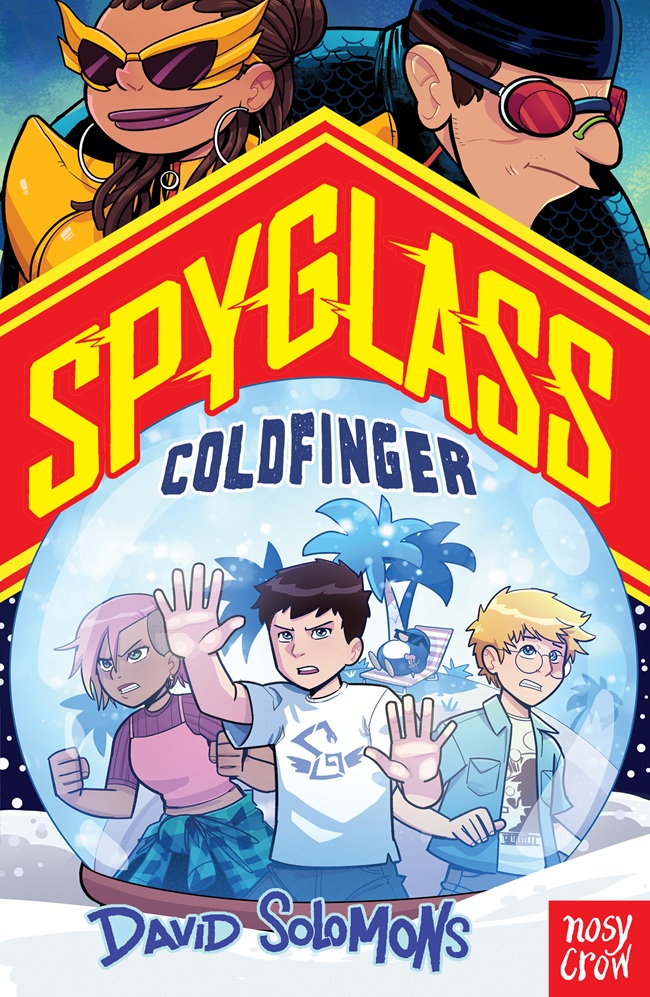 showcases that instinct. Described by David as ‘a mash-up of the Famous Five and James Bond’ and ‘that feeling of the endless summer and ice cream and beaches mixed up with an absurdly dangerous high-stakes spy caper,’ the Spyglass novels also showcase his longstanding talent for crafting amusingly arresting opening lines. ‘Nobody knew it yet, but the fate of the world would be decided on a sizzling Tuesday afternoon,’ begins Mastermind of Mayhem. The series also sees him take two very different distinctly British elements — the glamour of a Bond-style secret agent story, and the less glamorous context of GoldenCliff Holiday Park — to create a uniquely David Solomons-esque story world.
While some things change (for example, in the publishing world, David notes that these days ‘books have to be shorter and more illustrated’, which he attributes in part to ‘the post-pandemic reading slump in kids and the attention deficit that seems to have accrued’), the appeal of his books and his writing process remain the same some eleven years on from the launch of Superhero: ‘The thing I think greets every writer is that the next book is a blank page. And you’re like, “Here we go! How do I do this? How on earth did I do it? Did I do it? How do I do it again? So, that’s always the same”.’ David’s response to me asking what he’s most proud of through his writing journey also chimes with that sense of continuity: ‘I’m proud that I’m still doing it. I’m still here. I’m still writing my books. I’m still coming up with, I hope, really cracking stories and getting them out there. So, I think I’m proud in an Elton John way that I’m still standing, and proud that kids want to tell me my books inspired him or her. That’s pretty special.’ Much like David’s fiction, which remains of the wildly entertaining kind story-mad monsters can’t help but munch through.
Joanne Owen is a writer, reviewer and workshop presenter. With a background in children’s publishing, she’s the author of several books for children and young adults, among them the Martha Mayhem series, the Carnegie Medal-nominated Puppet Master, and You Can Write Awesome Stories.
Books mentioned:
Superhero series, published by Nosy Crow, £7.99 pbk
My Brother is a Superhero, 978-1805138082
My Gym Teacher is an Alien Overlord, 978-0857637338
My Evil Twin is a Supervillain, 978-1805139614
My Arch-Enemy is a Brain in a Jar, 978-0857639912
My Cousin Is a Time Traveller, 978-0857639929
A Beginner’s Guide to Ruling the Galaxy, Nosy Crow, 978-0857639936, £7.99 pbk
The Ministry of Manners, Piccadilly Press, 978-1835873175, £7.99 pbk
Spyglass series, published by Nosy Crow:
Spyglass: Mastermind of Mayhem, 978-1805132363, £7.99pbk
Spyglass: Coldfinger, 978-1805132370, £7.99pbk


